## Diagram: Manual Curation Workflow
### Overview
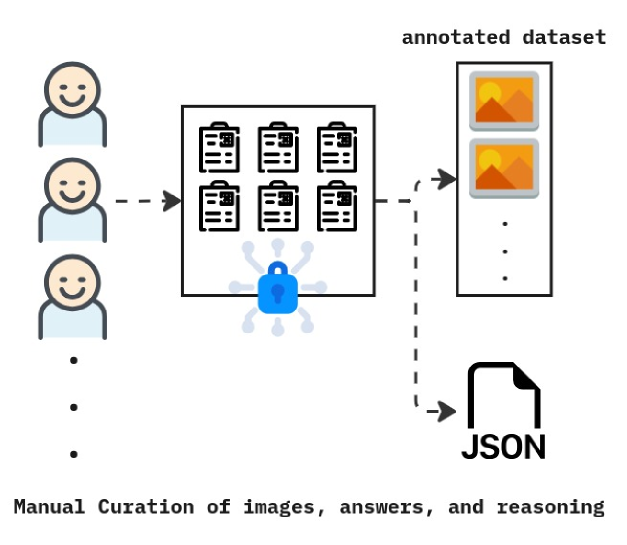
This image is a schematic diagram illustrating a workflow for the "Manual Curation of images, answers, and reasoning." It depicts a process where human curators interact with a secure system to produce structured outputs, specifically an annotated dataset and a JSON file.
### Components/Axes
The diagram is composed of three main sections arranged horizontally, connected by dotted arrows indicating flow.
1. **Left Section (Input/Actors):**
* Contains three identical, simplified human icons (smiling faces with light blue shirts) arranged vertically.
* Below the third icon are three vertical dots (`...`), implying a larger, indefinite number of human participants.
* A dotted arrow originates from this group and points to the central section.
2. **Central Section (Processing/Secure System):**
* A large rectangular box.
* Inside the box, at the top, are six identical document/clipboard icons arranged in a 2x3 grid.
* At the bottom center of the box is a prominent blue padlock icon, symbolizing security, privacy, or a protected process.
* Faint, light blue lines radiate from the padlock, suggesting it is active or central to the system's function.
3. **Right Section (Outputs):**
* Two distinct output paths are shown, both originating from the central box via dotted arrows.
* **Top Output Path:** Leads to a tall, vertical rectangle labeled **"annotated dataset"** at the top. Inside this rectangle are two image icons (depicting a landscape with an orange sun/mountain) at the top, followed by three vertical dots (`...`), indicating a continuing series of such annotated images.
* **Bottom Output Path:** Leads to a file icon labeled **"JSON"**. The icon has a folded corner and a small graphic of curly braces `{}` on it, representing a structured data file.
### Detailed Analysis
* **Flow Direction:** The process flows unidirectionally from left to right: Humans → Secure Curation System → Structured Outputs.
* **Textual Content:**
* Primary Title (Bottom): `Manual Curation of images, answers, and reasoning`
* Output Label (Top Right): `annotated dataset`
* Output Label (Bottom Right): `JSON`
* **Iconography & Symbolism:**
* **Human Icons:** Represent the manual, human-in-the-loop aspect of the curation.
* **Document Icons:** Likely represent individual data items, tasks, or records being curated.
* **Padlock:** A key element indicating that the curation process occurs within a secure, private, or controlled environment.
* **Image Icons in Output:** Represent the final product—images that have been annotated or labeled.
* **JSON File:** Represents the export of curated data in a machine-readable, structured format.
### Key Observations
1. The diagram explicitly highlights **security** (the padlock) as a core component of the curation system.
2. The outputs are dual-format: a human-interpretable **annotated dataset** (visual) and a machine-interpretable **JSON** file (data structure).
3. The use of ellipses (`...`) in both the human group and the annotated dataset implies scalability—the process is designed for many curators and results in a large dataset.
4. The connection between the central system and the outputs is not a single line but a branching path, showing the generation of two distinct but related products from the same curation activity.
### Interpretation
This diagram outlines a **human-in-the-loop data curation pipeline**, likely for machine learning or computer vision tasks. The core message is that raw data (implied by the document icons) is processed by human curators within a secure framework to produce high-quality, labeled training data.
* **Process Significance:** The "Manual Curation" title emphasizes that this is not an automated process. Human judgment is applied to create "answers and reasoning," which are then embedded into the dataset. This suggests the creation of a **reasoning-aware** or **explainable** dataset, where annotations may include not just labels but also justifications.
* **Security Implication:** The central padlock suggests the data being curated is sensitive (e.g., private user data, proprietary information) or that the curation process itself needs to be integrity-protected to ensure the quality and trustworthiness of the resulting dataset.
* **Output Relationship:** The `annotated dataset` and `JSON` file are two sides of the same coin. The former is the visual, human-auditable product, while the latter is the structured, programmatically accessible version ready for ingestion by algorithms. This dual output ensures both usability and verifiability.
* **Underlying Need:** The workflow addresses a critical need in AI development: transforming unstructured or loosely structured data into a clean, labeled, and reasoned format that can reliably train or evaluate models, with an added emphasis on security and human expertise.