## Bar Chart: Refusal Ratio by Training Set and Testing Set
### Overview
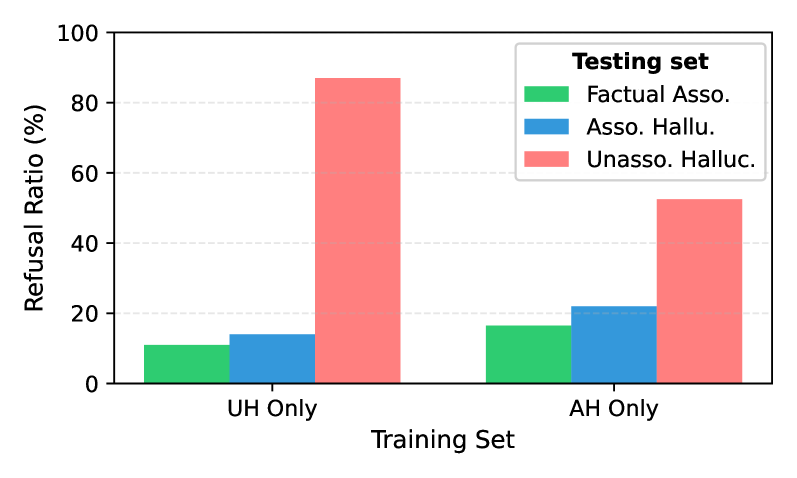
The image is a bar chart comparing the refusal ratio (%) across different training sets (UH Only, AH Only) and testing sets (Factual Asso., Asso. Hallu., Unasso. Halluc.). The chart visualizes how the training data influences the model's refusal to answer based on the type of hallucination present in the testing data.
### Components/Axes
* **X-axis:** Training Set (UH Only, AH Only)
* **Y-axis:** Refusal Ratio (%) with a scale from 0 to 100, incrementing by 20.
* **Legend (Top-Right):** Testing set
* Factual Asso. (Green)
* Asso. Hallu. (Blue)
* Unasso. Halluc. (Red)
### Detailed Analysis
**Training Set: UH Only**
* **Factual Asso. (Green):** Refusal Ratio is approximately 11%.
* **Asso. Hallu. (Blue):** Refusal Ratio is approximately 14%.
* **Unasso. Halluc. (Red):** Refusal Ratio is approximately 87%.
**Training Set: AH Only**
* **Factual Asso. (Green):** Refusal Ratio is approximately 17%.
* **Asso. Hallu. (Blue):** Refusal Ratio is approximately 22%.
* **Unasso. Halluc. (Red):** Refusal Ratio is approximately 53%.
### Key Observations
* For both training sets, the "Unasso. Halluc." testing set has the highest refusal ratio.
* The "AH Only" training set generally results in higher refusal ratios across all testing sets compared to the "UH Only" training set.
* The difference in refusal ratio between "Unasso. Halluc." and the other two testing sets is much more pronounced for the "UH Only" training set.
### Interpretation
The data suggests that the type of training data significantly impacts the model's refusal behavior when faced with different types of hallucinations in the testing data. Specifically, models trained on "UH Only" data are much more likely to refuse to answer when presented with "Unasso. Halluc." compared to "Factual Asso." or "Asso. Hallu.". Training on "AH Only" data seems to mitigate this effect to some extent, leading to a more balanced refusal ratio across different hallucination types. The high refusal rate for "Unasso. Halluc." could indicate that the model struggles to handle or identify this type of hallucination, leading it to refuse to answer more frequently.