## Diagram: Environmental and Linguistic Token Grounding
### Overview
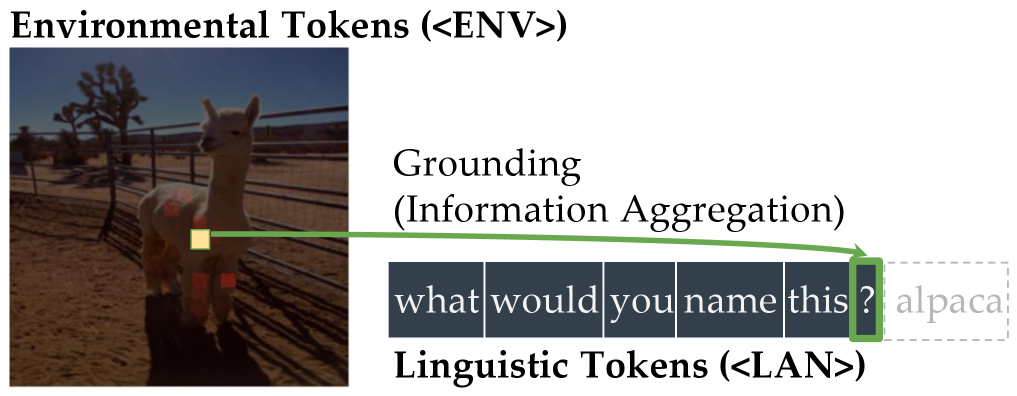
The image illustrates a concept of grounding between environmental tokens (visual information) and linguistic tokens (textual information). It shows an image of an alpaca in a desert-like environment, which is linked to a sequence of text tokens representing a question, and a potential answer.
### Components/Axes
* **Title:** Environmental Tokens (<ENV>)
* **Image:** A photograph of an alpaca standing in a desert-like environment with a fence and a Joshua tree in the background. The alpaca has red markings on its body.
* **Grounding:** The text "Grounding (Information Aggregation)" indicates the process of linking the visual and textual information.
* **Linguistic Tokens:** A sequence of text tokens presented in dark gray boxes: "what", "would", "you", "name", "this", "?".
* **Proposed Answer:** The word "alpaca" is shown in light gray, enclosed in a dashed box, suggesting a potential answer to the question.
* **Title:** Linguistic Tokens (<LAN>)
* **Arrow:** A green arrow originates from a yellow square on the alpaca's body in the image and points to a green square around the question mark token.
### Detailed Analysis
* The image of the alpaca represents the environmental context. The red markings on the alpaca are not explained.
* The question "what would you name this?" represents the linguistic context.
* The green arrow visually connects the alpaca in the image to the question, suggesting that the question is about the alpaca.
* The proposed answer "alpaca" is a direct response to the question, indicating a successful grounding of the environmental and linguistic tokens.
### Key Observations
* The diagram highlights the process of linking visual information (the alpaca) with textual information (the question and answer).
* The arrow visually represents the grounding process, connecting the environmental token (alpaca) to the linguistic token (question).
* The proposed answer demonstrates a successful grounding, where the linguistic token accurately describes the environmental token.
### Interpretation
The diagram illustrates a simplified model of how environmental and linguistic information can be linked together. The "Grounding (Information Aggregation)" process suggests that the system is aggregating information from both the visual and textual domains to arrive at a coherent understanding. The diagram demonstrates a basic form of visual question answering, where the system can identify the object in the image (alpaca) and answer a question about it. The red markings on the alpaca are not explained and could represent areas of interest or focus for the system. The dashed box around "alpaca" suggests that it is a predicted or suggested answer, rather than a confirmed one.