\n
## Bar Chart: Comparison with Different Settings and GKG-LLM
### Overview
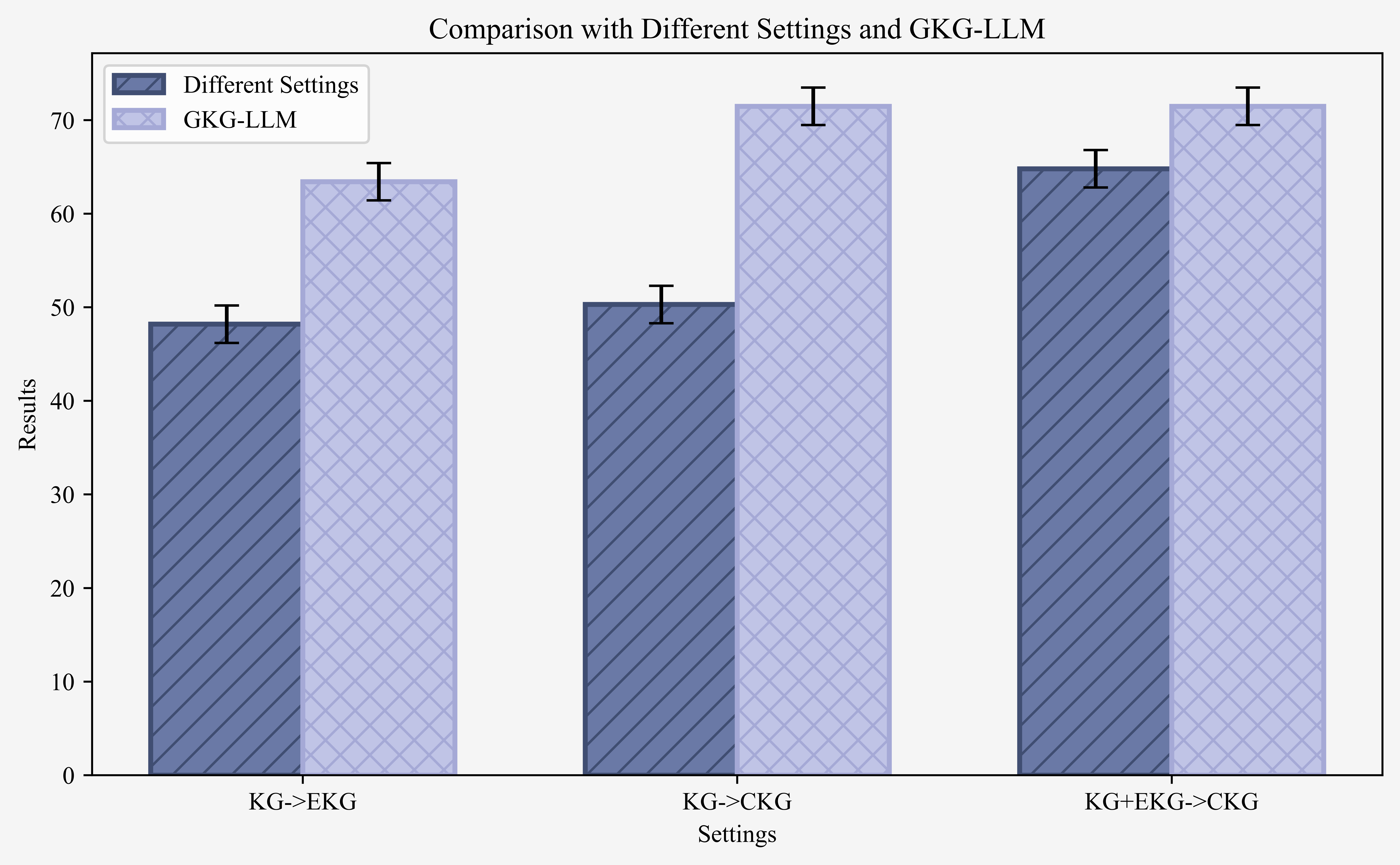
This bar chart compares the "Results" achieved using different settings alongside a GKG-LLM approach. The chart displays three settings: "KG->EKG", "KG->CKG", and "KG+EKG->CKG". For each setting, two bars are presented: one representing "Different Settings" (darker blue) and another representing "GKG-LLM" (lighter blue with a cross-hatch pattern). Error bars are included on top of each bar, indicating the variability or uncertainty in the results.
### Components/Axes
* **Title:** "Comparison with Different Settings and GKG-LLM" (centered at the top)
* **X-axis:** "Settings" with three categories: "KG->EKG", "KG->CKG", "KG+EKG->CKG"
* **Y-axis:** "Results" with a scale ranging from 0 to 70 (approximately).
* **Legend:** Located in the top-left corner.
* "Different Settings" - represented by a solid, darker blue color.
* "GKG-LLM" - represented by a lighter blue color with a cross-hatch pattern.
### Detailed Analysis
The chart presents the following data points (approximate values based on visual inspection):
* **KG->EKG:**
* Different Settings: Approximately 48 ± 4 (based on the error bar).
* GKG-LLM: Approximately 64 ± 5.
* **KG->CKG:**
* Different Settings: Approximately 52 ± 4.
* GKG-LLM: Approximately 72 ± 5.
* **KG+EKG->CKG:**
* Different Settings: Approximately 66 ± 4.
* GKG-LLM: Approximately 72 ± 5.
The "GKG-LLM" bars are consistently higher than the "Different Settings" bars across all three settings. The error bars indicate some variability in the results, but the GKG-LLM approach generally yields better results.
### Key Observations
* The GKG-LLM approach consistently outperforms the "Different Settings" approach across all tested settings.
* The largest difference in performance between the two approaches is observed for the "KG->CKG" setting.
* The "KG+EKG->CKG" setting yields the highest overall results for both approaches.
* The error bars suggest that the results for "GKG-LLM" are slightly more variable than those for "Different Settings".
### Interpretation
The data suggests that incorporating the GKG-LLM approach leads to improved results compared to using different settings alone. The consistent outperformance of GKG-LLM indicates its effectiveness in enhancing the performance of the system being evaluated. The largest improvement observed with the "KG->CKG" setting might suggest that this setting benefits most from the GKG-LLM integration. The relatively small error bars suggest a reasonable degree of confidence in the results, although some variability exists. The chart demonstrates a clear positive correlation between the use of GKG-LLM and the achieved results, highlighting its potential as a valuable component in the system. The settings themselves likely represent different configurations or parameters used within the system, and the chart provides a comparative analysis of their performance with and without the GKG-LLM enhancement.