## Flowchart: Cognitive Processing Pipeline
### Overview
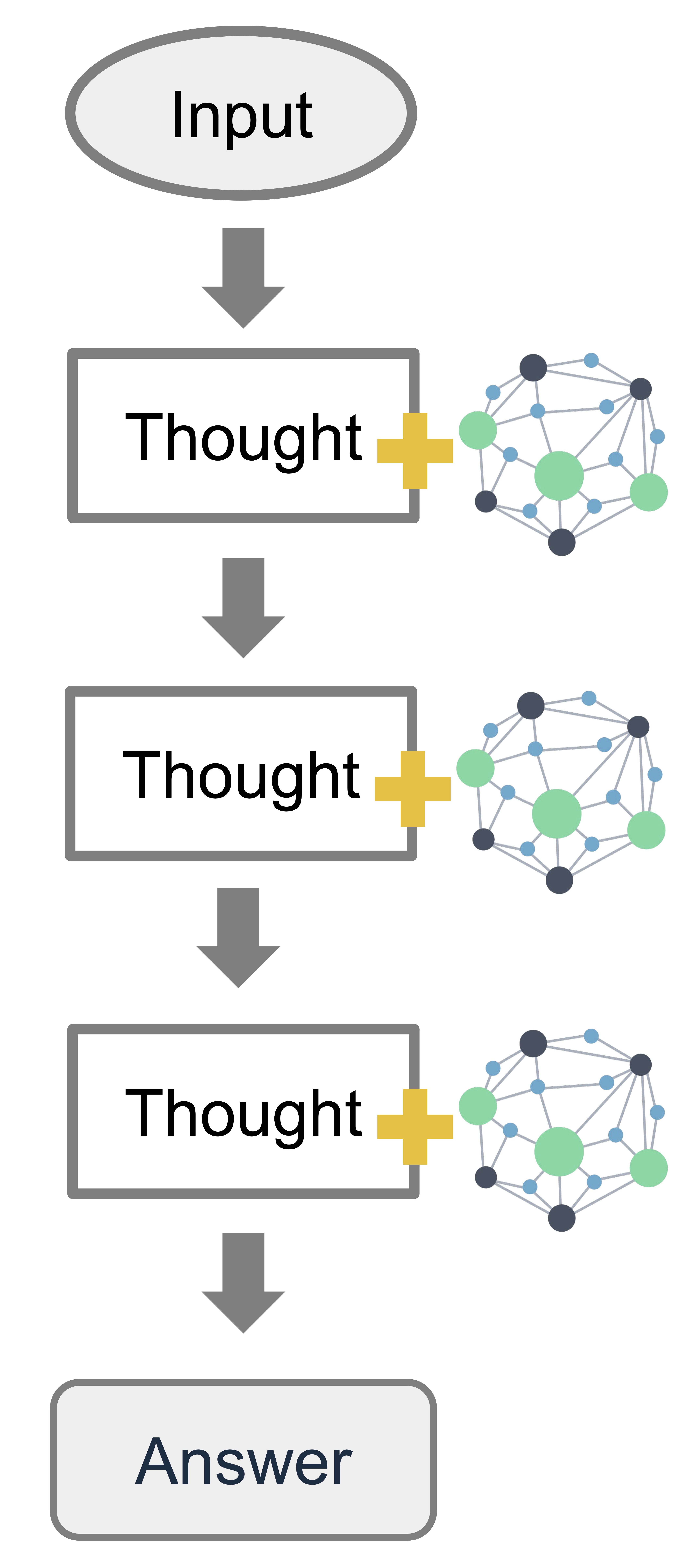
The diagram illustrates a sequential cognitive processing workflow starting with an "Input" and progressing through three iterative "Thought" stages, culminating in an "Answer". Each "Thought" stage is accompanied by a network diagram representing interconnected nodes, suggesting complex information processing.
### Components/Axes
1. **Input**: Oval-shaped starting point (top of diagram)
2. **Thought Stages**: Three rectangular blocks labeled "Thought" (center-left)
3. **Network Diagrams**: Three interconnected node systems (dark blue, light blue, green nodes) connected to each "Thought" block via yellow plus signs
4. **Answer**: Final rectangular output (bottom of diagram)
5. **Arrows**: Gray directional indicators showing process flow
6. **Node Colors**:
- Dark blue (largest nodes)
- Light blue (medium nodes)
- Green (smallest nodes)
- No explicit legend provided
### Detailed Analysis
- **Input → First Thought**: Initial information enters the system and triggers the first cognitive processing stage, represented by a network with dominant dark blue nodes
- **Thought Iteration**: Each subsequent "Thought" block shows progressively lighter node colors (dark blue → light blue → green), suggesting refinement or abstraction of information
- **Network Connections**: The yellow plus signs between "Thought" blocks and networks imply additive or combinatorial processing
- **Final Output**: The "Answer" block receives processed information from the third Thought stage's network
### Key Observations
1. The three Thought stages show decreasing node size and increasing lightness in color, potentially indicating:
- Information distillation
- Abstraction layers
- Confidence scoring
2. Network density remains consistent across stages, suggesting maintained contextual relationships
3. No explicit feedback loops or error correction mechanisms are depicted
4. The absence of a legend for node colors limits quantitative interpretation
### Interpretation
This diagram represents a simplified model of cognitive processing where:
1. **Input** triggers sequential reasoning stages ("Thought")
2. Each "Thought" stage processes information through interconnected nodes, with color progression suggesting:
- Dark blue: Core concepts/primary data
- Light blue: Secondary associations
- Green: Tertiary refinements
3. The yellow plus signs may represent:
- Information merging
- Cognitive weighting
- Confidence aggregation
4. The final "Answer" emerges from synthesized processing across all three stages
The model emphasizes linear progression rather than parallel processing, and the node color gradient implies a qualitative rather than quantitative transformation of information. The lack of error handling suggests this represents idealized cognitive processing rather than real-world implementation.