\n
## Diagram: LLM Consistency Evaluation
### Overview
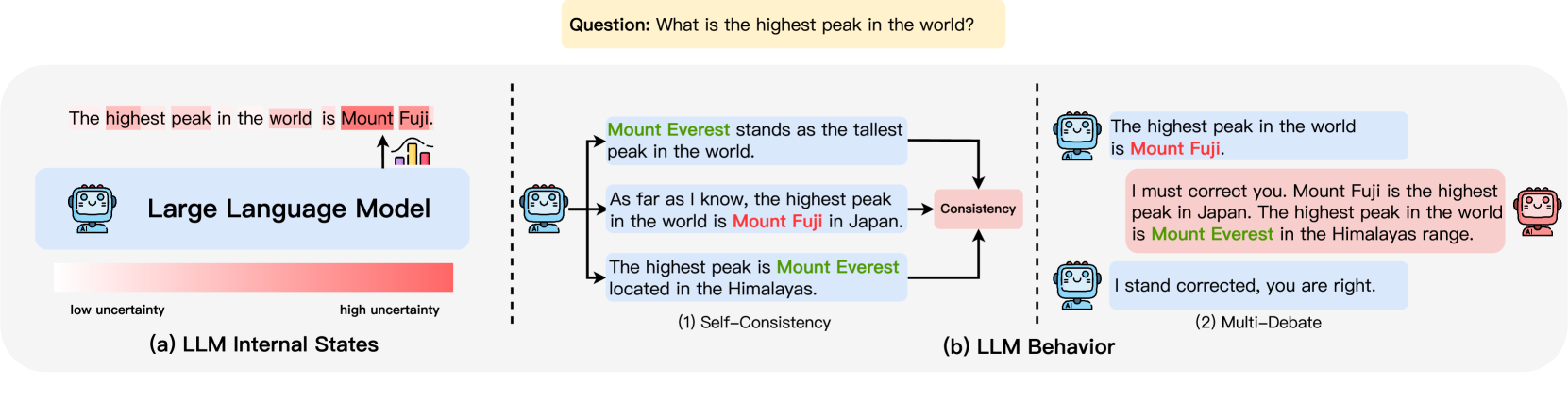
This diagram illustrates the internal states and behavior of a Large Language Model (LLM) when answering the question: "What is the highest peak in the world?". It demonstrates a scenario where the LLM initially provides an incorrect answer (Mount Fuji) and then corrects itself through self-consistency and multi-debate processes. The diagram is divided into two main sections: (a) LLM Internal States and (b) LLM Behavior.
### Components/Axes
* **Question:** "What is the highest peak in the world?" - Located at the top of the diagram.
* **LLM Internal States (a):** A vertical gradient bar representing uncertainty, ranging from "low uncertainty" (green) to "high uncertainty" (red). An icon of a robot head is positioned to the left of the bar, labeled "Large Language Model". An upward-pointing arrow with a mountain icon is positioned above the bar.
* **LLM Behavior (b):** A flow diagram showing the LLM's responses in two stages: (1) Self-Consistency and (2) Multi-Debate. Each stage consists of a series of speech bubbles representing the LLM's statements.
* **Consistency Arrow:** A green arrow labeled "Consistency" connects the Self-Consistency stage to the Multi-Debate stage.
* **Speech Bubbles:** Represent the LLM's responses at each stage.
* **Robot Icons:** Represent the LLM in each speech bubble.
### Detailed Analysis or Content Details
**(a) LLM Internal States:**
* The uncertainty gradient ranges from green at the bottom (low uncertainty) to red at the top (high uncertainty). The initial statement "The highest peak in the world is Mount Fuji." is associated with a higher level of uncertainty (towards the red end of the gradient).
**(b) LLM Behavior:**
**(1) Self-Consistency:**
* **Statement 1:** "Mount Everest stands as the tallest peak in the world." - Associated with a robot icon.
* **Statement 2:** "As far as I know, the highest peak in the world is Mount Fuji in Japan." - Associated with a robot icon.
* **Statement 3:** "The highest peak is Mount Everest located in the Himalayas." - Associated with a robot icon.
**(2) Multi-Debate:**
* **Statement 1:** "The highest peak in the world is Mount Fuji." - Associated with a robot icon.
* **Statement 2:** "I must correct you. Mount Fuji is the highest peak in Japan. The highest peak in the world is Mount Everest in the Himalayas range." - Associated with a robot icon.
* **Statement 3:** "I stand corrected, you are right." - Associated with a robot icon.
### Key Observations
* The LLM initially states Mount Fuji as the highest peak, then corrects itself to Mount Everest through a process of self-consistency and debate.
* The "Consistency" arrow indicates a positive feedback loop where the LLM refines its answer.
* The LLM demonstrates an ability to acknowledge and correct its own errors.
* The initial statement is associated with higher uncertainty, while the final corrected statement is implied to have lower uncertainty.
### Interpretation
This diagram illustrates the iterative refinement process that LLMs can undergo to improve the accuracy of their responses. The initial incorrect answer highlights the potential for LLMs to generate plausible but factually incorrect information. The self-consistency and multi-debate stages demonstrate mechanisms for mitigating this issue. The diagram suggests that LLMs don't simply "know" facts but rather arrive at answers through a process of reasoning and self-correction. The uncertainty gradient visually represents the LLM's confidence level in its responses, which decreases as it identifies and corrects its errors. The diagram is a simplified representation of a complex process, but it effectively conveys the core idea of LLM consistency evaluation and the importance of iterative refinement. The diagram does not provide any numerical data, but rather a qualitative illustration of the LLM's behavior.