## Diagram: Hybrid Probabilistic-Classical Computing System for Machine Learning
### Overview
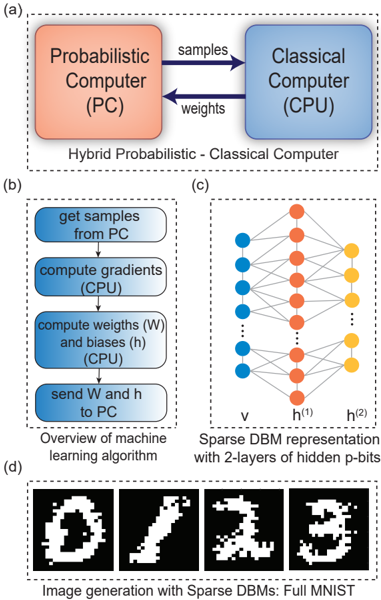
This image is a multi-panel technical diagram illustrating a hybrid computing architecture involving probabilistic and classical computers, an overview of a machine learning algorithm designed for this architecture, the representation of a Sparse Deep Boltzmann Machine (DBM), and examples of image generation using this approach. The figure is divided into four sub-panels labeled (a), (b), (c), and (d), each presenting a distinct aspect of the system.
### Components/Axes
**Panel (a): Hybrid Probabilistic - Classical Computer**
* **Left Component (Orange Box)**: Labeled "Probabilistic Computer (PC)".
* **Right Component (Blue Box)**: Labeled "Classical Computer (CPU)".
* **Data Flow Arrows**:
* An arrow pointing from "Probabilistic Computer (PC)" to "Classical Computer (CPU)" is labeled "samples".
* An arrow pointing from "Classical Computer (CPU)" to "Probabilistic Computer (PC)" is labeled "weights".
* **Overall Title (Bottom-Center)**: "Hybrid Probabilistic - Classical Computer".
**Panel (b): Overview of machine learning algorithm**
* This is a vertical flowchart with four rectangular, rounded-corner steps, colored in a gradient from light blue at the top to a slightly darker blue at the bottom.
* **Step 1 (Top)**: "get samples from PC"
* **Step 2**: "compute gradients (CPU)"
* **Step 3**: "compute weights (W) and biases (h) (CPU)"
* **Step 4 (Bottom)**: "send W and h to PC"
* **Flow Direction**: Downward arrows connect each step, indicating sequential execution.
* **Overall Title (Bottom-Center)**: "Overview of machine learning algorithm".
**Panel (c): Sparse DBM representation with 2-layers of hidden p-bits**
* This diagram represents a neural network-like structure with three vertical layers of nodes.
* **Layer 1 (Left)**: Consists of blue circular nodes. There are 5 visible nodes at the top and 3 visible nodes at the bottom, separated by a vertical ellipsis (...), indicating many more nodes. This layer is labeled "v" at the bottom.
* **Layer 2 (Middle)**: Consists of orange circular nodes. There are 5 visible nodes at the top and 3 visible nodes at the bottom, separated by a vertical ellipsis (...), indicating many more nodes. This layer is labeled "h^(1)" at the bottom.
* **Layer 3 (Right)**: Consists of yellow circular nodes. There are 3 visible nodes at the top and 3 visible nodes at the bottom, separated by a vertical ellipsis (...), indicating many more nodes. This layer is labeled "h^(2)" at the bottom.
* **Connections**: Lines connect nodes between adjacent layers (Layer 1 to Layer 2, and Layer 2 to Layer 3), indicating weighted connections. The connections appear to be sparse, as not every node in one layer is connected to every node in the next.
* **Overall Title (Bottom-Center)**: "Sparse DBM representation with 2-layers of hidden p-bits".
**Panel (d): Image generation with Sparse DBMs: Full MNIST**
* This panel displays four distinct black-and-white pixelated images arranged horizontally. Each image is a representation of a handwritten digit.
* **Image 1 (Left)**: Appears to be the digit "0".
* **Image 2**: Appears to be the digit "1".
* **Image 3**: Appears to be the digit "2".
* **Image 4 (Right)**: Appears to be the digit "3".
* **Overall Title (Bottom-Center)**: "Image generation with Sparse DBMs: Full MNIST".
### Detailed Analysis
**Panel (a):** This diagram illustrates a feedback loop between a "Probabilistic Computer (PC)" and a "Classical Computer (CPU)". The PC generates "samples" which are sent to the CPU. The CPU then processes these samples to compute "weights", which are subsequently sent back to the PC. This suggests an iterative process where the PC acts as a sampler or generator, and the CPU performs optimization or learning based on the PC's output.
**Panel (b):** This flowchart details the steps of a machine learning algorithm executed within the hybrid computing framework.
1. The process begins by "getting samples from PC", indicating the PC's role in providing data.
2. Next, the "CPU" computes "gradients", which are essential for optimizing machine learning models.
3. Following gradient computation, the "CPU" calculates "weights (W) and biases (h)", which are the parameters of the machine learning model.
4. Finally, these updated "W and h" parameters are "sent to PC", closing the loop and updating the probabilistic computer's state or model. This sequence describes a typical iterative training process for a machine learning model, where the PC handles the probabilistic sampling aspect and the CPU handles the deterministic optimization.
**Panel (c):** This diagram visualizes a "Sparse DBM (Deep Boltzmann Machine)" with two hidden layers.
* The "v" layer (visible layer, blue nodes) represents the input or observable data.
* The "h^(1)" layer (first hidden layer, orange nodes) and "h^(2)" layer (second hidden layer, yellow nodes) represent increasingly abstract features or representations learned by the model.
* The "p-bits" in the title likely refer to probabilistic bits, indicating that the nodes in this DBM operate probabilistically, consistent with the "Probabilistic Computer" in panel (a). The "sparse" nature implies that not all nodes are fully connected, which can be beneficial for efficiency or learning specific types of representations.
**Panel (d):** This panel showcases the output of the system: "Image generation with Sparse DBMs". The four images are pixelated representations of handwritten digits (0, 1, 2, 3) from the "Full MNIST" dataset. This demonstrates that the hybrid system, utilizing Sparse DBMs, is capable of generating realistic (albeit pixelated) images, which is a common task for generative machine learning models. The quality of the digits suggests successful learning of the underlying data distribution.
### Key Observations
* The entire system is designed around a feedback loop between a probabilistic and a classical computer.
* The classical computer (CPU) is responsible for the computational heavy lifting of gradient calculation and parameter updates (weights and biases).
* The probabilistic computer (PC) is responsible for generating samples and likely holding the probabilistic model parameters (W and h).
* The machine learning model used is a "Sparse DBM with 2-layers of hidden p-bits," indicating a deep generative model.
* The application demonstrated is image generation, specifically for handwritten digits from the MNIST dataset.
### Interpretation
This technical document describes a novel approach to machine learning by leveraging a "Hybrid Probabilistic - Classical Computer" architecture. The core idea is to offload the probabilistic sampling aspects of a Deep Boltzmann Machine (DBM) to a specialized "Probabilistic Computer (PC)", while the computationally intensive gradient calculations and parameter updates (weights and biases) are handled by a "Classical Computer (CPU)".
The "Overview of machine learning algorithm" (b) clearly outlines the iterative training process: the PC provides samples, the CPU computes gradients and updates model parameters (W and h), and these updated parameters are then sent back to the PC to refine its probabilistic model. This suggests that the PC might be a hardware accelerator or a specialized device designed for efficient sampling from complex probability distributions, which is often a bottleneck in training DBMs.
The "Sparse DBM representation" (c) indicates the specific type of neural network being trained. DBMs are generative models capable of learning complex data distributions. The "2-layers of hidden p-bits" imply a deep architecture where 'p-bits' are likely physical or simulated probabilistic bits, aligning with the "Probabilistic Computer" concept. The sparsity in connections could be a design choice for efficiency, regularization, or to model specific types of data structures.
Finally, the "Image generation with Sparse DBMs: Full MNIST" (d) serves as a proof-of-concept, demonstrating the system's ability to learn and generate images of handwritten digits. The MNIST dataset is a standard benchmark for image recognition and generation tasks. The successful generation of recognizable digits (0, 1, 2, 3) implies that the hybrid system effectively learns the underlying patterns of the dataset.
In essence, this document proposes a synergistic computing paradigm where the strengths of probabilistic hardware (for sampling) are combined with the strengths of classical hardware (for optimization) to efficiently train and utilize complex generative models like Sparse DBMs, particularly for tasks such as image generation. This approach could potentially overcome computational limitations faced by purely classical systems when dealing with highly probabilistic or quantum-inspired machine learning models.