## Image Comparison: Ground-truth vs. Generated Scenarios
### Overview
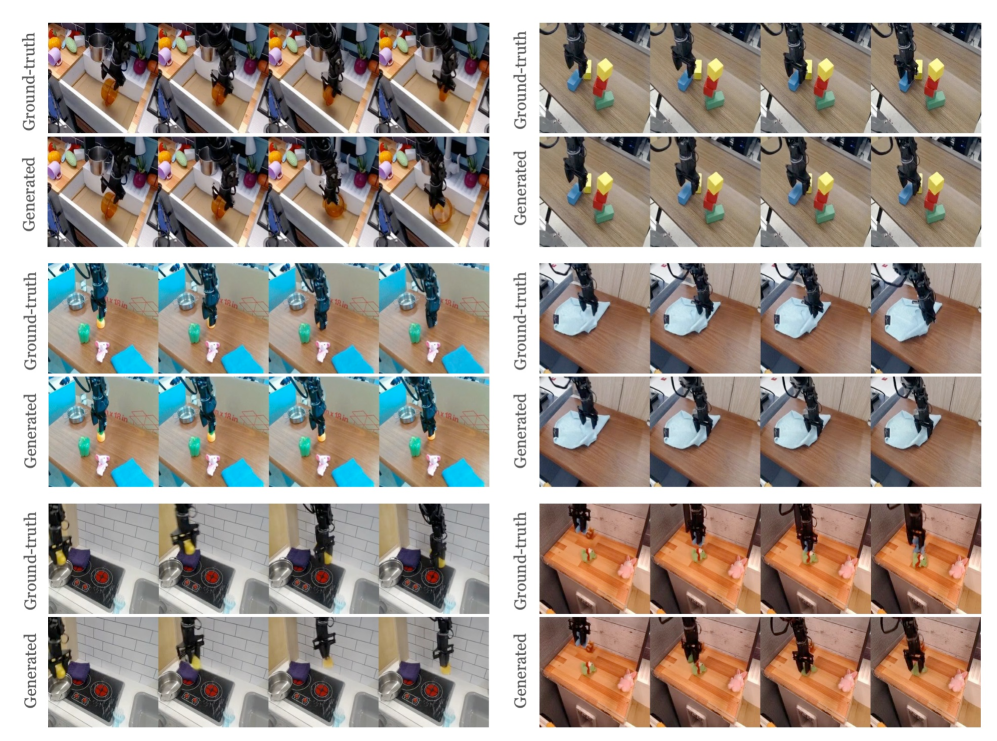
The image presents a side-by-side comparison of 10 scenarios (5 rows × 2 columns) showcasing "Ground-truth" (real-world) images and their corresponding "Generated" (AI-simulated) versions. Each row represents a distinct task or environment, with multiple sequential images per scenario to illustrate motion or interaction.
### Components/Axes
- **Columns**:
- Left: "Ground-truth" (real-world scenarios)
- Right: "Generated" (AI-simulated scenarios)
- **Rows**:
1. Kitchen (mug, fruits, robot arm)
2. Blocks (stacked cubes, robot arm)
3. Toys (plastic animals, robot arm)
4. Cloth (folded fabric, robot arm)
5. Oven (burner, pot, robot arm)
- **Image Layout**:
- Each scenario contains 5 sequential images (e.g., robot arm movement).
- No explicit axis markers, legends, or numerical data.
### Detailed Analysis
- **Kitchen Scenario**:
- Ground-truth: Mug, banana, apple, and robot arm interacting with objects.
- Generated: Similar objects but slight positional discrepancies (e.g., banana slightly misaligned).
- **Blocks Scenario**:
- Ground-truth: Blue, yellow, red, and green cubes stacked in a tower.
- Generated: Cubes stacked but with minor color blending (e.g., red cube appears slightly orange).
- **Toys Scenario**:
- Ground-truth: Pink pig, green dinosaur, and robot arm.
- Generated: Toys rendered with lower resolution; pig appears slightly flattened.
- **Cloth Scenario**:
- Ground-truth: Blue fabric folded neatly on a table.
- Generated: Fabric rendered with unrealistic creases and lighting artifacts.
- **Oven Scenario**:
- Ground-truth: Red burner, silver pot, and robot arm.
- Generated: Burner appears oversaturated; pot lacks reflective details.
### Key Observations
1. **Consistency**: Generated images generally replicate object shapes and arrangements but with minor inaccuracies.
2. **Lighting/Texture**: Ground-truth images exhibit realistic lighting and material textures (e.g., glossy mug, matte blocks), while generated versions show simplified or exaggerated effects.
3. **Motion Artifacts**: In dynamic scenarios (e.g., robot arm movement), generated sequences sometimes lag in synchronization with ground-truth.
### Interpretation
The comparison highlights the capabilities and limitations of AI-generated imagery in replicating real-world scenarios. While object placement and basic interactions are well-simulated, subtle details like lighting, texture, and motion precision reveal areas for improvement. This suggests the AI model excels at structural replication but struggles with nuanced environmental fidelity. The scenarios span diverse tasks (kitchen, stacking, play, fabric handling, appliance use), indicating the model's versatility across contexts. Outliers, such as the flattened toy pig, point to potential weaknesses in rendering complex geometries or soft materials.