## Screenshot: Code Editor with Theorem Definitions
### Overview
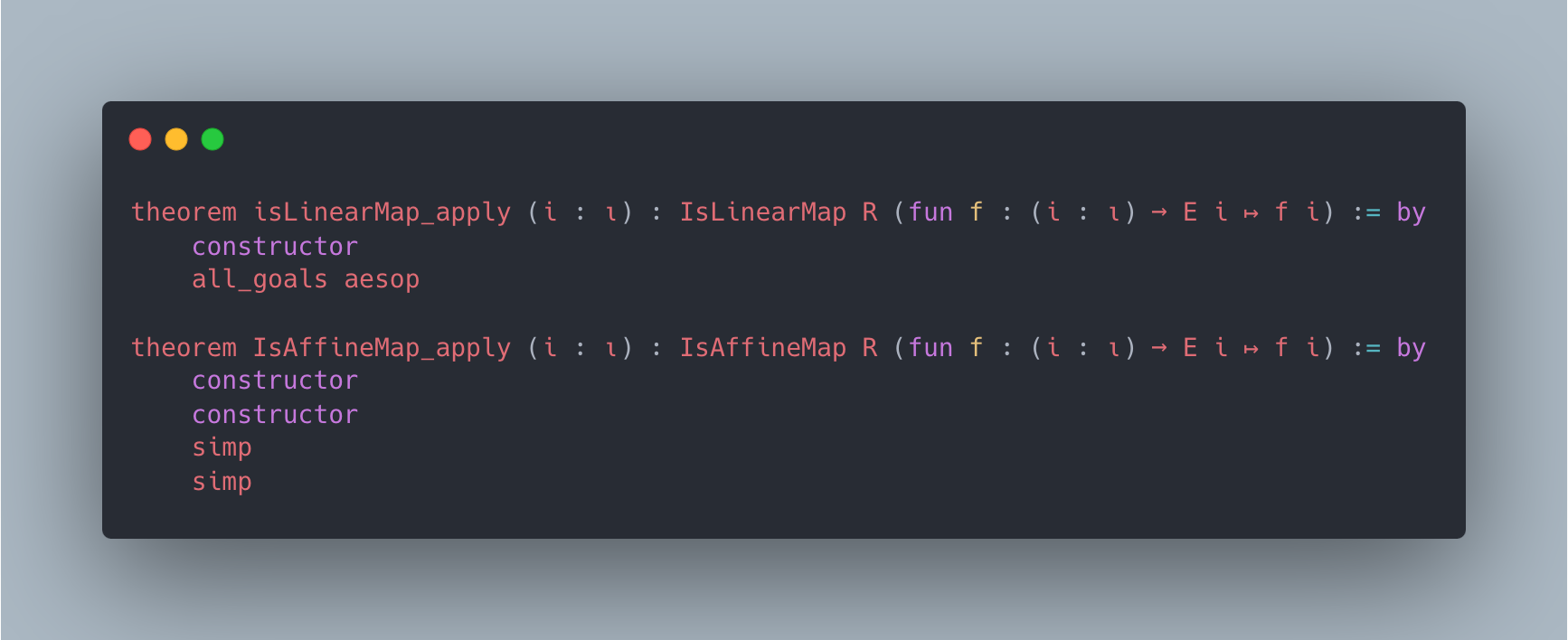
The image shows a code editor interface with two theorem definitions written in a formal proof language (likely Lean 4). The editor has a dark theme with syntax-highlighted code. Two theorem blocks are visible, each defining a property (`IsLinearMap` and `IsAffineMap`) and their proofs using tactics like `constructor` and `simp`.
### Components/Axes
- **UI Elements**:
- Top-left corner: Three circular buttons (red, yellow, green) for window controls (close, minimize, maximize).
- Code editor background: Dark gray/black with light-colored syntax highlighting.
- **Code Structure**:
- Two theorem definitions separated by blank lines.
- Each theorem includes a type signature, proof goal, and tactics.
### Detailed Analysis
#### First Theorem (`IsLinearMap`):
```lean4
theorem isLinearMap_apply (i : ι) : IsLinearMap R (fun f : (i : ι) → E i ↦ f i) := by
constructor
all_goals aesop
```
- **Text Colors**:
- `theorem`, `IsLinearMap_apply`, `IsLinearMap`, `R`, `E i ↦ f i`: Red.
- `constructor`, `all_goals`, `aesop`: Purple.
- `by`: Pink.
- **Syntax**:
- `i : ι` declares a variable `i` of type `ι`.
- `fun f : (i : ι) → E i ↦ f i` defines a function `f` mapping `i` to `E i ↦ f i`.
- `by constructor` applies the `constructor` tactic to build the proof.
- `all_goals aesop` likely refers to a tactic for handling all goals (possibly a typo for `aesop` as a lemma name).
#### Second Theorem (`IsAffineMap`):
```lean4
theorem IsAffineMap_apply (i : ι) : IsAffineMap R (fun f : (i : ι) → E i ↦ f i) := by
constructor
constructor
simp
simp
```
- **Text Colors**:
- `theorem`, `IsAffineMap_apply`, `IsAffineMap`, `R`, `E i ↦ f i`: Red.
- `constructor`, `simp`: Purple.
- `by`: Pink.
- **Syntax**:
- Similar structure to the first theorem but with two `constructor` calls and two `simp` (simplification) tactics.
### Key Observations
1. **Repetition of Tactics**:
- The second theorem uses `constructor` twice, suggesting nested or sequential proof steps.
- `simp` is called twice, indicating repeated simplification.
2. **Shared Elements**:
- Both theorems share the same function type `(i : ι) → E i ↦ f i`.
- The `by` keyword introduces automated proof tactics.
3. **Unclear Term**:
- `aesop` in the first theorem is ambiguous; it may be a typo (e.g., `aesop` instead of `aesop` or another term).
### Interpretation
This code defines formal proofs for linear and affine maps in a mathematical library. The `IsLinearMap` and `IsAffineMap` theorems likely assert properties about functions preserving linearity or affinity. The use of `constructor` implies building proofs by constructing elements (e.g., verifying axioms), while `simp` applies simplification rules to reduce subgoals. The `aesop` term is unclear but might reference a specific lemma or tactic in the context of the proof assistant. The repetition of tactics in the second theorem suggests a more complex proof structure, possibly requiring multiple layers of construction or simplification.
### Notable Patterns
- **Syntax Consistency**: Red highlights key terms (theorems, types), while purple/pink indicate tactics and keywords.
- **Automation**: The `by` keyword delegates proof construction to the proof assistant, common in interactive theorem provers like Lean.
- **Potential Typo**: `aesop` may need verification against the intended lemma or tactic name.
This code exemplifies formal verification workflows, where proofs are constructed programmatically using tactics to ensure mathematical correctness.