## Screenshot: ImandraX Automated Reasoning Engine Promotion
### Overview
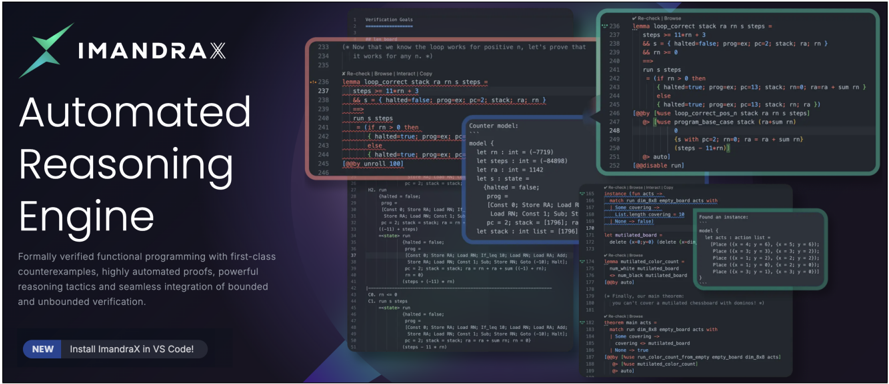
The image is a promotional screenshot for **ImandraX**, an automated reasoning engine. It features a dark-themed interface with technical text, code snippets, and a call-to-action button. The design emphasizes formal verification, automation, and integration with VS Code.
---
### Components/Axes
1. **Logo**:
- Top-left corner: "IMANDRAX" in white uppercase letters with a green geometric "X" icon.
2. **Main Text**:
- Left-aligned headline: "Automated Reasoning Engine" (large white font).
- Subtext: "Formally verified functional programming with first-class counterexamples, highly automated proofs, powerful reasoning tactics and seamless integration of bounded and unbounded verification." (smaller white font).
3. **Code Snippets**:
- Multiple overlapping code blocks with syntax highlighting:
- **Red-highlighted code**: Contains loops, conditionals (`if-then-else`), and variable declarations (e.g., `let s : int = 142`).
- **Blue-highlighted code**: Includes function definitions (e.g., `let rec loop_correct...`) and verification goals.
- **Green-highlighted code**: Shows verification steps (e.g., `let s = { halted=false; ... }`).
- Line numbers visible (e.g., 233–246, 248–252).
4. **Call-to-Action Button**:
- Bottom-left: Blue button with "NEW" in white, followed by "Install ImandraX in VS Code!" (white text on dark background).
---
### Detailed Analysis
- **Code Snippets**:
- The code appears to demonstrate formal verification of loops and functions, with annotations like `verification_goals` and `halted=false`.
- Variables (e.g., `rn`, `steps`, `pc`) and constructs (e.g., `let rec`, `let s = ...`) suggest functional programming with automated proof generation.
- **Color Coding**:
- Red: Keywords/control structures (e.g., `if`, `else`, `then`).
- Blue: Function definitions and verification logic.
- Green: Variable assignments and state declarations.
- **Layout**:
- Code snippets overlap diagonally, creating a layered effect to emphasize complexity.
- Text and code are left-aligned, with the button anchored to the bottom-left.
---
### Key Observations
1. **Promotional Focus**:
- The image prioritizes technical credibility over aesthetics, using code examples to showcase capabilities.
2. **Automation Emphasis**:
- Phrases like "highly automated proofs" and "first-class counterexamples" highlight the engine's efficiency.
3. **Integration**:
- The VS Code installation prompt underscores seamless developer workflow integration.
---
### Interpretation
The image positions ImandraX as a tool for developers requiring **formally verified code** with minimal manual proofwork. The overlapping code snippets suggest the engine handles complex verification tasks (e.g., loop correctness, state transitions) across bounded and unbounded contexts. The use of syntax highlighting in the code blocks implies the tool supports multiple programming paradigms, while the VS Code integration targets a broad audience of developers. The absence of numerical data or charts reinforces its focus on textual and logical reasoning rather than statistical analysis.
**Notable Outlier**: The "NEW" label on the button suggests a recent release or feature update, likely a key selling point.