## Line Chart: Accuracy vs. Attack Ratio for Different Federated Learning Algorithms
### Overview
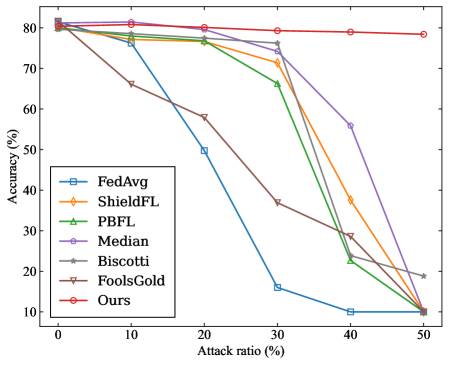
The image is a line chart comparing the accuracy of different federated learning algorithms as the attack ratio increases. The x-axis represents the attack ratio (percentage), and the y-axis represents the accuracy (percentage). Several algorithms are compared: FedAvg, ShieldFL, PBFL, Median, Biscotti, FoolsGold, and "Ours".
### Components/Axes
* **X-axis:** Attack ratio (%), with markers at 0, 10, 20, 30, 40, and 50.
* **Y-axis:** Accuracy (%), with markers at 10, 20, 30, 40, 50, 60, 70, and 80.
* **Legend:** Located on the left side of the chart, listing the algorithms and their corresponding line colors and markers:
* FedAvg (blue squares)
* ShieldFL (orange diamonds)
* PBFL (green triangles)
* Median (purple pentagons)
* Biscotti (gray stars)
* FoolsGold (brown inverted triangles)
* Ours (red circles)
### Detailed Analysis
* **FedAvg (blue squares):** The accuracy of FedAvg decreases significantly as the attack ratio increases.
* At 0% attack ratio, accuracy is approximately 80%.
* At 20% attack ratio, accuracy is approximately 50%.
* At 30% attack ratio, accuracy is approximately 15%.
* At 40% attack ratio, accuracy is approximately 10%.
* At 50% attack ratio, accuracy is approximately 10%.
* **ShieldFL (orange diamonds):** The accuracy of ShieldFL also decreases with increasing attack ratio, but not as drastically as FedAvg.
* At 0% attack ratio, accuracy is approximately 80%.
* At 20% attack ratio, accuracy is approximately 75%.
* At 30% attack ratio, accuracy is approximately 75%.
* At 40% attack ratio, accuracy is approximately 70%.
* At 50% attack ratio, accuracy is approximately 15%.
* **PBFL (green triangles):** The accuracy of PBFL decreases with increasing attack ratio.
* At 0% attack ratio, accuracy is approximately 80%.
* At 20% attack ratio, accuracy is approximately 77%.
* At 30% attack ratio, accuracy is approximately 70%.
* At 40% attack ratio, accuracy is approximately 20%.
* At 50% attack ratio, accuracy is approximately 10%.
* **Median (purple pentagons):** The accuracy of Median decreases with increasing attack ratio.
* At 0% attack ratio, accuracy is approximately 80%.
* At 20% attack ratio, accuracy is approximately 78%.
* At 30% attack ratio, accuracy is approximately 75%.
* At 40% attack ratio, accuracy is approximately 57%.
* At 50% attack ratio, accuracy is approximately 15%.
* **Biscotti (gray stars):** The accuracy of Biscotti decreases with increasing attack ratio.
* At 0% attack ratio, accuracy is approximately 80%.
* At 20% attack ratio, accuracy is approximately 78%.
* At 30% attack ratio, accuracy is approximately 40%.
* At 40% attack ratio, accuracy is approximately 30%.
* At 50% attack ratio, accuracy is approximately 15%.
* **FoolsGold (brown inverted triangles):** The accuracy of FoolsGold decreases significantly as the attack ratio increases.
* At 0% attack ratio, accuracy is approximately 80%.
* At 10% attack ratio, accuracy is approximately 68%.
* At 20% attack ratio, accuracy is approximately 58%.
* At 40% attack ratio, accuracy is approximately 28%.
* At 50% attack ratio, accuracy is approximately 10%.
* **Ours (red circles):** The accuracy of "Ours" remains relatively constant regardless of the attack ratio.
* At 0% attack ratio, accuracy is approximately 80%.
* At 50% attack ratio, accuracy is approximately 78%.
### Key Observations
* The "Ours" algorithm consistently maintains high accuracy, even with increasing attack ratios.
* FedAvg, FoolsGold, PBFL, Median, Biscotti, and ShieldFL are all negatively impacted by increasing attack ratios, with varying degrees of severity.
* FedAvg experiences the most significant drop in accuracy as the attack ratio increases.
### Interpretation
The chart demonstrates the vulnerability of different federated learning algorithms to attacks. The "Ours" algorithm appears to be the most robust against attacks, maintaining a high level of accuracy even with a high attack ratio. The other algorithms, particularly FedAvg and FoolsGold, are significantly affected by increasing attack ratios, indicating their susceptibility to malicious actors. This suggests that the "Ours" algorithm incorporates mechanisms to mitigate the impact of attacks, making it a more reliable choice in adversarial environments. The data highlights the importance of developing robust federated learning algorithms that can withstand attacks and maintain accuracy.