TECHNICAL ASSET FINGERPRINT
8c0ed7338fad88d4c8a45eed
Click to view fullscreen
Press ESC or click to close
FOUND IN PAPERS
EXPERT: healer-alpha-free VERSION 1
RUNTIME: free/openrouter/healer-alpha
INTEL_VERIFIED
## Diagram: Iterative Belief Update Process
### Overview
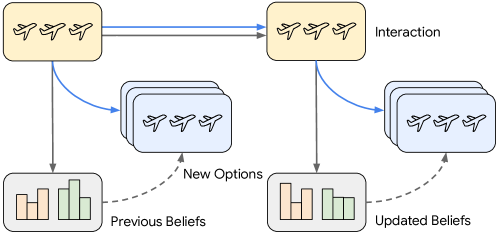
The image is a process flow diagram illustrating a two-stage, iterative system where interactions between agents lead to the generation of new options and the updating of beliefs. The diagram is structured in two parallel vertical columns, representing sequential stages of a process. Each stage involves agents (represented by airplane icons), belief distributions (bar charts), and the generation of new options.
### Components/Axes
The diagram contains the following labeled components and visual elements:
1. **Top-Level Process Flow:**
* **Left Column (Stage 1):** A beige box containing three airplane icons. A solid blue arrow points from this box to an identical beige box in the right column.
* **Right Column (Stage 2):** A beige box containing three airplane icons. The label **"Interaction"** is positioned to the right of this box.
* **Connection:** A solid blue arrow connects the left agent box to the right agent box, indicating a direct flow or interaction between the two stages.
2. **Belief and Option Generation (Per Stage):**
* **Stage 1 (Left):**
* **Previous Beliefs:** A bar chart at the bottom-left with three bars: orange (left), green (center), gray (right). The label **"Previous Beliefs"** is below it.
* **New Options:** A stack of three light blue cards, each containing three airplane icons. The label **"New Options"** is to the right of this stack.
* **Flow:** A solid gray arrow points from the top agent box down to the "Previous Beliefs" chart. A dashed gray arrow points from the "Previous Beliefs" chart to the "New Options" stack.
* **Stage 2 (Right):**
* **Updated Beliefs:** A bar chart at the bottom-right with three bars: orange (left), green (center), gray (right). The label **"Updated Beliefs"** is below it.
* **New Options:** A second stack of three light blue cards, each containing three airplane icons. This stack is unlabeled but is visually identical to the first "New Options" stack.
* **Flow:** A solid gray arrow points from the top agent box down to the "Updated Beliefs" chart. A dashed gray arrow points from the "Updated Beliefs" chart to the second "New Options" stack.
3. **Visual Elements & Spatial Grounding:**
* **Agent Icons:** Simple line drawings of airplanes, used consistently in all beige boxes and blue option cards.
* **Bar Charts:** Each chart has three vertical bars. The left bar is orange, the center bar is green, and the right bar is gray. The relative heights of the bars differ between the "Previous Beliefs" and "Updated Beliefs" charts.
* **Arrows:**
* **Solid Blue:** Horizontal, top-level flow from Stage 1 to Stage 2.
* **Solid Gray:** Vertical, downward flow from agent box to belief chart within each stage.
* **Dashed Gray:** Diagonal, upward flow from belief chart to "New Options" stack within each stage.
* **Positioning:** The entire diagram is laid out in a 2x2 grid. The agent boxes occupy the top row. The belief charts and option stacks occupy the bottom row, with the belief charts on the outer edges (left and right) and the option stacks positioned centrally between the columns.
### Detailed Analysis
* **Trend Verification (Belief Charts):**
* **"Previous Beliefs" Chart (Left):** The orange bar is the tallest, the green bar is of medium height, and the gray bar is the shortest. This suggests a belief distribution where the first option (orange) is most favored, followed by the second (green), with the third (gray) being least favored.
* **"Updated Beliefs" Chart (Right):** The orange bar remains the tallest, but its height relative to the others appears slightly reduced. The green bar has increased in height, becoming closer to the orange bar. The gray bar remains the shortest but may have increased slightly. The key trend is a **convergence** or **rebalancing** of beliefs, with the middle option (green) gaining favor relative to the leading option (orange) after the interaction stage.
* **Process Flow:** The diagram depicts a clear sequence:
1. Initial agents (Stage 1) operate based on "Previous Beliefs."
2. These beliefs influence the generation of "New Options."
3. An "Interaction" occurs, moving the process to Stage 2.
4. In Stage 2, agents operate again, leading to "Updated Beliefs."
5. These updated beliefs then influence the generation of a new set of "New Options."
### Key Observations
1. **Symmetry and Iteration:** The structure is highly symmetrical, implying the process is designed to be cyclical or repeatable. The output of Stage 2 ("Updated Beliefs" and new "New Options") could logically feed back into a subsequent Stage 1.
2. **Belief Update Mechanism:** The core change visualized is in the bar charts. The interaction between agents does not create a completely new belief distribution but rather **adjusts the weights** of existing options (orange, green, gray).
3. **Option Generation:** "New Options" are generated as a direct consequence of the current belief state (indicated by the dashed arrows from the charts). The options themselves (airplane icons) are abstract, representing potential actions, strategies, or choices available to the agents.
4. **Agent Consistency:** The agent icons (airplanes) are identical across all boxes and cards, suggesting the same type of entity or decision-maker is involved at all stages.
### Interpretation
This diagram models a **multi-agent learning or decision-making system**. It illustrates how collective interactions ("Interaction") lead to a revision of shared beliefs ("Previous Beliefs" → "Updated Beliefs"). This revised understanding of the world then informs the creation of new strategies or choices ("New Options").
The change in the bar charts is the most significant data point. It suggests that the interaction served to **moderate extreme beliefs** or **promote a previously less-favored option** (the green bar). This could represent a consensus-building process, the incorporation of new information, or the outcome of a negotiation where agents adjust their preferences based on the actions or communications of others.
The use of airplane icons is likely metaphorical, representing agents navigating a decision space. The "New Options" being stacks of cards implies a discrete set of potential future paths generated from the current belief state. The entire process is a feedback loop: beliefs shape options, interactions based on those options update beliefs, and the cycle continues. This is a foundational concept in fields like game theory, reinforcement learning, and computational social science.
DECODING INTELLIGENCE...