## Line Chart: Accuracy vs. C Parameter
### Overview
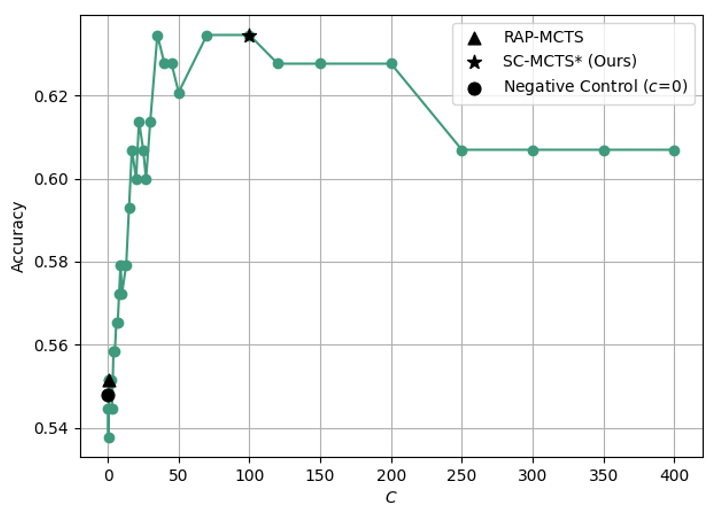
The chart illustrates the relationship between the parameter "C" and accuracy for three distinct methods: RAP-MCTS, SC-MCTS* (Ours), and Negative Control (c=0). The x-axis represents the parameter "C" (ranging from 0 to 400), while the y-axis represents accuracy (ranging from 0.54 to 0.62). The legend is positioned in the top-right corner, with distinct markers for each method.
### Components/Axes
- **X-axis (C)**: Labeled "C" with increments of 50 (0, 50, 100, ..., 400).
- **Y-axis (Accuracy)**: Labeled "Accuracy" with increments of 0.02 (0.54, 0.56, ..., 0.62).
- **Legend**:
- **RAP-MCTS**: Triangle marker (green line).
- **SC-MCTS* (Ours)**: Star marker (green line).
- **Negative Control (c=0)**: Circle marker (green line).
### Detailed Analysis
1. **RAP-MCTS (Triangle)**:
- Starts at approximately **0.545** when C=0.
- Peaks at **0.63** (slightly above the y-axis upper bound of 0.62) at C=50.
- Drops to **0.62** at C=100 and remains flat until C=400.
2. **SC-MCTS* (Ours, Star)**:
- Starts at approximately **0.545** when C=0.
- Peaks at **0.63** at C=100.
- Drops to **0.62** at C=150 and remains flat until C=400.
3. **Negative Control (c=0, Circle)**:
- Starts at approximately **0.545** when C=0.
- Gradually increases to **0.56** at C=50.
- Plateaus at **0.56** from C=50 to C=400.
### Key Observations
- **Peak Accuracy**: Both RAP-MCTS and SC-MCTS* achieve higher accuracy (0.63) compared to the Negative Control (0.56).
- **C Parameter Sensitivity**:
- RAP-MCTS peaks earlier (C=50) than SC-MCTS* (C=100).
- After their respective peaks, both methods stabilize at 0.62.
- **Negative Control**: Shows minimal improvement (0.545 → 0.56) and no further gains beyond C=50.
### Interpretation
The data suggests that **RAP-MCTS** and **SC-MCTS*** outperform the **Negative Control** in terms of accuracy. The **SC-MCTS*** (Ours) achieves the highest peak accuracy (0.63) but requires a higher C value (100) to reach it compared to RAP-MCTS (C=50). The **Negative Control** (c=0) demonstrates significantly lower performance, indicating that the intervention (RAP-MCTS/SC-MCTS*) is critical for improving accuracy. The plateauing behavior of all methods after their peaks implies diminishing returns for increasing C beyond optimal values. The **SC-MCTS*** (Ours) may offer a more efficient trade-off between C and accuracy, as it achieves the same peak as RAP-MCTS but with a higher C threshold.
**Note**: The y-axis upper bound (0.62) appears to be slightly lower than the observed peak values (0.63), suggesting potential axis scaling discrepancies or data extrapolation.