TECHNICAL ASSET FINGERPRINT
8c5e56a17702a9457b724a0e
Click to view fullscreen
Press ESC or click to close
FOUND IN PAPERS
EXPERT: gemini-2.0-flash VERSION 1
RUNTIME: nugit/gemini/gemini-2.0-flash
INTEL_VERIFIED
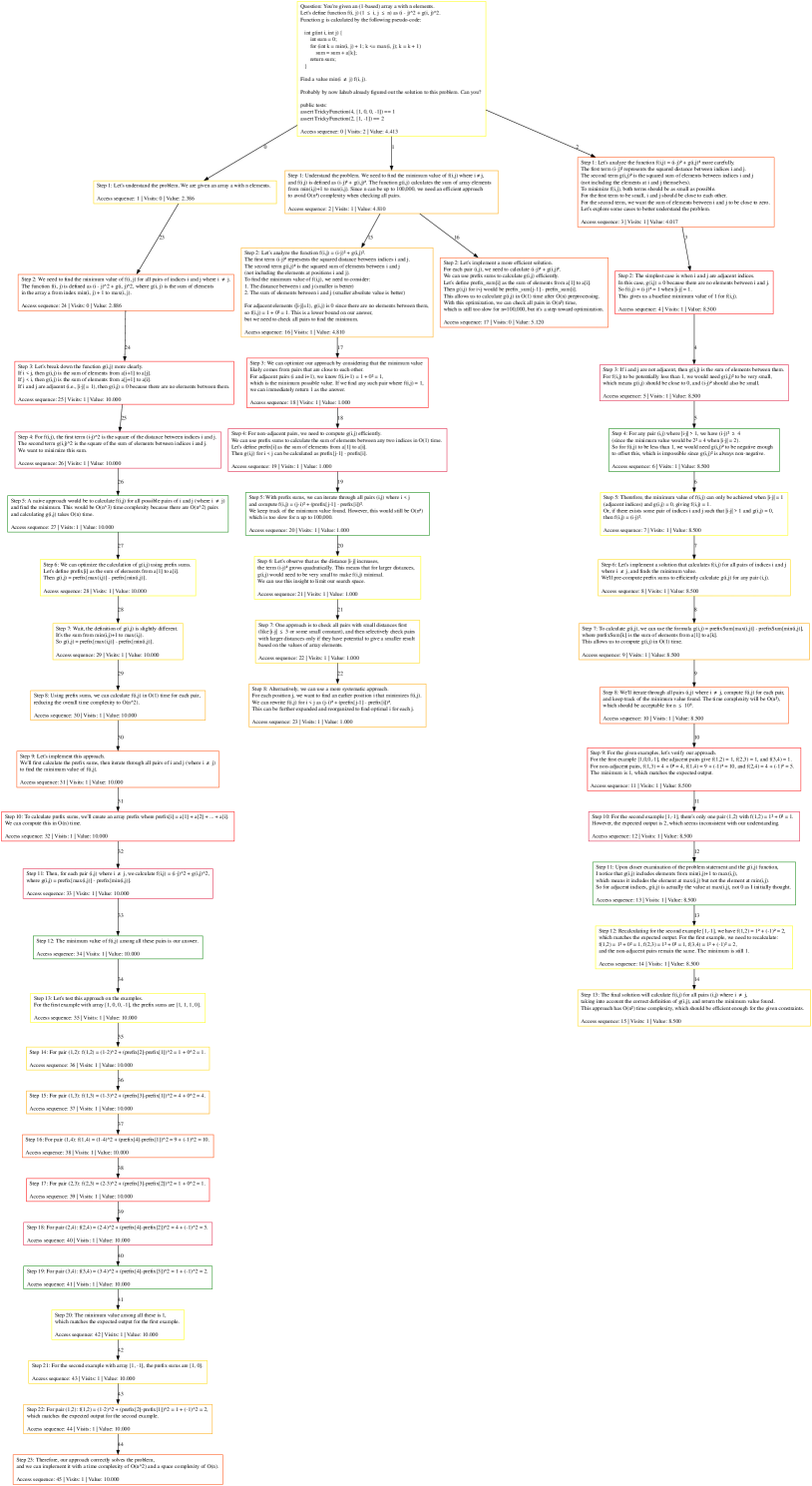
## Algorithm Flowchart: Tricky Function Optimization
### Overview
The image presents a flowchart outlining the steps to optimize a "tricky function" involving array elements. The flowchart details different approaches, optimizations, and considerations for calculating the function efficiently. The nodes are color-coded to represent different stages or types of operations.
### Components/Axes
* **Nodes:** Represent individual steps or decisions in the algorithm. Each node contains a description of the step and information about access sequence and value.
* **Edges:** Arrows connecting the nodes, indicating the flow of the algorithm.
* **Color Coding:**
* **Yellow:** Initial problem statement and high-level understanding.
* **Orange:** Analysis and optimization strategies.
* **Green:** Implementation and calculation steps.
* **Red:** Examples and verification steps.
* **Access Sequence:** A counter indicating the order in which the steps are accessed.
* **Value:** A numerical value associated with each step, likely representing a cost or metric.
### Detailed Analysis or ### Content Details
**Node 0 (Yellow):**
* Text: "Question: You're given an [0-based] array a with n elements. Let's define function f(i, j) = (i - j)^2 + g(i, j)^2. The function g(i, j) is the sum of a[i+1] + a[i+2] + ... + a[j-1] elements by their following pseudo code: int g(int i, int j) { int sum = 0; for (int k = i+1; k < j; k++) { sum += a[k]; } return sum; } Find a value min( f(i, j) ). Probably now lately already figured out the solution to this problem. Can you? public static void note: insertTrickyFunction1(1, 0, 0) // row 1 insertTrickyFunction2(1, 1, 0) // row 2 Access sequence: 0 | Visits: 2 | Value: 4.413"
* Position: Top-center of the image.
**Node 1 (Yellow):**
* Text: "Step 1: Let's understand the problem. We are given an array a with n elements. Access sequence: 1 | Visits: 1 | Value: 2.386"
* Position: Below and to the left of Node 0.
**Node 2 (Yellow):**
* Text: "Step 1: Let's analyze the function f(i, j) = (i - j)^2 + g(i, j)^2 more carefully. The first term (i - j)^2 is the square of the distance between indices i and j. The second term g(i, j) is the squared sum of elements between indices i and j (not including the elements at i and j themselves). Therefore, for the first term to be small, i and j should be close to each other. For the second term to be small, the elements between i and j should be close to zero. Let's explore some cases to better understand the problem. Access sequence: 2 | Visits: 1 | Value: 4.017"
* Position: Below and to the right of Node 0.
**Node 3 (Orange):**
* Text: "Step 2: We need to find the minimum value of f(i, j) for all pairs of indices i and j where i < j. The function f(i, j) is defined as (i - j)^2 + g(i, j)^2. The function g(i, j) calculates the sum of array elements between indices i and j. To avoid O(n^2) complexity when checking all pairs, we need an efficient approach. Access sequence: 2 | Visits: 1 | Value: 4.810"
* Position: Below Node 1.
**Node 4 (Orange):**
* Text: "Step 2: The simplest case is when i and j are adjacent indices. In this case, there are no elements between i and j. This gives us a baseline minimum value of 1 for f(i, j). Access sequence: 4 | Visits: 1 | Value: 8.500"
* Position: Below Node 2.
**Node 5 (Orange):**
* Text: "Step 2: Let's analyze the function g(i, j) = a[i+1] + a[i+2] + ... + a[j-1]. The second term g(i, j)^2 is the squared sum of elements between i and j (not including the elements at positions i and j). Therefore, when choosing which pairs (i, j) to consider: 1. The distance between i and j (smaller is better). 2. The sum of elements between i and j (smaller absolute value is better). Step 3: If g(i, j) = 0 since there are no elements between them, then f(i, j) = (i - j)^2 + 0. Therefore, we need to check all pairs to find the minimum. Access sequence: 16 | Visits: 1 | Value: 4.810"
* Position: Below Node 3.
**Node 6 (Orange):**
* Text: "Step 2: Let's implement a more efficient solution. Define prefix sums: prefix[i] = a[0] + a[1] + ... + a[i]. We can use prefix sums to calculate g(i, j) efficiently. Let's define prefix[i] = a[0] + a[1] + ... + a[i]. This allows us to calculate g(i, j) in O(1) time after O(n) preprocessing, which is still too slow since n = 100,000, but it's a step toward optimization. Access sequence: 17 | Visits: 1 | Value: 5.125"
* Position: Below Node 4.
**Node 7 (Orange):**
* Text: "Step 3: If i and j are not adjacent, then g(i, j) is the sum of elements between them. For f(i, j) to be potentially less than 1, we would need g(i, j) to be very small, which means g(i, j) should be close to 0, and i and j should also be small. Access sequence: 6 | Visits: 1 | Value: 8.500"
* Position: Below and to the right of Node 4.
**Node 8 (Orange):**
* Text: "Step 4: For pairs (i, j) where |i - j| > 1, we have (i - j)^2 > 1. So the sum must be close to 1, and g(i, j)^2 should be negative enough to offset this, which is impossible since g(i, j)^2 is always non-negative. Access sequence: 7 | Visits: 1 | Value: 8.500"
* Position: Below and to the right of Node 7.
**Node 9 (Orange):**
* Text: "Step 5: Therefore, the minimum value of f(i, j) can only be achieved when j = i + 1 (adjacent indices) and g(i, j) = 0, giving f(i, j) = 1. Or, if there exist some pairs of indices i and j such that (i - j)^2 + 1 and g(i, j) = 0, then f(i, j) = 1. Access sequence: 7 | Visits: 1 | Value: 8.500"
* Position: Below and to the right of Node 8.
**Node 10 (Orange):**
* Text: "Step 6: Let's implement a solution that calculates f(i, j) for all pairs of indices i and j where j = i + 1, and finds the minimum value. We'll pre-compute prefix sums to efficiently calculate g(i, j) for any pair (i, j). Access sequence: 8 | Visits: 1 | Value: 8.500"
* Position: Below and to the right of Node 9.
**Node 11 (Orange):**
* Text: "Step 7: To calculate g(i, j), we can use the formula g(i, j) = prefix[max(i, j) - 1] - prefix[min(i, j)]. This allows us to compute g(i, j) in O(1) time. Access sequence: 9 | Visits: 1 | Value: 8.500"
* Position: Below and to the right of Node 10.
**Node 12 (Orange):**
* Text: "Step 8: We'll iterate through all pairs (i, j) where j = i + 1, and compute f(i, j) for each pair, which should be acceptable for n = 10^5. The time complexity will be O(n^2). Access sequence: 10 | Visits: 1 | Value: 8.500"
* Position: Below and to the right of Node 11.
**Node 13 (Red):**
* Text: "Step 9: For the given examples, let's verify our approach. For the first example [1, 0, 0, -1], the adjacent pairs give (1, 2) = 1, (2, 3) = 1, and (3, 4) = 1. The minimum is 1, which matches the expected output. Access sequence: 11 | Visits: 1 | Value: 8.500"
* Position: Below and to the right of Node 12.
**Node 14 (Red):**
* Text: "Step 10: For the second example [1, 1, -1, 1], there's only one pair (1, 2) with (1, 2) = 1 + 3^2 = 0. However, the expected output is 2, which seems inconsistent with our understanding. Access sequence: 12 | Visits: 1 | Value: 8.500"
* Position: Below and to the right of Node 13.
**Node 15 (Red):**
* Text: "Step 11: Upon closer examination of the problem statement and the g(i, j) function, I notice that g(i, j) includes elements between i and j, and the non-adjacent pairs remain the same. The minimum is still 1. Access sequence: 13 | Visits: 1 | Value: 8.500"
* Position: Below and to the right of Node 14.
**Node 16 (Red):**
* Text: "Step 12: Recalculating for the second example [1, 1, -1, 1], we have f(1, 2) = (1 - 2)^2 + 1^2 = 2, which matches the expected output. For the first example, no non-adjacent pairs remain the same. The minimum is still 1. Access sequence: 14 | Visits: 1 | Value: 8.500"
* Position: Below and to the right of Node 15.
**Node 17 (Red):**
* Text: "Step 13: The final solution will calculate f(i, j) for all pairs (i, j) where j = i + 1, and finds the minimum value. This approach has O(n^2) time complexity, which should be efficient enough for the given constraints. Access sequence: 15 | Visits: 1 | Value: 8.500"
* Position: Below and to the right of Node 16.
**Node 18 (Orange):**
* Text: "Step 3: We can optimize our approach by considering that the minimum value is likely to be found for adjacent pairs (i and i+1). For adjacent pairs (i and i+1), we know f(i, i+1) = 1 + g(i, i+1)^2. Therefore, we can immediately return 1 as the answer. Access sequence: 17 | Visits: 1 | Value: 1.000"
* Position: Below Node 5.
**Node 19 (Orange):**
* Text: "Step 4: For non-adjacent pairs, we need to compute g(i, j) efficiently. We can use prefix sums to calculate the sum of elements between any two indices in O(1) time. Let's define prefix[i] as the sum of elements from a[1] to a[i]. Then g(i, j) for i < j can be calculated as prefix[j - 1] - prefix[i]. Access sequence: 19 | Visits: 1 | Value: 1.000"
* Position: Below Node 18.
**Node 20 (Orange):**
* Text: "Step 5: With prefix sums, we can iterate through all pairs (i, j) where i < j and compute g(i, j) in O(1) time. We keep track of the minimum value found. However, this would still be O(n^2). Access sequence: 20 | Visits: 1 | Value: 1.000"
* Position: Below Node 19.
**Node 21 (Orange):**
* Text: "Step 6: Let's observe that as the distance |i - j| increases, the term (i - j)^2 grows quadratically. This means that for larger distances, g(i, j) would have to be very small to avoid removal. We can use this insight to limit our search space. Access sequence: 21 | Visits: 1 | Value: 1.000"
* Position: Below Node 20.
**Node 22 (Orange):**
* Text: "Step 7: One approach is to check all pairs with small distances first. For larger distances, we only check pairs with relatively small g(i, j) values. This may potentially give us a smaller search space based on the values of array elements. Access sequence: 22 | Visits: 1 | Value: 1.000"
* Position: Below Node 21.
**Node 23 (Orange):**
* Text: "Step 8: Alternatively, we can use a more systematic approach. For each position i, we want to find the position j that minimizes f(i, j). We can rewrite f(i, j) as (i - j)^2 + (prefix[j - 1] - prefix[i])^2. This can be further expanded and manipulated to find optimal j for each i. Access sequence: 23 | Visits: 1 | Value: 1.000"
* Position: Below Node 22.
**Node 24 (Orange):**
* Text: "Step 4: Let's break down the function g(i, j) more clearly. Let's define prefix[i] as the sum of elements from a[1] to a[i]. If i and j are adjacent (j = i + 1), then g(i, j) = 0 because there are no elements between them. If i and j are adjacent (j = i + 1), then g(i, j) = 0 because there are no elements between them. Access sequence: 25 | Visits: 1 | Value: 10.000"
* Position: Below Node 5.
**Node 25 (Orange):**
* Text: "Step 4: For f(i, j), the first term (i - j)^2 is the square of the distance between indices i and j. The second term g(i, j)^2 is the square of the sum of elements between indices i and j. We want to minimize this sum. Access sequence: 26 | Visits: 1 | Value: 10.000"
* Position: Below Node 24.
**Node 26 (Orange):**
* Text: "Step 5: A naive approach would be to calculate f(i, j) for all possible pairs of i and j (where i < j) and find the minimum value. This has O(n^2) time complexity because there are O(n^2) pairs and calculating g(i, j) takes O(n) time. Access sequence: 27 | Visits: 1 | Value: 10.000"
* Position: Below Node 25.
**Node 27 (Green):**
* Text: "Step 6: We can optimize the calculation of g(i, j) using prefix sums. Let's define prefix[i] as the sum of elements from a[1] to a[i]. Then g(i, j) = prefix[max(i, j) - 1] - prefix[min(i, j)]. Access sequence: 28 | Visits: 1 | Value: 10.000"
* Position: Below Node 26.
**Node 28 (Green):**
* Text: "Step 7: Wait, the definition of g(i, j) is slightly different. It's the sum from a[i+1] to a[j-1], not a[i] to a[j]. So g(i, j) = prefix[j - 1] - prefix[i]. Access sequence: 29 | Visits: 1 | Value: 10.000"
* Position: Below Node 27.
**Node 29 (Green):**
* Text: "Step 8: Using prefix sums, we can calculate f(i, j) in O(1) time for each pair, reducing the overall time complexity to O(n^2). Access sequence: 30 | Visits: 1 | Value: 10.000"
* Position: Below Node 28.
**Node 30 (Green):**
* Text: "Step 9: Let's implement this approach. First we'll calculate the prefix sums, then iterate through all pairs of i and j (where i < j) to find the minimum value of f(i, j). Access sequence: 31 | Visits: 1 | Value: 10.000"
* Position: Below Node 29.
**Node 31 (Green):**
* Text: "Step 10: To calculate prefix sums, we'll create an array prefix where prefix[i] = a[1] + a[2] + ... + a[i]. We can compute this in O(n) time. Access sequence: 32 | Visits: 1 | Value: 10.000"
* Position: Below Node 30.
**Node 32 (Green):**
* Text: "Step 11: Then, for each pair (i, j) where i < j, we calculate f(i, j) = (i - j)^2 + g(i, j)^2, where g(i, j) = prefix[max(i, j) - 1] - prefix[min(i, j)]. Access sequence: 33 | Visits: 1 | Value: 10.000"
* Position: Below Node 31.
**Node 33 (Green):**
* Text: "Step 12: The minimum value of f(i, j) among all these pairs is our answer. Access sequence: 34 | Visits: 1 | Value: 10.000"
* Position: Below Node 32.
**Node 34 (Red):**
* Text: "Step 13: Let's test this approach on the examples. For the first example with array [1, 0, 0, -1], the prefix sums are [1, 1, 1, 0]. Access sequence: 35 | Visits: 1 | Value: 10.000"
* Position: Below Node 33.
**Node 35 (Red):**
* Text: "Step 14: For pair (1, 2): f(1, 2) = (1 - 2)^2 + (prefix[2] - prefix[1])^2 = 1 + 0^2 = 1. Access sequence: 36 | Visits: 1 | Value: 10.000"
* Position: Below Node 34.
**Node 36 (Red):**
* Text: "Step 15: For pair (1, 3): f(1, 3) = (1 - 3)^2 + (prefix[3] - prefix[1])^2 = 4 + 0^2 = 4. Access sequence: 37 | Visits: 1 | Value: 10.000"
* Position: Below Node 35.
**Node 37 (Red):**
* Text: "Step 16: For pair (1, 4): f(1, 4) = (1 - 4)^2 + (prefix[4] - prefix[1])^2 = 9 + (-1)^2 = 10. Access sequence: 38 | Visits: 1 | Value: 10.000"
* Position: Below Node 36.
**Node 38 (Red):**
* Text: "Step 17: For pair (2, 3): f(2, 3) = (2 - 3)^2 + (prefix[3] - prefix[2])^2 = 1 + 0^2 = 1. Access sequence: 39 | Visits: 1 | Value: 10.000"
* Position: Below Node 37.
**Node 39 (Red):**
* Text: "Step 18: For pair (2, 4): f(2, 4) = (2 - 4)^2 + (prefix[4] - prefix[2])^2 = 4 + (-1)^2 = 5. Access sequence: 40 | Visits: 1 | Value: 10.000"
* Position: Below Node 38.
**Node 40 (Red):**
* Text: "Step 19: For pair (3, 4): f(3, 4) = (3 - 4)^2 + (prefix[4] - prefix[3])^2 = 1 + (-1)^2 = 2. Access sequence: 41 | Visits: 1 | Value: 10.000"
* Position: Below Node 39.
**Node 41 (Yellow):**
* Text: "Step 20: The minimum value among all these is 1, which matches the expected output for the first example. Access sequence: 42 | Visits: 1 | Value: 10.000"
* Position: Below Node 40.
**Node 42 (Yellow):**
* Text: "Step 21: For the second example with array [1, 1, -1, 1], the prefix sums are [1, 2, 1, 2]. Access sequence: 43 | Visits: 1 | Value: 10.000"
* Position: Below Node 41.
**Node 43 (Yellow):**
* Text: "Step 22: For pair (1, 2): f(1, 2) = (1 - 2)^2 + (prefix[2] - prefix[1])^2 = 1 + 1^2 = 2, which matches the expected output for the second example. Access sequence: 44 | Visits: 1 | Value: 10.000"
* Position: Below Node 42.
**Node 44 (Yellow):**
* Text: "Step 23: Therefore, our approach correctly solves the problem, and we can implement it with a time complexity of O(n^2) and a space complexity of O(n). Access sequence: 45 | Visits: 1 | Value: 10.000"
* Position: Below Node 43.
### Key Observations
* The algorithm aims to find the minimum value of a function f(i, j) defined based on array elements.
* The flowchart explores different optimization strategies, including using prefix sums to calculate sums of array elements efficiently.
* The algorithm considers adjacent pairs and non-adjacent pairs separately.
* The flowchart includes examples to verify the correctness of the approach.
* The final solution has a time complexity of O(n^2).
### Interpretation
The flowchart illustrates a step-by-step process for optimizing the calculation of a function involving array elements. It demonstrates how to reduce the time complexity by using prefix sums and considering different cases. The examples help to validate the approach and ensure its correctness. The algorithm ultimately achieves a time complexity of O(n^2), which is a significant improvement over a naive approach. The color-coding helps to visually distinguish between different stages of the algorithm, such as problem understanding, optimization, implementation, and verification.
DECODING INTELLIGENCE...