TECHNICAL ASSET FINGERPRINT
8c8e8eae0fab8270f205d200
Click to view fullscreen
Press ESC or click to close
FOUND IN PAPERS
EXPERT: healer-alpha-free VERSION 1
RUNTIME: free/openrouter/healer-alpha
INTEL_VERIFIED
## Chart Type: Multi-Panel Line Chart (Normalized MSE vs Time)
### Overview
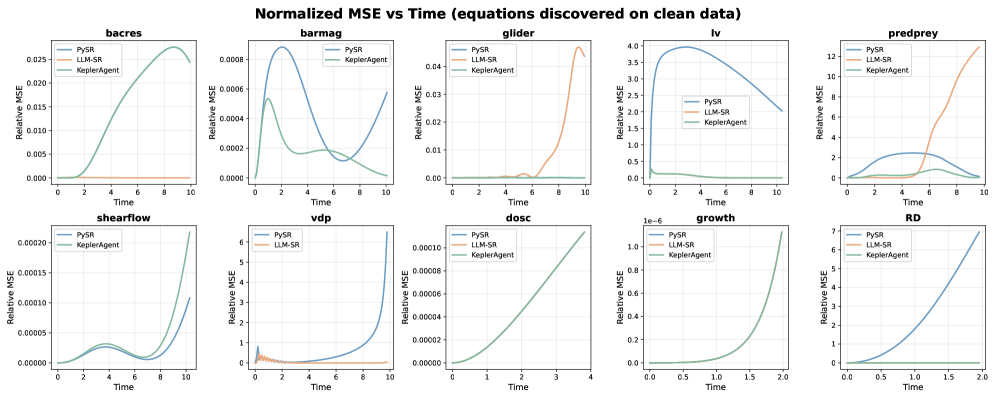
The image displays a 2x5 grid of line charts, each comparing the performance of three different methods (PySR, LLM-SR, KeplerAgent) over time for a specific equation discovery task. The overarching title is "Normalized MSE vs Time (equations discovered on clean data)". Each subplot represents a different target equation or system, identified by a short title. The y-axis represents "Relative MSE" (Mean Squared Error), and the x-axis represents "Time". The charts illustrate how the error of the discovered equations evolves over time for each method.
### Components/Axes
* **Main Title:** "Normalized MSE vs Time (equations discovered on clean data)"
* **Subplot Titles (Top Row, Left to Right):** `bacres`, `barmag`, `glider`, `lv`, `predprey`
* **Subplot Titles (Bottom Row, Left to Right):** `shearflow`, `vdp`, `dosc`, `growth`, `RD`
* **Axes Labels (Consistent across all subplots):**
* **X-axis:** "Time"
* **Y-axis:** "Relative MSE"
* **Legend (Present in each subplot):**
* **PySR:** Blue line
* **LLM-SR:** Orange line
* **KeplerAgent:** Green line
* **Placement:** Typically in the top-left or top-right corner of each subplot's plotting area.
* **Axis Scales:** The scales for both Time and Relative MSE vary significantly between subplots, indicating different magnitudes of error and time ranges for each equation.
### Detailed Analysis
**Subplot 1: `bacres`**
* **Trend:** PySR (blue) shows a steep, concave-down increase in MSE, peaking around Time=8 before slightly declining. LLM-SR (orange) and KeplerAgent (green) remain flat near zero MSE throughout.
* **Key Points:** PySR MSE rises from ~0 to a peak of ~0.025. The other two methods are negligible.
**Subplot 2: `barmag`**
* **Trend:** PySR (blue) has a sharp, narrow peak early (Time~2), then declines and rises again later. LLM-SR (orange) has a broader, lower peak around Time~1.5. KeplerAgent (green) shows a moderate, broad peak around Time~2.
* **Key Points:** PySR peak MSE ~0.0008. LLM-SR peak ~0.0005. KeplerAgent peak ~0.0005.
**Subplot 3: `glider`**
* **Trend:** PySR (blue) and KeplerAgent (green) are flat near zero. LLM-SR (orange) shows a dramatic, exponential-like increase starting around Time=6.
* **Key Points:** LLM-SR MSE rises from ~0 to >0.04 by Time=10.
**Subplot 4: `lv` (Lotka-Volterra)**
* **Trend:** PySR (blue) starts high (~3.8), peaks near Time=3 (~4.0), then declines steadily. LLM-SR (orange) and KeplerAgent (green) are flat near zero.
* **Key Points:** PySR MSE is orders of magnitude higher than the others.
**Subplot 5: `predprey`**
* **Trend:** PySR (blue) has a low, broad hump peaking around Time=4 (~2.0). LLM-SR (orange) shows a sharp, exponential increase starting around Time=6, reaching >12. KeplerAgent (green) is flat near zero.
* **Key Points:** LLM-SR error becomes extremely large. PySR error is moderate. KeplerAgent performs best.
**Subplot 6: `shearflow`**
* **Trend:** PySR (blue) and KeplerAgent (green) follow very similar paths: a small hump around Time=4, a dip, then a sharp rise after Time=8. KeplerAgent's rise is steeper.
* **Key Points:** Both end with MSE ~0.00010-0.00020. The y-axis scale is very small (1e-4).
**Subplot 7: `vdp` (Van der Pol oscillator)**
* **Trend:** PySR (blue) is flat near zero. LLM-SR (orange) shows a sharp, exponential increase starting around Time=8.
* **Key Points:** LLM-SR MSE rises from ~0 to >6 by Time=10.
**Subplot 8: `dosc`**
* **Trend:** PySR (blue) and KeplerAgent (green) are flat near zero. LLM-SR (orange) shows a smooth, accelerating increase.
* **Key Points:** LLM-SR MSE rises from 0 to ~0.00010 by Time=4. The y-axis scale is very small (1e-4).
**Subplot 9: `growth`**
* **Trend:** PySR (blue) and KeplerAgent (green) are flat near zero. LLM-SR (orange) shows a very sharp, exponential increase.
* **Key Points:** LLM-SR MSE rises from 0 to >1.0 by Time=2.0. The y-axis has a multiplier of 1e-6, so values are on the order of 1e-6.
**Subplot 10: `RD` (Reaction-Diffusion?)**
* **Trend:** PySR (blue) shows a smooth, accelerating increase. LLM-SR (orange) and KeplerAgent (green) are flat near zero.
* **Key Points:** PySR MSE rises from 0 to >7 by Time=2.0.
### Key Observations
1. **Method Performance is Highly Equation-Dependent:** No single method (PySR, LLM-SR, KeplerAgent) is universally superior. Their relative performance flips dramatically between different equations.
2. **Catastrophic Failure Modes:** LLM-SR exhibits extreme, exponential error growth in several cases (`glider`, `predprey`, `vdp`, `growth`), suggesting instability or poor generalization for those dynamics.
3. **Stability of KeplerAgent:** KeplerAgent (green) often remains stable with low error (flat line near zero), particularly in `bacres`, `lv`, `predprey`, `dosc`, `growth`, and `RD`. It is rarely the worst performer.
4. **PySR's Variable Performance:** PySR (blue) shows the widest range of behaviors: it can be the worst (`lv`, `RD`), have moderate error (`predprey`), or perform well (`bacres`, `glider`).
5. **Scale Discrepancies:** The y-axis scales differ by orders of magnitude (e.g., `shearflow` max ~2e-4 vs. `predprey` max >12), indicating the inherent difficulty or error magnitude varies greatly across the tested equations.
### Interpretation
This collection of charts serves as a benchmark comparison of symbolic regression or equation discovery algorithms. The data suggests that the choice of algorithm must be carefully matched to the problem domain.
* **Underlying Pattern:** The plots reveal a trade-off between methods that may have higher initial error but remain stable (KeplerAgent) versus methods that can achieve very low error but risk catastrophic divergence for certain equation types (LLM-SR, and to a lesser extent, PySR).
* **Equation Complexity:** The equations where LLM-SR fails spectacularly (`glider`, `predprey`, `vdp`) likely represent more complex, nonlinear dynamical systems. Its success on simpler or different types of equations (`shearflow`, `dosc`) indicates its performance is not uniformly poor.
* **Investigative Insight:** A researcher viewing this would conclude that robustness (KeplerAgent) and peak accuracy (variable across methods) are separate axes of performance. The ideal algorithm would combine the stability of KeplerAgent with the peak accuracy potential shown by the best-performing method in each individual plot. The charts highlight specific failure cases (`predprey` for LLM-SR, `lv` for PySR) that warrant deeper investigation into why those methods struggle with those particular mathematical structures.
DECODING INTELLIGENCE...