## Screenshot: Code Editor with Formal Proof Snippet
### Overview
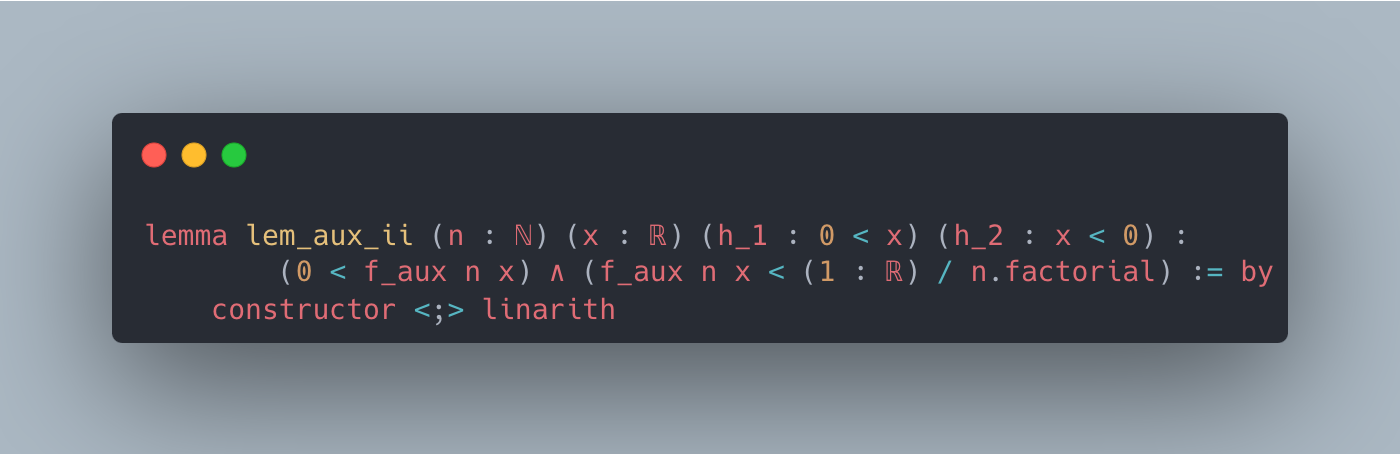
The image shows a code editor displaying a formal proof snippet written in a functional programming or proof assistant language (likely Coq or Lean). The code is syntax-highlighted with color-coded elements, and the editor interface includes a window control bar with three colored circles (red, yellow, green) in the top-left corner.
### Components/Axes
- **UI Elements**:
- **Window Control Bar**: Top-left corner with three circular buttons:
- Red circle (close)
- Yellow circle (minimize)
- Green circle (maximize)
- **Code Block**: Dark background with syntax-highlighted text.
- **Text Content**:
- **Lemma Declaration**: `lemma lem_aux_ii (n : N) (x : R) (h1 : 0 < x) (h2 : x < 0) :`
- `N` and `R` likely represent natural numbers and real numbers, respectively.
- `h1` and `h2` are hypotheses (contradictory: `0 < x` and `x < 0`).
- **Logical Expression**:
- `(0 < f_aux n x) /\ (f_aux n x < (1 : R)) / n.factorial) :=`
- `f_aux` is a function returning a value between 0 and 1.
- Division by `n.factorial` (factorial of `n`).
- **Constructor**: `constructor <> linarith`
- `linarith` is a tactic in Coq/Lean for linear arithmetic proofs.
### Detailed Analysis
- **Textual Elements**:
- **Lemma Name**: `lem_aux_ii` (auxiliary lemma II).
- **Parameters**:
- `n : N` (natural number).
- `x : R` (real number).
- **Hypotheses**:
- `h1 : 0 < x` (x is positive).
- `h2 : x < 0` (x is negative) — **contradiction**.
- **Logical Expression**:
- `0 < f_aux n x` (output of `f_aux` is positive).
- `f_aux n x < (1 : R)` (output of `f_aux` is less than 1).
- Division by `n.factorial` (factorial of `n`).
- **Constructor**: `constructor <> linarith` (invokes the `linarith` tactic).
- **Syntax Highlighting**:
- Keywords (`lemma`, `constructor`): Red.
- Variables (`n`, `x`, `h1`, `h2`): Yellow.
- Operators (`:`, `<`, `>`, `:`, `/`, `:=`): Blue.
- Mathematical symbols (`0`, `1`, `: R`): Green.
- Comments (`// n.factorial`): Light gray.
### Key Observations
1. **Contradictory Hypotheses**: `h1` and `h2` assert `0 < x` and `x < 0`, which is logically impossible. This suggests the lemma is part of a proof by contradiction.
2. **Factorial Division**: The term `n.factorial` implies the lemma involves combinatorial or recursive reasoning.
3. **Tactic Usage**: `linarith` is a specialized tactic for linear arithmetic, indicating the lemma deals with inequalities or bounds.
### Interpretation
This code snippet defines a lemma (`lem_aux_ii`) that likely proves a property about a function `f_aux` under contradictory hypotheses. The use of `linarith` suggests the proof involves linear inequalities, and the division by `n.factorial` hints at a combinatorial or recursive structure. The contradictory hypotheses (`h1` and `h2`) imply the lemma is part of a broader proof strategy where such contradictions are resolved or leveraged to establish a result. The code is typical of formal verification in proof assistants like Coq or Lean, where lemmas are rigorously defined and proven using automated tactics.