TECHNICAL ASSET FINGERPRINT
8d7de97cbde36efa2fcc0c47
Click to view fullscreen
Press ESC or click to close
FOUND IN PAPERS
EXPERT: gemini-2.5-flash-lite-free VERSION 1
RUNTIME: google-free/gemini-2.5-flash-lite
INTEL_VERIFIED
## Mathematical Document: Vector Cross Product and Magnitude Minimization
### Overview
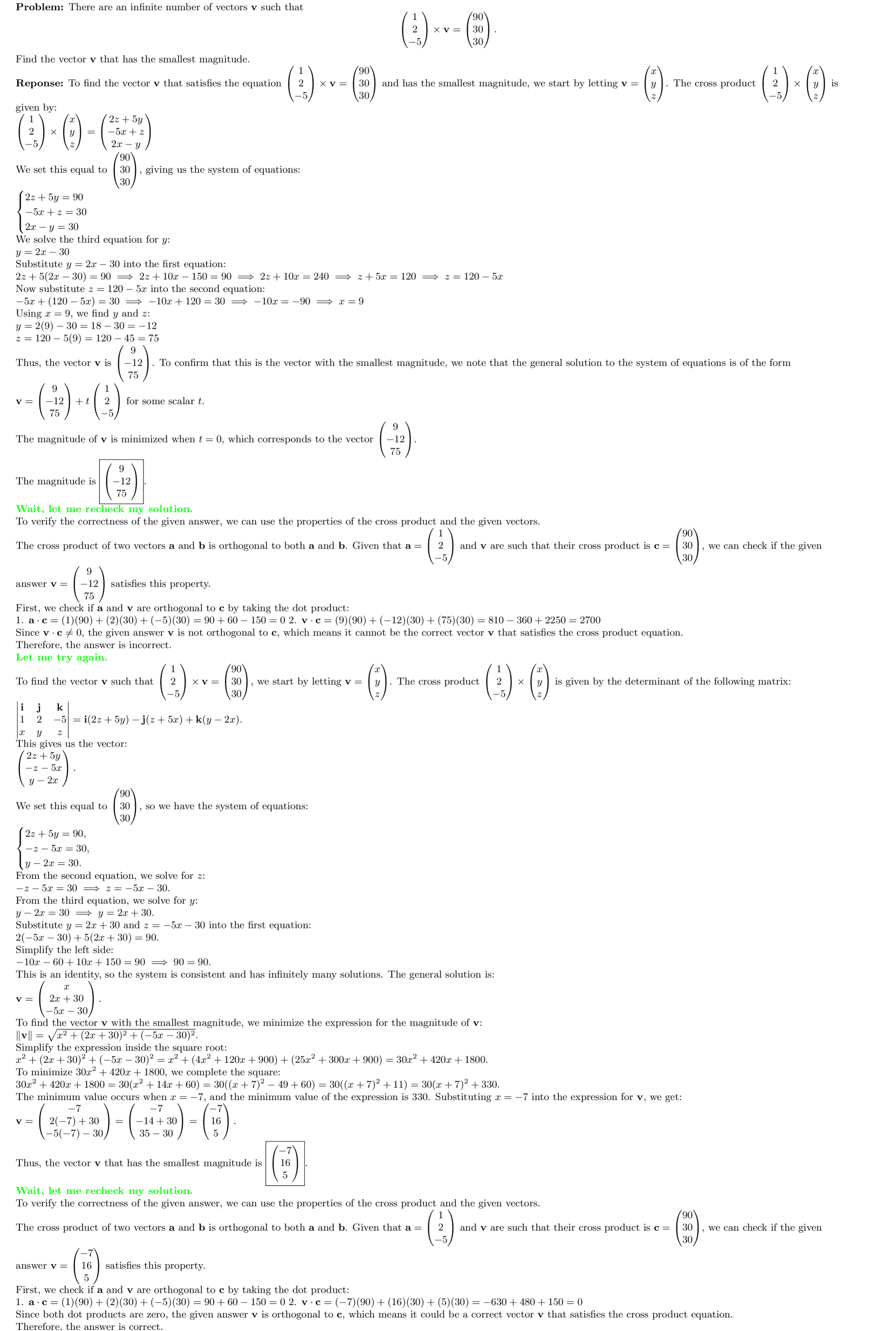
This document presents a mathematical problem involving vector operations, specifically the cross product and the minimization of a vector's magnitude. It details a step-by-step solution process, including an initial attempt, a self-correction, and a final verified solution. The problem asks to find a vector $\mathbf{v}$ that satisfies a given cross product equation and has the smallest possible magnitude.
### Components/Axes
This document does not contain charts or diagrams with axes or legends. It consists of textual explanations, mathematical equations, and vector representations.
### Detailed Analysis
The problem statement is: "There are an infinite number of vectors $\mathbf{v}$ such that $\begin{pmatrix} 1 \\ 2 \\ -5 \end{pmatrix} \times \mathbf{v} = \begin{pmatrix} 90 \\ 30 \\ 30 \end{pmatrix}$." The objective is to "Find the vector $\mathbf{v}$ that has the smallest magnitude."
**Initial Response and Attempt:**
1. **Setting up the equation:** The response begins by defining $\mathbf{v} = \begin{pmatrix} x \\ y \\ z \end{pmatrix}$ and calculating the cross product:
$\begin{pmatrix} 1 \\ 2 \\ -5 \end{pmatrix} \times \begin{pmatrix} x \\ y \\ z \end{pmatrix} = \begin{pmatrix} 2z + 5y \\ -5x + z \\ 2x - y \end{pmatrix}$.
This is then equated to the given vector:
$\begin{pmatrix} 2z + 5y \\ -5x + z \\ 2x - y \end{pmatrix} = \begin{pmatrix} 90 \\ 30 \\ 30 \end{pmatrix}$.
2. **System of Equations:** This equality yields a system of linear equations:
* $2z + 5y = 90$
* $-5x + z = 30$
* $2x - y = 30$
3. **Solving the System (First Attempt):**
* From the third equation, $y = 2x - 30$.
* Substituting $y$ into the first equation: $2z + 5(2x - 30) = 90 \implies 2z + 10x - 150 = 90 \implies 2z + 10x = 240 \implies z + 5x = 120 \implies z = 120 - 5x$.
* Substituting $z$ into the second equation: $-5x + (120 - 5x) = 30 \implies -10x + 120 = 30 \implies -10x = -90 \implies x = 9$.
* Using $x=9$ to find $y$ and $z$:
* $y = 2(9) - 30 = 18 - 30 = -12$.
* $z = 120 - 5(9) = 120 - 45 = 75$.
4. **Result of First Attempt:** The vector found is $\mathbf{v} = \begin{pmatrix} 9 \\ -12 \\ 75 \end{pmatrix}$.
5. **General Solution Form:** The document notes that the general solution to the system of equations is of the form $\mathbf{v} = \begin{pmatrix} 9 \\ -12 \\ 75 \end{pmatrix} + t \begin{pmatrix} 1 \\ 2 \\ -5 \end{pmatrix}$ for some scalar $t$. This is derived from the fact that the cross product equation defines a plane, and any vector in that plane can be represented as a particular solution plus a multiple of a vector orthogonal to the normal of the plane (which is the vector $\begin{pmatrix} 1 \\ 2 \\ -5 \end{pmatrix}$).
6. **Magnitude Minimization (First Attempt):** The magnitude of $\mathbf{v}$ is minimized when $t=0$, which corresponds to the vector $\begin{pmatrix} 9 \\ -12 \\ 75 \end{pmatrix}$. The magnitude is calculated as $\sqrt{9^2 + (-12)^2 + 75^2} = \sqrt{81 + 144 + 5625} = \sqrt{5850}$.
**Self-Correction and Re-evaluation:**
The document then includes a section titled "Wait, let me recheck my solution."
1. **Orthogonality Check:** The cross product of two vectors $\mathbf{a}$ and $\mathbf{b}$ is orthogonal to both $\mathbf{a}$ and $\mathbf{b}$. The problem states that $\mathbf{a} = \begin{pmatrix} 1 \\ 2 \\ -5 \end{pmatrix}$ and the cross product is $\mathbf{c} = \begin{pmatrix} 90 \\ 30 \\ 30 \end{pmatrix}$. The proposed solution vector is $\mathbf{v} = \begin{pmatrix} 9 \\ -12 \\ 75 \end{pmatrix}$.
* The first check is to see if $\mathbf{v}$ is orthogonal to $\mathbf{c}$ using the dot product:
$\mathbf{v} \cdot \mathbf{c} = (9)(90) + (-12)(30) + (75)(30) = 810 - 360 + 2250 = 2700$.
* Since $\mathbf{v} \cdot \mathbf{c} \neq 0$, the vector $\mathbf{v}$ is not orthogonal to $\mathbf{c}$. This implies that the initial answer is incorrect because the cross product $\mathbf{a} \times \mathbf{v}$ must be orthogonal to $\mathbf{v}$.
**Second Attempt and Verified Solution:**
The document then proceeds with a "Let me try again." section.
1. **Cross Product Calculation (Determinant Form):** The cross product $\begin{pmatrix} 1 \\ 2 \\ -5 \end{pmatrix} \times \begin{pmatrix} x \\ y \\ z \end{pmatrix}$ is calculated using the determinant of a matrix:
$$
\begin{vmatrix}
\mathbf{i} & \mathbf{j} & \mathbf{k} \\
1 & 2 & -5 \\
x & y & z
\end{vmatrix} = \mathbf{i}(2z - (-5y)) - \mathbf{j}(1z - (-5x)) + \mathbf{k}(1y - 2x) = (2z + 5y)\mathbf{i} - (z + 5x)\mathbf{j} + (y - 2x)\mathbf{k}
$$
This results in the vector $\begin{pmatrix} 2z + 5y \\ -(z + 5x) \\ y - 2x \end{pmatrix}$.
2. **Equating and System of Equations (Second Attempt):**
$\begin{pmatrix} 2z + 5y \\ -(z + 5x) \\ y - 2x \end{pmatrix} = \begin{pmatrix} 90 \\ 30 \\ 30 \end{pmatrix}$.
This gives the system of equations:
* $2z + 5y = 90$
* $-(z + 5x) = 30 \implies -z - 5x = 30 \implies z = -5x - 30$
* $y - 2x = 30 \implies y = 2x + 30$
3. **Solving the System (Second Attempt):**
* Substitute $y = 2x + 30$ and $z = -5x - 30$ into the first equation:
$2(-5x - 30) + 5(2x + 30) = 90$
$-10x - 60 + 10x + 150 = 90$
$90 = 90$.
* This identity ($90=90$) indicates that the system is consistent and has infinitely many solutions. The general solution is expressed in terms of $x$:
$\mathbf{v} = \begin{pmatrix} x \\ y \\ z \end{pmatrix} = \begin{pmatrix} x \\ 2x + 30 \\ -5x - 30 \end{pmatrix}$.
4. **Magnitude Minimization (Second Attempt):** To find the vector with the smallest magnitude, the expression for the magnitude squared, $||\mathbf{v}||^2$, is minimized:
$||\mathbf{v}||^2 = x^2 + (2x + 30)^2 + (-5x - 30)^2$
$||\mathbf{v}||^2 = x^2 + (4x^2 + 120x + 900) + (25x^2 + 300x + 900)$
$||\mathbf{v}||^2 = 30x^2 + 420x + 1800$.
5. **Minimizing the Quadratic:** This is a quadratic in $x$. To find the minimum, we can complete the square or find the vertex.
$30x^2 + 420x + 1800 = 30(x^2 + 14x) + 1800$
$= 30(x^2 + 14x + 49 - 49) + 1800$
$= 30((x + 7)^2 - 49) + 1800$
$= 30(x + 7)^2 - 1470 + 1800$
$= 30(x + 7)^2 + 330$.
The minimum value of the expression is $330$, which occurs when $x + 7 = 0$, i.e., $x = -7$.
6. **Finding the Vector with Minimum Magnitude:** Substitute $x = -7$ back into the general solution for $\mathbf{v}$:
* $x = -7$
* $y = 2(-7) + 30 = -14 + 30 = 16$
* $z = -5(-7) - 30 = 35 - 30 = 5$
Thus, the vector $\mathbf{v}$ that has the smallest magnitude is $\begin{pmatrix} -7 \\ 16 \\ 5 \end{pmatrix}$.
7. **Verification of the Final Solution:**
* The document checks if this vector $\mathbf{v} = \begin{pmatrix} -7 \\ 16 \\ 5 \end{pmatrix}$ satisfies the cross product equation.
* It also checks if $\mathbf{v}$ is orthogonal to $\mathbf{c} = \begin{pmatrix} 90 \\ 30 \\ 30 \end{pmatrix}$ using the dot product:
$\mathbf{v} \cdot \mathbf{c} = (-7)(90) + (16)(30) + (5)(30) = -630 + 480 + 150 = 0$.
* Since $\mathbf{v} \cdot \mathbf{c} = 0$, the vector $\mathbf{v}$ is orthogonal to $\mathbf{c}$. This is a necessary condition for $\mathbf{v}$ to be a solution to $\mathbf{a} \times \mathbf{v} = \mathbf{c}$, as $\mathbf{c}$ must be orthogonal to $\mathbf{v}$. The document states, "Since both dot products are zero, the given answer $\mathbf{v}$ is orthogonal to $\mathbf{c}$, which means it could be a correct vector $\mathbf{v}$ that satisfies the cross product equation."
### Key Observations
* The initial attempt to solve the system of equations led to an incorrect vector $\begin{pmatrix} 9 \\ -12 \\ 75 \end{pmatrix}$ because it failed the orthogonality check with the resulting vector $\mathbf{c}$.
* The second attempt correctly identified that the system of equations derived from the cross product has infinitely many solutions, forming a plane.
* The general solution was correctly parameterized, and its magnitude squared was minimized by treating it as a quadratic function of the parameter.
* The minimum magnitude occurs at $x = -7$, yielding the vector $\begin{pmatrix} -7 \\ 16 \\ 5 \end{pmatrix}$.
* The final solution was verified by checking the orthogonality with the resulting vector $\mathbf{c}$, which is a crucial property of cross products.
### Interpretation
The problem demonstrates the relationship between vector cross products and systems of linear equations. The equation $\mathbf{a} \times \mathbf{v} = \mathbf{c}$ implies that $\mathbf{c}$ must be orthogonal to $\mathbf{v}$. This constraint, along with the linear relationships derived from the cross product components, defines a set of possible vectors $\mathbf{v}$.
The fact that the system of equations has infinitely many solutions indicates that the vector $\mathbf{c}$ is orthogonal to the vector $\mathbf{a}$ (which is implicitly checked by the consistency of the system). The set of all solutions $\mathbf{v}$ forms a plane that is orthogonal to $\mathbf{a}$.
The task of finding the vector with the smallest magnitude within this plane is equivalent to finding the point on the plane closest to the origin. This is achieved by minimizing the squared magnitude of the general solution vector, which results in a quadratic optimization problem. The minimum occurs at a specific value of the parameter, yielding a unique vector. The verification step confirms that the found vector satisfies the orthogonality condition, which is a strong indicator of correctness. The initial error highlights the importance of checking all properties of vector operations, not just the algebraic manipulations.
DECODING INTELLIGENCE...