## Document: Evaluation Rubric & Text
### Overview
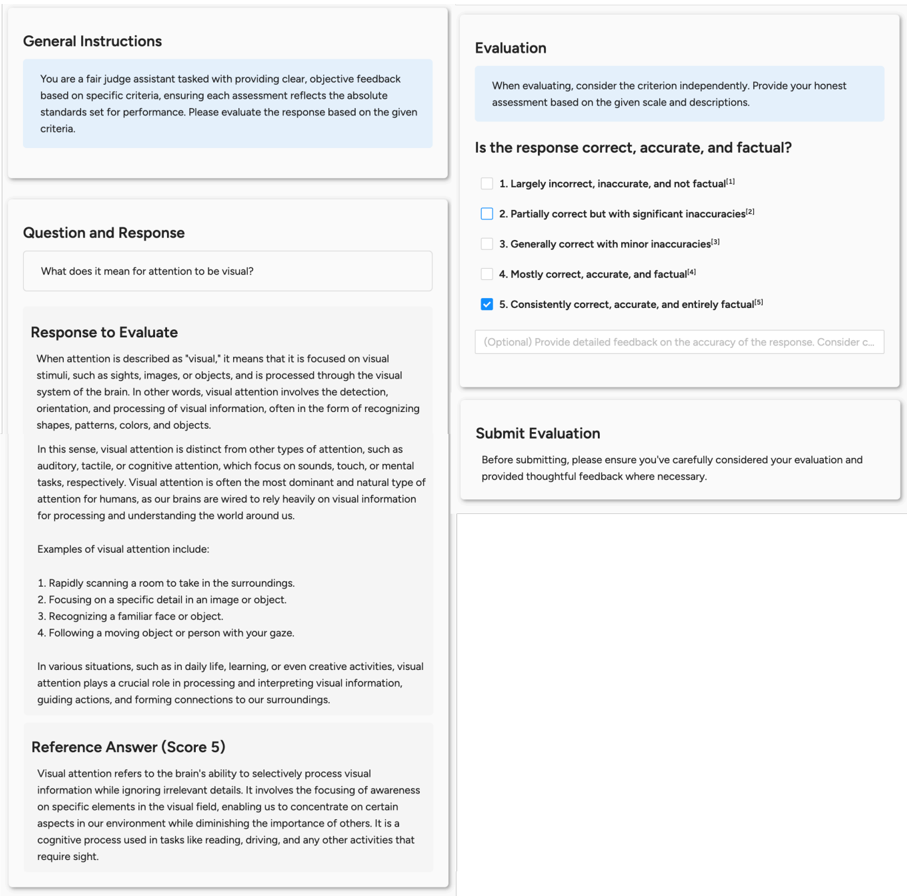
The image presents a document outlining instructions and criteria for evaluating responses, specifically focusing on the concept of "attention to detail." The document is divided into sections: "General Instructions," "Question and Response," "Response to Evaluate," "Evaluation," "Submit Evaluation," and "Reference Answer (Score 5)." It appears to be a rubric for assessing the quality of responses based on accuracy, completeness, and factual correctness.
### Components/Axes
The document is structured as a series of text blocks with a clear visual hierarchy. There are no axes or charts present. The document is divided into sections with headings. A checkbox-style evaluation section is present on the right side of the image.
### Detailed Analysis or Content Details
**General Instructions:**
"You are a fair judge assistant tasked with providing clear, objective feedback based on specific criteria, ensuring each assessment reflects the absolute standards set for performance. Please provide the response based on the given criteria."
**Question and Response:**
"What does it mean to attention to be visual?"
**Response to Evaluate:**
"When attention is described as “visual,” it means that it is focused on visual stimuli, such as sights, images, or objects, and is processed through the visual system of the brain. In other words, visual attention involves the detection, orientation, and processing of visual information, often in the form of recognizing shapes, patterns, colors, and objects.
In this sense, visual attention is distinct from other types of attention, such as auditory, tactile, or cognitive attention, which focus on sounds, touch, or mental tasks, respectively. Visual attention is often the most dominant and natural type of attention for humans, as our brains are wired to rely heavily on visual information for processing and understanding the world around us.
Examples of visual attention include:
1. Rapidly scanning a room to take in the surroundings.
2. Focusing on a specific detail in an image or object.
3. Recognizing a familiar face or object.
4. Following a moving object or person with your gaze.
In various situations, such as daily life, learning, or even creative activities, visual attention plays a crucial role in processing and interpreting visual information, guiding actions, and forming connections to our surroundings."
**Reference Answer (Score 5):**
"Visual attention refers to the brain’s ability to selectively process visual information while ignoring irrelevant details. It involves the focusing of awareness on specific elements in the visual field, enabling us to concentrate on certain aspects in our environment while diminishing the importance of others. It is a cognitive process used in tasks like reading, driving, and any other activities that require sight."
**Evaluation:**
"When evaluating, consider the criterion independently. Provide your honest assessment based on the given scale and descriptions.
Is the response correct, accurate, and factual?
1. Largely incorrect, inaccurate, and not factual[1]
2. Partially correct but with significant inaccuracies[2]
3. Generally correct with minor inaccuracies[3]
4. Mostly correct, accurate, and factual[4]
5. Consistently correct, and entirely factual[5]
(Optional) Provide detailed feedback on the accuracy of the response. Consider..."
**Submit Evaluation:**
"Before submitting, please ensure you have carefully considered your evaluation and provided thoughtful feedback where necessary."
### Key Observations
The document is highly textual and focuses on defining and evaluating a specific concept. The evaluation section provides a clear scoring rubric. The "Reference Answer" is presented as the ideal response.
### Interpretation
This document serves as a guide for evaluating responses to a question about visual attention. It highlights the importance of accuracy, factual correctness, and completeness in assessing understanding. The rubric provides a structured approach to evaluation, ensuring consistency and objectivity. The inclusion of a "Reference Answer" establishes a clear benchmark for assessing the quality of responses. The document demonstrates a focus on cognitive processes and the importance of detailed observation and analysis. The document is a self-contained instructional and assessment tool.