\n
## Diagram: LLM Sentiment Analysis Flow
### Overview
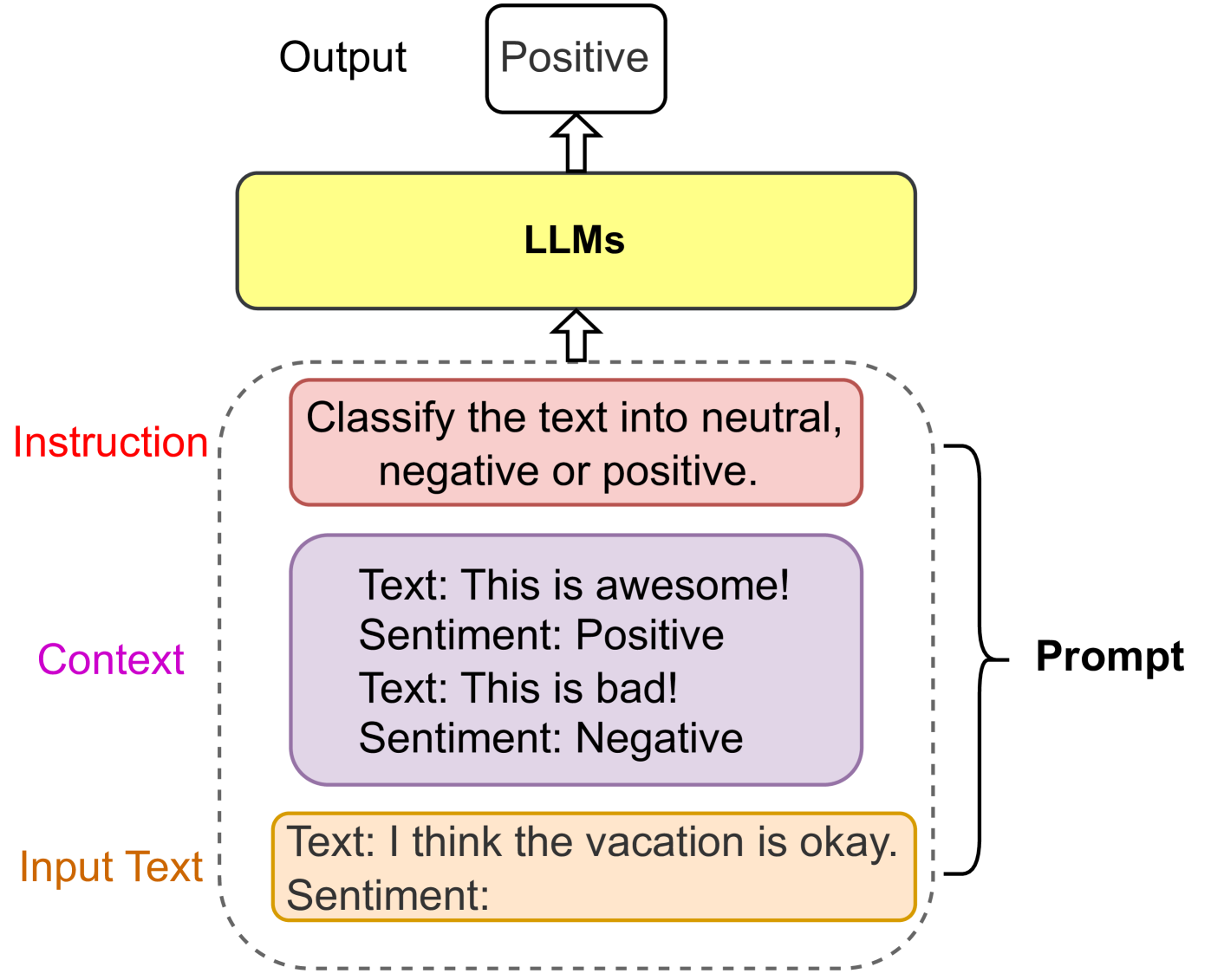
This diagram illustrates the process of sentiment analysis performed by Large Language Models (LLMs). It depicts the flow of information from input text, through instruction and context, to the LLM, and finally to the output. The diagram highlights examples of input text and their corresponding sentiment classifications.
### Components/Axes
The diagram consists of four main rectangular components stacked vertically: "Input Text", "Context", "Instruction", and "LLMs". An arrow indicates the flow of information upwards from "Input Text" to "LLMs" and then to "Output". A dashed, curved line encompasses "Input Text", "Context", and "Instruction", labeling this grouping as "Prompt".
* **Input Text:** Contains example text and a placeholder for sentiment.
* **Context:** Contains example text with sentiment classifications.
* **Instruction:** Specifies the task: "Classify the text into neutral, negative or positive."
* **LLMs:** Represents the Large Language Model itself.
* **Output:** Displays the sentiment classification "Positive".
* **Prompt:** Encompasses Input Text, Context, and Instruction.
### Detailed Analysis or Content Details
The diagram shows the following specific text and sentiment examples:
* **Input Text:** "Text: I think the vacation is okay. Sentiment:" - Sentiment is not specified.
* **Context:**
* "Text: This is awesome! Sentiment: Positive"
* "Text: This is bad! Sentiment: Negative"
* **Instruction:** "Classify the text into neutral, negative or positive."
* **Output:** "Positive"
The flow of information is indicated by a solid arrow pointing upwards from the "LLMs" block to the "Output" block. A dashed, curved arrow encompasses the "Input Text", "Context", and "Instruction" blocks, labeling them as the "Prompt".
### Key Observations
The diagram demonstrates a simple sentiment analysis pipeline. The LLM receives a prompt consisting of an instruction, context examples, and input text. Based on this prompt, the LLM generates an output, in this case, a sentiment classification of "Positive". The context provides examples of positive and negative sentiment to guide the LLM's classification. The input text is "I think the vacation is okay." which is a neutral statement.
### Interpretation
The diagram illustrates how LLMs can be used for sentiment analysis by providing them with a clear instruction and relevant context. The LLM leverages the provided examples to understand the desired classification scheme (neutral, negative, positive) and applies it to the input text. The output "Positive" suggests that the LLM, despite the neutral input text, may be biased towards positive sentiment or that the context examples heavily influence the classification. The diagram highlights the importance of prompt engineering in guiding LLM behavior. The diagram is a conceptual illustration and does not provide quantitative data or performance metrics. It serves to explain the process rather than demonstrate specific results.