## Diagram: Feature Similarity Information Flow
### Overview
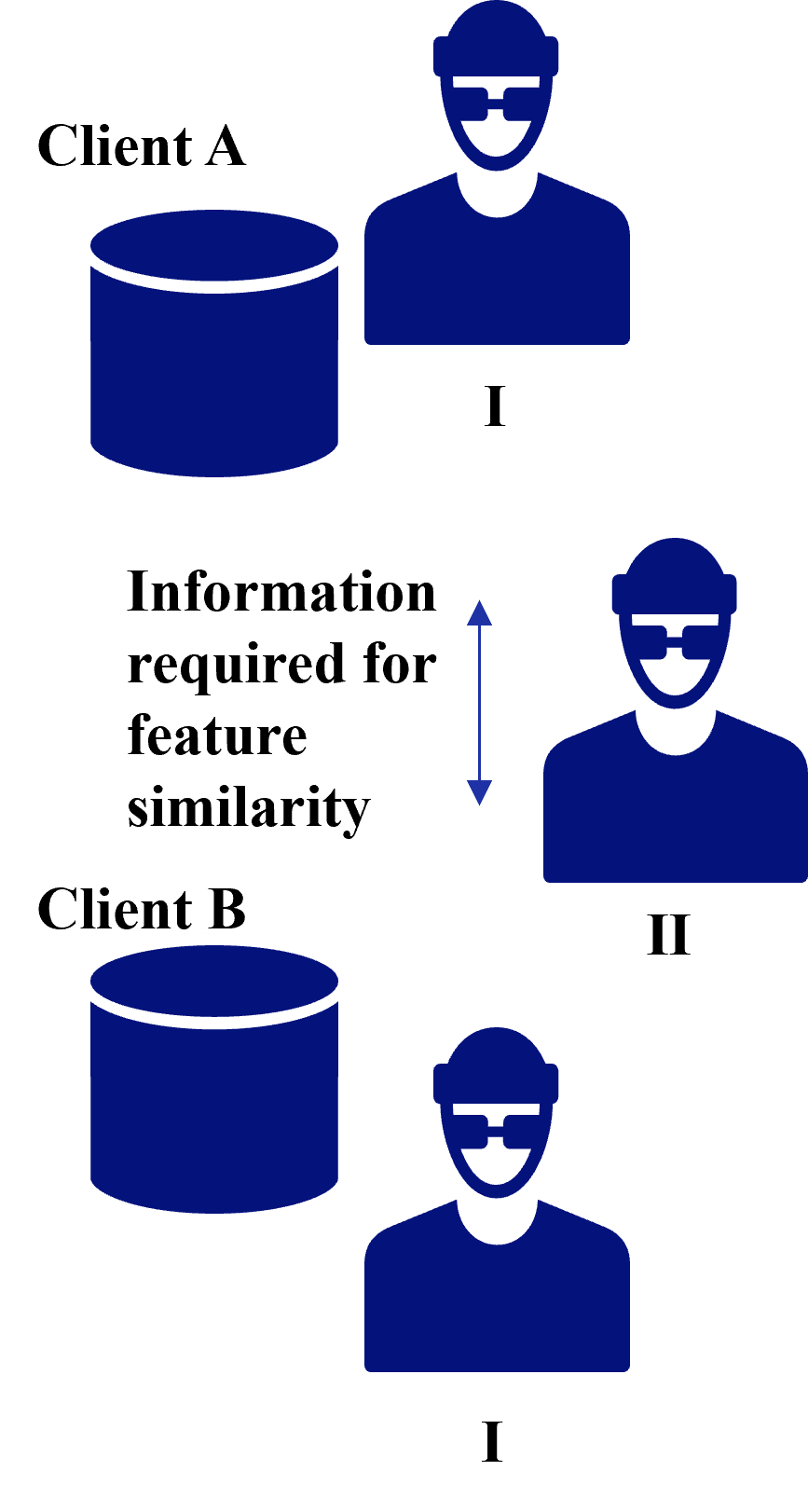
The image is a diagram illustrating the flow of information required for feature similarity between two clients, Client A and Client B. The diagram uses icons to represent clients, data stores, and a process involving information exchange.
### Components/Axes
* **Client A:** Labeled "Client A" at the top-left.
* **Client B:** Labeled "Client B" at the bottom-left.
* **Data Stores:** Two cylindrical icons, one next to each client label, representing data storage.
* **Process I:** A person icon with a hat and glasses, labeled "I" below, appears next to both Client A and Client B.
* **Process II:** A person icon with glasses, labeled "II" below, is positioned between Client A and Client B.
* **Information Flow:** A double-headed arrow pointing upwards and downwards, located between Client A and Client B, accompanied by the text "Information required for feature similarity".
### Detailed Analysis
* **Client A:**
* Data Store: A blue cylinder with a white outline.
* Process I: A blue person icon with a hat and glasses, labeled "I".
* **Client B:**
* Data Store: A blue cylinder with a white outline.
* Process I: A blue person icon with a hat and glasses, labeled "I".
* **Information Flow:**
* The text "Information required for feature similarity" is centered vertically between Client A and Client B.
* A blue double-headed arrow points upwards towards Client A and downwards towards Client B.
* **Process II:**
* A blue person icon with glasses, labeled "II", is positioned between the information flow arrow and the two Process I icons.
### Key Observations
* The diagram suggests a two-step process involving Process I and Process II.
* Information flows between Client A and Client B, facilitated by Process II.
* Both clients have their own data stores and instances of Process I.
### Interpretation
The diagram illustrates a system where feature similarity is determined by exchanging information between two clients. Each client has a data store and an initial processing step (Process I). The information required for feature similarity is then exchanged, potentially involving a second processing step (Process II), to determine the similarity between the clients' features. The diagram implies that Process II requires information from both Client A and Client B to perform its function. The presence of Process I at both clients suggests a pre-processing or data preparation step before the information is exchanged.