## Diagram: Client Interaction for Feature Similarity
### Overview
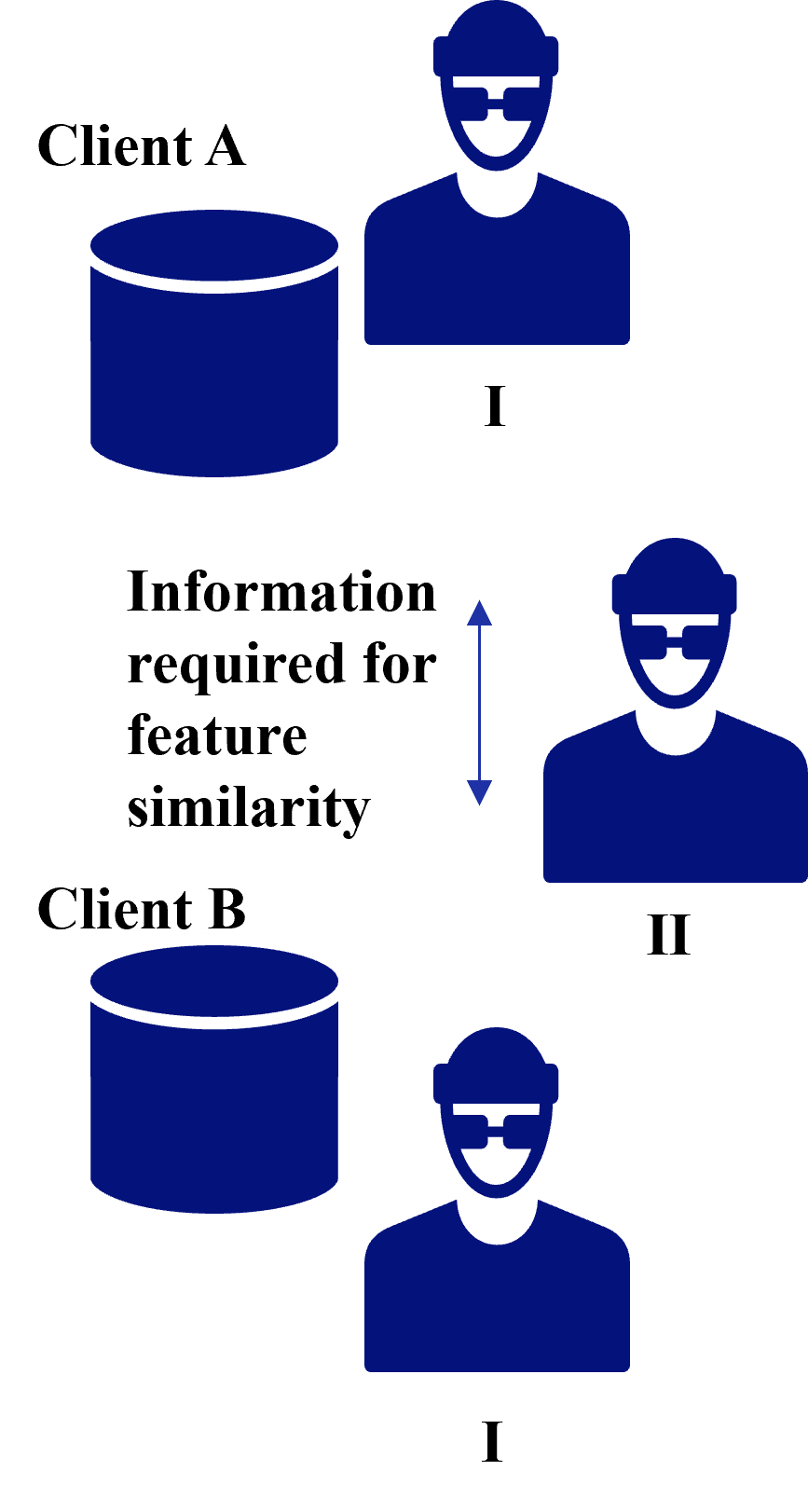
The diagram illustrates a two-way information exchange process between two entities labeled "Client A" and "Client B." Each client is represented by a blue cylindrical shape with a white outline, positioned adjacent to a stylized human figure wearing a blue helmet and visor. The figures are labeled "I" (Client A) and "II" (Client B), connected by a bidirectional arrow labeled "Information required for feature similarity."
### Components/Axes
- **Left Side (Client A)**:
- Blue cylinder labeled "Client A"
- Human figure labeled "I" wearing blue helmet/visor
- **Right Side (Client B)**:
- Blue cylinder labeled "Client B"
- Human figure labeled "II" wearing blue helmet/visor
- **Connecting Element**:
- Bidirectional blue arrow between figures I and II
- Arrow text: "Information required for feature similarity"
### Detailed Analysis
- **Client Representation**: Both clients use identical visual metaphors (blue cylinders with white outlines), suggesting standardized or comparable systems.
- **Human Figures**: The helmet/visor design implies technical or security roles, possibly data analysts or system operators.
- **Bidirectional Flow**: The arrow indicates mutual dependency in feature similarity assessment between the two clients.
### Key Observations
1. Symmetrical design emphasizes equal participation between Client A and Client B.
2. No numerical data or quantitative metrics are present in the diagram.
3. The use of "I" and "II" suggests sequential or hierarchical roles, though the bidirectional arrow contradicts strict hierarchy.
### Interpretation
This diagram represents a collaborative framework where two clients must exchange information to achieve feature similarity. The identical visual treatment of both clients implies they operate under the same technical constraints or standards. The human figures with protective gear suggest the process requires specialized expertise, possibly in data science or cybersecurity. The bidirectional arrow highlights that feature similarity is not a one-way process but requires continuous mutual validation. The absence of quantitative data points suggests this is a conceptual model rather than a measurement tool, focusing on process flow rather than performance metrics.