\n
## Diagram: Python Package Directory Structure
### Overview
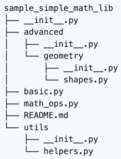
The image depicts a visual representation of a Python package directory structure, likely generated by a tree-like command-line utility. It shows the hierarchy of files and subdirectories within a package named `sample_simple_math_lib`. The structure is presented using lines and characters to indicate branching and file/directory names.
### Components/Axes
The diagram doesn't have traditional axes. It's a hierarchical tree structure. The root directory is `sample_simple_math_lib`. The structure is visually organized with indentation to represent nested directories.
### Detailed Analysis or Content Details
The directory structure is as follows:
* `sample_simple_math_lib`
* `__init__.py`
* `advanced`
* `__init__.py`
* `geometry`
* `__init__.py`
* `shapes.py`
* `basic.py`
* `math_ops.py`
* `README.md`
* `utils`
* `__init__.py`
* `helpers.py`
Each line represents a file or directory. The `+` and `L` characters are used to visually indicate branching in the tree structure. The files ending in `.py` are Python source code files. `README.md` is a Markdown file, likely containing documentation. `__init__.py` files are used to mark directories as Python packages.
### Key Observations
The package is organized into several submodules: `advanced`, `utils`, and individual files for basic operations (`basic.py`, `math_ops.py`). The `advanced` module further contains a `geometry` submodule. The presence of `__init__.py` files in each directory indicates that these directories are intended to be treated as Python packages or subpackages.
### Interpretation
This directory structure suggests a Python library designed for mathematical operations. The `basic` and `math_ops` files likely contain fundamental mathematical functions. The `advanced` module, with its `geometry` submodule, suggests more specialized mathematical capabilities. The `utils` module likely contains helper functions used throughout the library. The `README.md` file would provide documentation on how to use the library. The structure is well-organized, following common Python packaging conventions. This structure promotes modularity and reusability of the code.