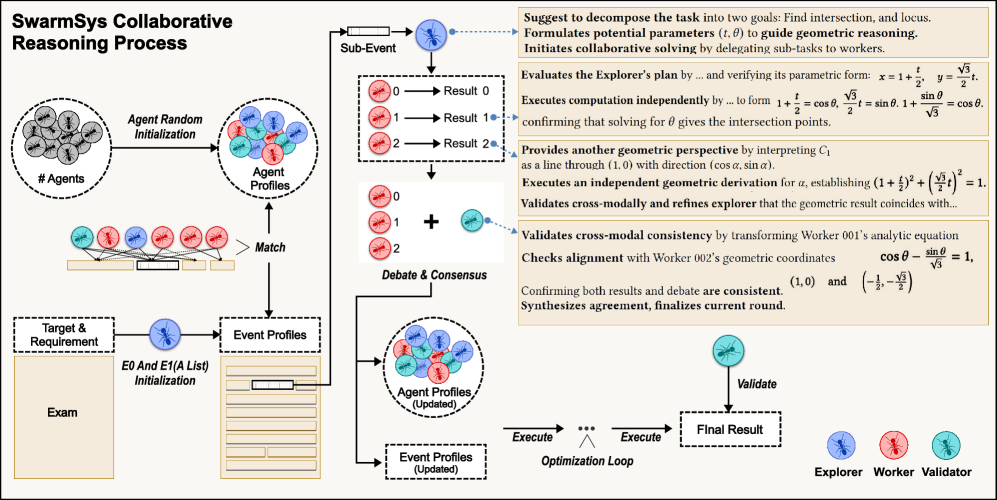
## Diagram: SwarmSys Collaborative Reasoning Process
### Overview
The diagram illustrates a multi-stage collaborative reasoning workflow involving agents with distinct roles (Explorer, Worker, Validator) to solve tasks through geometric reasoning, validation, and iterative optimization. The process emphasizes cross-modal consistency and geometric parameter validation.
### Components/Axes
1. **Left Panel (Agent Initialization & Matching)**:
- **Agent Random Initialization**: Circular cluster of agents (color-coded: blue=Explorer, red=Worker, green=Validator) with "# Agents" label.
- **Agent Profiles**: Updated profiles after initialization.
- **Match**: Connection between initialized agents and target requirements (Exam, E0, E1).
- **Event Profiles**: Tabular structure for event data.
2. **Right Panel (Collaborative Workflow)**:
- **Sub-Event**: Three possible results (0, 1, 2) with geometric reasoning steps.
- **Debate & Consensus**: Validation of geometric results using equations (e.g., `cos θ = sin θ = 1`).
- **Optimization Loop**: Iterative refinement of results.
- **Final Result**: Output after validation.
3. **Legend (Bottom Right)**:
- **Colors**:
- Blue = Explorer (geometric reasoning)
- Red = Worker (computation)
- Green = Validator (cross-modal checks)
### Detailed Analysis
1. **Agent Initialization**:
- Agents are randomly initialized with profiles, then matched to target requirements (Exam, E0, E1).
- Event Profiles are updated post-initialization.
2. **Sub-Event Processing**:
- Tasks are decomposed into goals (intersection, locus) with geometric parameters (`t`, `θ`).
- Results (0, 1, 2) are evaluated using equations like `x = 1 + t/2`, `y = √3/2 * t`.
3. **Debate & Consensus**:
- Geometric results are validated via cross-modal checks (e.g., Worker 001’s analytic equation vs. Worker 002’s coordinates).
- Consistency confirmed through equations like `(1 + ½)² + (√3/2 * t)² = 1`.
4. **Optimization Loop**:
- Iterative refinement of results based on validation outcomes.
### Key Observations
- **Role Specialization**: Each agent type (Explorer, Worker, Validator) has distinct responsibilities, ensuring multi-perspective problem-solving.
- **Geometric Focus**: The process relies heavily on geometric reasoning (e.g., lines, angles, cross-modality checks).
- **Iterative Validation**: Results are repeatedly validated and refined, emphasizing robustness.
### Interpretation
The diagram represents a decentralized, agent-based system where collaborative reasoning is structured around geometric problem-solving. The roles (Explorer, Worker, Validator) create a checks-and-balances mechanism:
- **Explorers** propose geometric hypotheses.
- **Workers** compute intermediate results.
- **Validators** ensure consistency across modalities (analytic vs. geometric).
The iterative optimization loop suggests a focus on minimizing errors through repeated validation. The use of geometric parameters (e.g., `θ`, `t`) implies tasks involving spatial reasoning (e.g., intersections, loci). The absence of numerical data in the diagram emphasizes the process over specific outcomes, highlighting adaptability to varying tasks.