\n
## Diagram: Network Graph with Highlighted Path
### Overview
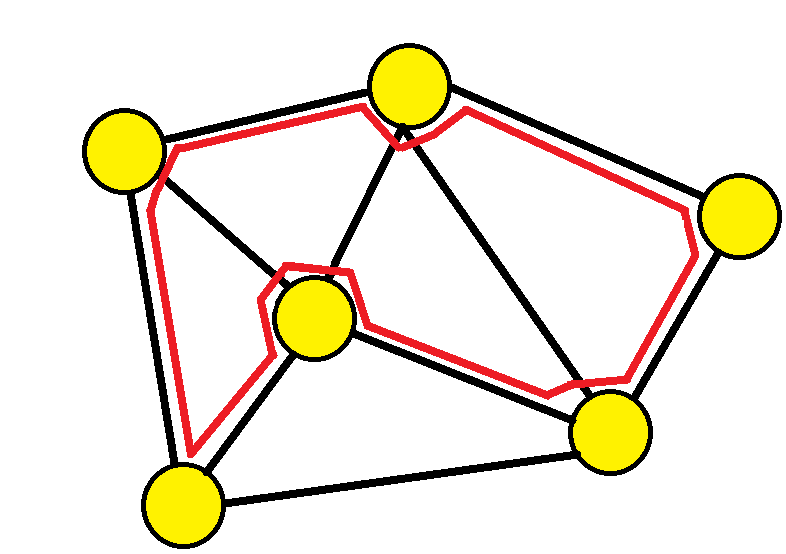
The image displays a simple undirected graph diagram consisting of six nodes (vertices) connected by edges (lines). A specific path through the graph is highlighted in red. There is no textual information, labels, titles, or legends present in the image.
### Components/Axes
* **Nodes:** Six identical, solid yellow circles with black outlines. They are arranged in a roughly hexagonal pattern with one node positioned centrally.
* **Edges:** Straight black lines connecting the nodes, representing the graph's structure. The graph is fully connected in a mesh-like topology.
* **Highlighted Path:** A thick, continuous red line that traces a specific route through the graph, overlaying some of the black edges.
### Detailed Analysis
**Graph Structure:**
The six nodes are positioned as follows (using approximate clock-face positions for reference):
1. Top-Left
2. Top-Center
3. Top-Right
4. Center
5. Bottom-Left
6. Bottom-Right
The black edges connect the nodes to form a network. The central node is connected to all five outer nodes. The outer nodes are also connected to their immediate neighbors, forming a perimeter.
**Highlighted Red Path:**
The red line traces a continuous path through the graph. Its route is as follows:
1. Starts at the **Top-Left** node.
2. Travels along the edge to the **Center** node.
3. From the Center node, it travels to the **Bottom-Right** node.
4. From the Bottom-Right node, it travels to the **Top-Right** node.
5. From the Top-Right node, it travels to the **Top-Center** node.
6. From the Top-Center node, it travels back to the **Center** node.
7. Finally, from the Center node, it travels to the **Bottom-Left** node, where the path ends.
This creates a path that visits five of the six nodes (all except the Top-Left node is visited only at the start, and the path does not return to it). The path revisits the central node twice.
### Key Observations
* The diagram is purely structural and contains no quantitative data, labels, or annotations.
* The red path is the only element that provides a specific narrative or sequence to the graph.
* The graph is planar (can be drawn without edges crossing), and the red path does not cross any edges it is not traveling along.
* The central node acts as a hub, being part of the red path three times (start, middle, and end segments).
### Interpretation
This diagram is an abstract representation of a network or a set of relationships. The yellow nodes could represent entities (e.g., computers, cities, people, states), and the black edges represent connections or relationships between them.
The red line highlights a specific **traversal, circuit, or route** through this network. Given that it starts and ends at different nodes and revisits the central hub, it could illustrate:
* A data packet's journey in a computer network.
* A logistics or travel route.
* A sequence of steps in a process or algorithm (like a depth-first search path).
* A critical path or a highlighted connection sequence in a system.
The absence of labels means the specific context is unknown. However, the visual structure clearly communicates the concept of a connected system and a defined path within it. The central node's importance is emphasized by its multiple connections and its role as a junction in the highlighted route.