\n
## Diagram: Cognition Bench - RyynEC
### Overview
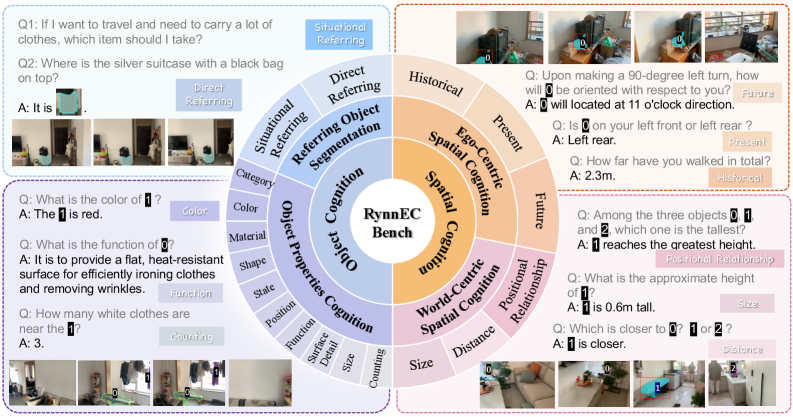
The image depicts a circular diagram titled "Cognition Bench - RyynEC". The diagram is segmented into various cognitive abilities, arranged radially around a central point. Each segment is associated with a question, an image, and an answer, demonstrating how the cognitive ability is applied in a real-world scenario. The diagram is surrounded by questions and answers related to visual reasoning and spatial understanding.
### Components/Axes
The diagram is structured as a circular wheel divided into segments representing different cognitive abilities. These segments include:
* **Direct Referring**
* **Situational Referring**
* **Referring Object Segmentation**
* **Historical Spatial Cognition**
* **Ego-Centric Spatial Cognition**
* **Spatial Cognition**
* **World-Centric Spatial Cognition**
* **Positional Relationship**
* **Object Properties Cognition**
* **Category**
* **Color**
* **Material**
* **Shape**
* **State**
* **Position**
* **Function**
* **Surface Detail**
* **Size**
* **Counting**
Each segment is associated with a question, an image, and an answer. The questions are positioned around the outer edge of the diagram, and the answers are placed near the corresponding questions. The images are located within the segments.
### Detailed Analysis or Content Details
Let's analyze the questions and answers surrounding the diagram:
1. **Q1:** If I want to travel and need to carry a lot of clothes, which item should I take?
* **Image:** A person holding a suitcase.
* **A1:** It is a suitcase.
2. **Q2:** Where is the silver suitcase with a black bag on top?
* **Image:** A scene with a silver suitcase and a black bag.
* **A:** It is.
3. **Q3:** What is the color of ❓?
* **Image:** A red object.
* **A:** The ❓ is red.
4. **Q4:** What is the function of ❓?
* **Image:** An ironing board.
* **A:** It is to provide a flat, heat-resistant surface for efficiently ironing clothes and removing wrinkles.
5. **Q5:** How many white clothes are near ❓?
* **Image:** A scene with clothes.
* **A:** 3.
6. **Q6:** Upon making a 90-degree left turn, how will ❓ be oriented with respect to you? ❓ will located at 11 o'clock direction.
* **Image:** A person walking.
* **A:** Is.
7. **Q7:** Is ❓ on your left front or left rear?
* **Image:** A person walking.
* **A:** Left rear.
8. **Q8:** How far have you walked in total?
* **Image:** A person walking.
* **A:** 2.3m.
9. **Q9:** Among the three objects ❓ ❓ and ❓ which one is the tallest?
* **Image:** Three objects of varying heights.
* **A:** Reaches the greatest height.
10. **Q10:** What is the approximate height of ❓?
* **Image:** An object.
* **A:** It is 0.6m tall.
11. **Q11:** Which is closer to ❓ ❓ or ❓?
* **Image:** Three objects.
* **A:** Is closer.
The central circle reads "Cognition Bench" and "RyynEC". The segments are color-coded, with shades of orange, yellow, and green.
### Key Observations
The diagram demonstrates a range of cognitive abilities, from basic object recognition (color, shape) to more complex spatial reasoning (historical, ego-centric, world-centric). The questions and answers are designed to test the ability to apply these cognitive skills in practical scenarios. The use of images alongside the questions and answers suggests a focus on visual reasoning. The questions are diverse, covering object properties, spatial relationships, and historical context.
### Interpretation
The "Cognition Bench - RyynEC" diagram appears to be a framework for evaluating and understanding different aspects of human cognition, particularly those related to visual perception and spatial reasoning. The arrangement of cognitive abilities in a circular format suggests that these abilities are interconnected and work together to enable intelligent behavior. The questions and answers serve as examples of how these abilities are used in everyday life. The diagram could be used as a tool for assessing cognitive function, developing AI systems, or simply for gaining a deeper understanding of how the human mind works. The use of question marks (❓) in several questions suggests a need for visual input to answer the questions, emphasizing the importance of visual information in these cognitive processes. The diagram highlights the importance of both static object properties (color, shape) and dynamic spatial relationships (position, distance) in cognitive processing. The inclusion of "Historical Spatial Cognition" suggests an ability to recall and reason about past spatial experiences.