## Diagram: Robot Interaction Flowchart
### Overview
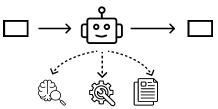
The image depicts a simplified flowchart featuring a central robot figure with bidirectional arrows and directional indicators. The diagram uses geometric shapes and dashed lines to represent relationships and processes. No textual labels, numerical data, or legends are present.
### Components/Axes
- **Central Robot**:
- Square body with rounded edges.
- Circular head with two dot-like eyes and a curved smile.
- Single antenna atop the head.
- **Arrows**:
- Two horizontal dashed arrows extending left and right from the robot’s body.
- Three vertical dashed arrows below the robot: left, down, and right.
- **Background**: Plain white with no gridlines or annotations.
### Detailed Analysis
- **Robot Positioning**: Centered in the diagram, acting as the focal point.
- **Arrow Flow**:
- Horizontal arrows suggest bidirectional interaction or output.
- Vertical arrows below the robot imply directional choices or states (left, neutral, right).
- **Visual Style**: Minimalist, using black outlines on a white background.
### Key Observations
- No textual labels or numerical values are present.
- The robot’s smiley face may imply a user-friendly or autonomous system.
- Dashed arrows suggest non-permanent or conditional pathways.
### Interpretation
This diagram likely represents a decision-making or process flow for an autonomous system (e.g., a robot navigating choices). The central robot could symbolize a core algorithm or AI module, with arrows indicating input/output streams or state transitions. The absence of labels leaves the exact purpose ambiguous, but the structure resembles a state machine or interaction model. The vertical arrows below the robot might represent conditional logic (e.g., "turn left," "stop," "turn right"), while the horizontal arrows could denote data exchange or task delegation.
**Note**: The diagram lacks explicit textual or numerical data, so interpretations are speculative based on visual symbolism.