TECHNICAL ASSET FINGERPRINT
9569ce6b1845199fca69d6d0
Click to view fullscreen
Press ESC or click to close
FOUND IN PAPERS
EXPERT: healer-alpha-free VERSION 1
RUNTIME: free/openrouter/healer-alpha
INTEL_VERIFIED
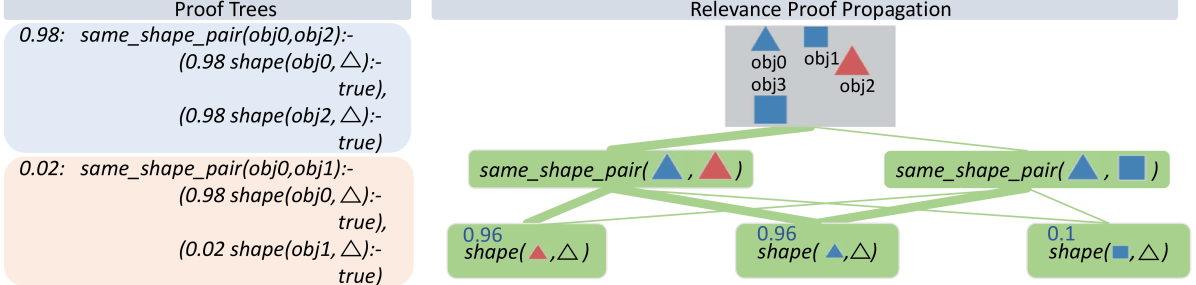
## Diagram: Proof Trees and Relevance Proof Propagation
### Overview
The image is a technical diagram illustrating a logical reasoning process. It is divided into two main panels: "Proof Trees" on the left and "Relevance Proof Propagation" on the right. The diagram visualizes how confidence scores (probabilities) are assigned to logical statements about object shapes and how these proofs propagate through a network to establish relationships between objects.
### Components/Axes
The diagram has no traditional chart axes. Its components are:
**Left Panel: Proof Trees**
* **Title:** "Proof Trees" (centered at the top of the left panel).
* **Content:** Two distinct proof trees, each presented in a colored box.
* **Top Box (Light Blue):** Contains a logical proof with a confidence score of `0.98`.
* **Bottom Box (Light Orange):** Contains a logical proof with a confidence score of `0.02`.
**Right Panel: Relevance Proof Propagation**
* **Title:** "Relevance Proof Propagation" (centered at the top of the right panel).
* **Object Legend (Top Center):** A grey box containing four labeled objects with associated shapes and colors:
* `obj0`: Blue triangle (▲)
* `obj1`: Blue square (■)
* `obj2`: Red triangle (▲)
* `obj3`: Blue square (■)
* **Propagation Network:** A hierarchical network of green nodes connected by green lines, showing the flow of logical inference.
* **Top Layer Nodes:** Two nodes representing `same_shape_pair` relationships.
* **Bottom Layer Nodes:** Three nodes representing `shape` properties of individual objects.
### Detailed Analysis
**1. Proof Trees (Left Panel)**
* **Proof 1 (Confidence: 0.98):**
* **Statement:** `same_shape_pair(obj0, obj2)`
* **Derivation:** This is proven by two sub-statements, both with confidence `0.98`:
* `shape(obj0, △)` is `true`.
* `shape(obj2, △)` is `true`.
* **Interpretation:** There is a 98% confidence that `obj0` and `obj2` are a pair of the same shape because both are confidently identified as triangles.
* **Proof 2 (Confidence: 0.02):**
* **Statement:** `same_shape_pair(obj0, obj1)`
* **Derivation:** This is derived from two sub-statements with conflicting confidences:
* `shape(obj0, △)` is `true` (confidence: `0.98`).
* `shape(obj1, △)` is `true` (confidence: `0.02`).
* **Interpretation:** There is only a 2% confidence that `obj0` and `obj1` are a same-shape pair. This low confidence stems from the very low confidence (`0.02`) that `obj1` is a triangle, which contradicts the visual legend showing `obj1` as a square.
**2. Relevance Proof Propagation (Right Panel)**
* **Object Legend:** Establishes the ground truth for the example:
* `obj0` = Blue Triangle
* `obj1` = Blue Square
* `obj2` = Red Triangle
* `obj3` = Blue Square
* **Propagation Network Nodes & Values:**
* **Top-Left Node:** `same_shape_pair(▲, ▲)` (Blue Triangle, Red Triangle). This corresponds to the pair (`obj0`, `obj2`).
* **Top-Right Node:** `same_shape_pair(▲, ■)` (Blue Triangle, Blue Square). This corresponds to the pair (`obj0`, `obj1`) or (`obj0`, `obj3`).
* **Bottom-Left Node:** `shape(▲, △)` with confidence `0.96`. This represents the property that a red triangle is a triangle.
* **Bottom-Center Node:** `shape(▲, △)` with confidence `0.96`. This represents the property that a blue triangle is a triangle.
* **Bottom-Right Node:** `shape(■, △)` with confidence `0.1`. This represents the (low confidence) property that a blue square is a triangle.
* **Flow and Connections:**
* The `same_shape_pair(▲, ▲)` node is connected to the two `shape(▲, △)` nodes (both confidence `0.96`). This visually represents the proof logic from the left panel: the high-confidence pair relationship is supported by high-confidence individual shape properties.
* The `same_shape_pair(▲, ■)` node is connected to one `shape(▲, △)` node (confidence `0.96`) and the `shape(■, △)` node (confidence `0.1`). This represents the low-confidence pair relationship being supported by one high-confidence and one low-confidence shape property.
### Key Observations
1. **Confidence Alignment:** The confidence scores in the Proof Trees (`0.98`, `0.02`) are closely mirrored by the propagated scores in the network (`0.96`, `0.1`). The minor discrepancy (0.98 vs 0.96) may be due to rounding or a slightly different calculation in the propagation step.
2. **Visual-Logical Consistency:** The diagram highlights a conflict. The object legend clearly shows `obj1` is a square, yet the low-confidence proof (`0.02`) attempts to assert it is a triangle. The propagation network correctly assigns a low confidence (`0.1`) to the statement `shape(■, △)`.
3. **Spatial Grounding:** The legend is positioned at the top-center of the right panel, providing the key to interpreting all shape symbols and colors in the network below. The proof trees are isolated on the left, providing the formal logical statements that the right panel visualizes.
4. **Color Coding:** Colors are used consistently: blue and red for object triangles, blue for squares, green for the propagation network, and distinct background colors (blue/orange) to separate high and low-confidence proofs.
### Interpretation
This diagram demonstrates a **probabilistic logical reasoning system**. It shows how a system can:
* **Generate Hypotheses:** Formulate logical statements (proofs) about relationships (`same_shape_pair`) based on object properties (`shape`).
* **Assign Confidence:** Attach numerical confidence scores to these statements, reflecting uncertainty in perception or reasoning.
* **Propagate Relevance:** Visualize how the confidence in a high-level relationship (like "these two objects have the same shape") is fundamentally dependent on and derived from the confidence in the lower-level properties of the individual objects involved.
The core message is that the strength of a logical conclusion is only as strong as its weakest premise. The high-confidence conclusion that `obj0` and `obj2` are both triangles is robust. In contrast, the attempt to conclude `obj0` and `obj1` are the same shape fails because the premise that `obj1` is a triangle has very low confidence, correctly reflecting the visual evidence that `obj1` is a square. This type of reasoning is crucial in fields like artificial intelligence, computer vision, and knowledge graphs, where systems must handle uncertainty and infer relationships from imperfect data.
DECODING INTELLIGENCE...