## Textual Document: Comparison of Waking State and Dream State
### Overview
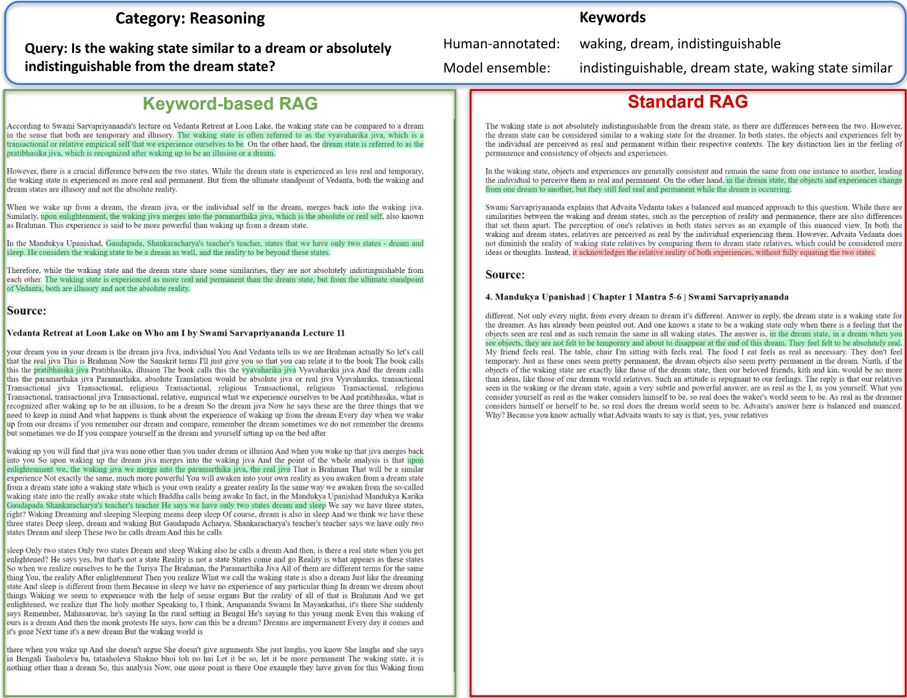
The image presents a comparative analysis of the waking state and the dream state, framed around the philosophical question of whether the waking state is similar to a dream or absolutely indistinguishable from it. The document is structured into two columns: "Keyword-based RAG" on the left and "Standard RAG" on the right. Both columns contain textual responses to the query, along with associated keywords and a similarity score. A bar chart at the bottom visually represents the similarity scores for different models.
### Components/Axes
The document consists of the following components:
* **Header:** "Category: Reasoning" and the query "Is the waking state similar to a dream or absolutely indistinguishable from the dream state?"
* **Left Column (Keyword-based RAG):** Contains a textual response, keywords, and a similarity score.
* **Right Column (Standard RAG):** Contains a textual response, keywords, and a similarity score.
* **Footer (Bar Chart):** A bar chart displaying similarity scores for various models.
* **X-axis:** Model names (Human-annotated, Model ensemble, Keyword-based RAG, Standard RAG).
* **Y-axis:** Similarity Score (ranging from 0 to 1).
### Detailed Analysis or Content Details
**Left Column (Keyword-based RAG):**
* **Text:** A detailed philosophical discussion referencing Swami Sarvupananda's lecture on Vedanta Retreat at Loon Lake. It discusses the illusory nature of both waking and dream states, referencing concepts like *maya*, *jiva*, and *Brahman*. It highlights the difference between the two states as being one of permanence and consistency.
* **Keywords:** waking, dream, indistinguishable
* **Similarity Score:** 0.863
**Right Column (Standard RAG):**
* **Text:** A response also discussing the indistinguishability of waking and dream states, referencing Swami Sarvupananda. It emphasizes the subjective experience and the consistency of objects and experiences within each state. It also touches upon the perception of reality and the role of the individual's mind.
* **Keywords:** waking, dream, state similar
* **Similarity Score:** 0.854
**Bar Chart:**
The bar chart displays the following approximate similarity scores:
* **Human-annotated:** 0.94 (highest score, light blue bar)
* **Model ensemble:** 0.88 (dark blue bar)
* **Keyword-based RAG:** 0.86 (green bar)
* **Standard RAG:** 0.85 (orange bar, lowest score)
The bars are arranged horizontally, with "Human-annotated" on the left and "Standard RAG" on the right. The Y-axis is labeled "Similarity Score" and ranges from 0 to 1.
### Key Observations
* The "Human-annotated" response has the highest similarity score, indicating it is the closest to a ground truth or ideal response.
* Both RAG models (Keyword-based and Standard) provide similar responses, with the Keyword-based RAG slightly outperforming the Standard RAG.
* The similarity scores are all relatively high (above 0.85), suggesting both models are capable of generating relevant and coherent responses.
* The textual content in both columns is largely overlapping, focusing on the philosophical concepts of illusion and reality in the context of waking and dream states.
### Interpretation
The document demonstrates a comparison of two different Retrieval-Augmented Generation (RAG) approaches in answering a complex philosophical question. The results suggest that both methods are effective in retrieving and synthesizing information to provide relevant responses. The higher score of the "Human-annotated" response serves as a benchmark for evaluating the performance of the models. The slight advantage of the "Keyword-based RAG" model could be attributed to its ability to focus on specific keywords related to the query, potentially leading to a more targeted and accurate response.
The consistent themes across both RAG responses – the illusory nature of reality, the subjective experience of consciousness, and the role of perception – highlight the core philosophical concepts at play. The bar chart provides a quantitative measure of the similarity between the model responses and the human-annotated response, offering insights into the effectiveness of each approach. The data suggests that while RAG models can generate insightful responses, they still fall short of the nuanced understanding and coherence of a human expert. The document is a clear example of how AI can be used to explore and analyze complex philosophical questions, but also underscores the importance of human oversight and evaluation.