## Comparison Table: AI Agent Reasoning Processes
### Overview
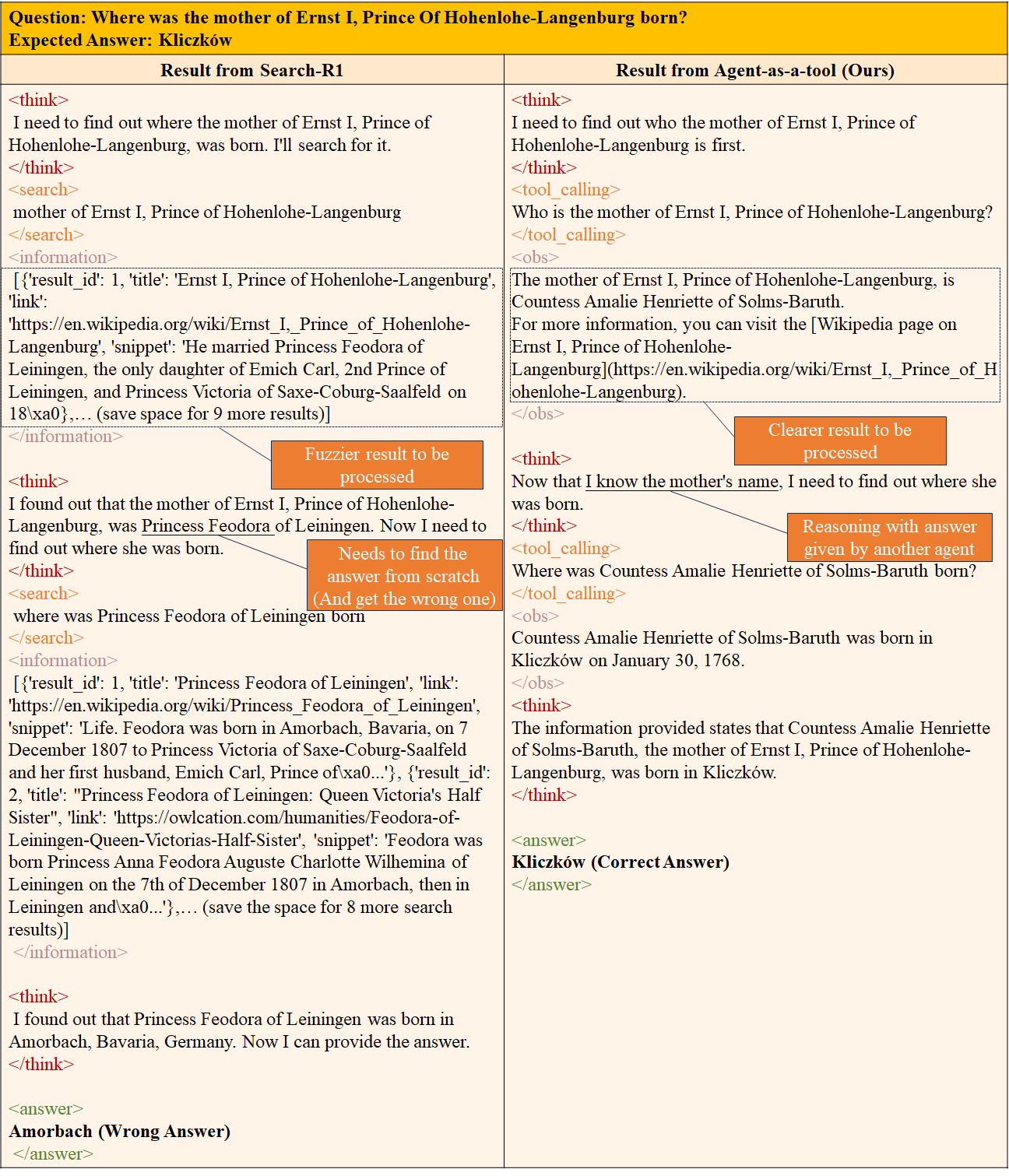
The image displays a comparative analysis of two different AI agent reasoning workflows attempting to answer the historical question: "Where was the mother of Ernst I, Prince Of Hohenlohe-Langenburg born?" The table contrasts a "Search-R1" agent (left column), which fails due to an incorrect entity identification, against an "Agent-as-a-tool" agent (right column), which succeeds by decomposing the problem into distinct, verifiable steps.
### Components/Axes
* **Header:** Contains the primary question and the expected answer ("Kliczków").
* **Table Structure:** A two-column layout.
* **Left Column:** "Result from Search-R1" (The failing process).
* **Right Column:** "Result from Agent-as-a-tool (Ours)" (The successful process).
* **Annotations:** Three orange text boxes with arrows pointing to specific sections of the reasoning process, providing meta-commentary on the agent's performance.
### Detailed Analysis
#### Left Column: Result from Search-R1 (Failure)
* **Initial Step:** The agent searches for "mother of Ernst I, Prince of Hohenlohe-Langenburg".
* **Information Retrieval:** The search returns a snippet about Ernst I marrying Princess Feodora of Leiningen.
* **Annotation:** An orange box labeled "Fuzzier result to be processed" points to the search result.
* **Reasoning Error:** The agent incorrectly assumes Princess Feodora of Leiningen is the mother.
* **Annotation:** An orange box labeled "Needs to find the answer from scratch (And get the wrong one)" points to the reasoning step where the agent pivots to searching for Feodora's birthplace.
* **Secondary Search:** The agent searches for "where was Princess Feodora of Leiningen born".
* **Result:** The agent retrieves information about Feodora being born in Amorbach, Bavaria.
* **Conclusion:** The agent incorrectly concludes that Amorbach is the answer.
* **Final Answer:** "Amorbach (Wrong Answer)"
#### Right Column: Result from Agent-as-a-tool (Success)
* **Initial Step:** The agent identifies the need to first determine the identity of the mother.
* **Tool Call:** "Who is the mother of Ernst I, Prince of Hohenlohe-Langenburg?"
* **Observation:** The agent correctly identifies the mother as "Countess Amalie Henriette of Solms-Baruth."
* **Annotation:** An orange box labeled "Clearer result to be processed" points to this observation.
* **Secondary Step:** Now knowing the mother's name, the agent proceeds to find her birthplace.
* **Annotation:** An orange box labeled "Reasoning with answer given by another agent" points to the transition between identifying the mother and searching for her birthplace.
* **Tool Call:** "Where was Countess Amalie Henriette of Solms-Baruth born?"
* **Observation:** The agent retrieves the correct data: "Countess Amalie Henriette of Solms-Baruth was born in Kliczków on January 30, 1768."
* **Final Answer:** "Kliczków (Correct Answer)"
### Key Observations
* **Entity Conflation:** The "Search-R1" agent suffers from a common retrieval error: it conflates the wife of the subject (Princess Feodora) with the mother of the subject.
* **Decomposition:** The "Agent-as-a-tool" workflow succeeds because it treats the query as a multi-hop reasoning problem, ensuring the subject (the mother) is correctly identified *before* attempting to answer the location question.
* **Annotation Logic:** The annotations serve as a critique of the "Search-R1" process, highlighting exactly where the logic diverges from the correct path.
### Interpretation
This image serves as a technical demonstration of the superiority of "Agentic" or "Tool-use" workflows over standard "Search-and-Generate" workflows for complex, multi-step queries.
* **The Failure Mode:** The "Search-R1" agent demonstrates a "greedy" failure. It retrieves a search result that contains the subject's name and immediately assumes the context of that result (the wife) is the answer to the user's query. It lacks the verification step to confirm if the entity found is actually the entity requested.
* **The Success Mode:** The "Agent-as-a-tool" approach demonstrates "Chain of Thought" reasoning. By forcing the agent to explicitly call a tool to identify the mother first, it creates a "ground truth" anchor. Once the mother is correctly identified as Countess Amalie Henriette of Solms-Baruth, the second search query becomes highly specific, leaving little room for the ambiguity that caused the failure in the left column.
* **Implication:** This highlights that for AI systems, the *process* of reasoning (decomposing the problem) is often more important than the raw search capability. Even with access to the same information, the agent that structures its inquiry logically will outperform the agent that relies on a single, potentially misleading search result.