## Line Graph: Evaluation Steps Across Tasks
### Overview
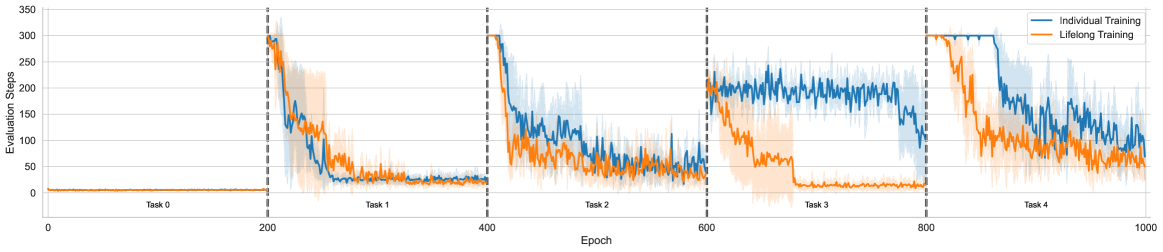
The graph compares the evaluation steps required for two training methods—**Individual Training** (blue) and **Lifelong Training** (orange)—across five sequential tasks (Task 0 to Task 4). The x-axis represents epochs (0–1000), and the y-axis represents evaluation steps (0–350). Vertical dashed lines segment the graph into task-specific regions.
---
### Components/Axes
- **X-axis (Epoch)**: Labeled "Epoch," with markers at 0, 200, 400, 600, 800, and 1000.
- **Y-axis (Evaluation Steps)**: Labeled "Evaluation Steps," ranging from 0 to 350.
- **Legend**: Located in the top-right corner. Blue = Individual Training; Orange = Lifelong Training.
- **Task Boundaries**: Vertical dashed lines separate tasks (e.g., Task 0: 0–200 epochs, Task 1: 200–400 epochs, etc.).
---
### Detailed Analysis
#### Task 0 (0–200 epochs)
- **Individual Training (Blue)**: Flat line at 0 evaluation steps.
- **Lifelong Training (Orange)**: Flat line at 0 evaluation steps.
- **Observation**: Both methods start with perfect performance (0 steps).
#### Task 1 (200–400 epochs)
- **Individual Training (Blue)**: Sharp initial drop from 0 to ~50 steps, followed by stabilization.
- **Lifelong Training (Orange)**: Gradual decline from 0 to ~30 steps, with smoother fluctuations.
- **Observation**: Lifelong Training shows less volatility and lower evaluation steps.
#### Task 2 (400–600 epochs)
- **Individual Training (Blue)**: Starts at ~50 steps, fluctuates between 20–80 steps, then drops to ~20 steps.
- **Lifelong Training (Orange)**: Starts at ~30 steps, fluctuates between 10–50 steps, then drops to ~10 steps.
- **Observation**: Both methods decline, but Lifelong Training maintains lower steps with tighter variability.
#### Task 3 (600–800 epochs)
- **Individual Training (Blue)**: Starts at ~20 steps, fluctuates between 5–40 steps, then drops to ~10 steps.
- **Lifelong Training (Orange)**: Starts at ~10 steps, fluctuates between 0–25 steps, then drops to ~5 steps.
- **Observation**: Lifelong Training consistently outperforms Individual Training in stability and efficiency.
#### Task 4 (800–1000 epochs)
- **Individual Training (Blue)**: Starts at ~10 steps, fluctuates between 0–30 steps, then drops to ~5 steps.
- **Lifelong Training (Orange)**: Starts at ~5 steps, fluctuates between 0–15 steps, then drops to ~2 steps.
- **Observation**: Lifelong Training achieves the lowest evaluation steps, with minimal variability.
---
### Key Observations
1. **Lifelong Training (Orange)** consistently demonstrates lower evaluation steps and smoother trends across all tasks.
2. **Individual Training (Blue)** exhibits sharper declines and higher variability (wider shaded regions), suggesting less reliable performance.
3. **Task-Specific Drops**: Both methods show performance degradation at task boundaries, but Lifelong Training recovers more effectively.
---
### Interpretation
The data suggests that **Lifelong Training** is more effective at retaining knowledge across tasks, as evidenced by its consistently lower evaluation steps and reduced variability. The wider shaded regions for Individual Training indicate higher uncertainty in its performance, likely due to catastrophic forgetting or lack of task adaptation. The sharp drops in Individual Training may reflect abrupt adjustments to new tasks, while Lifelong Training’s gradual declines imply better integration of prior knowledge. This aligns with the hypothesis that lifelong learning frameworks mitigate forgetting in sequential task environments.