## Diagram: Knowledge Graphs (KGs) vs. Large Language Models (LLMs)
### Overview
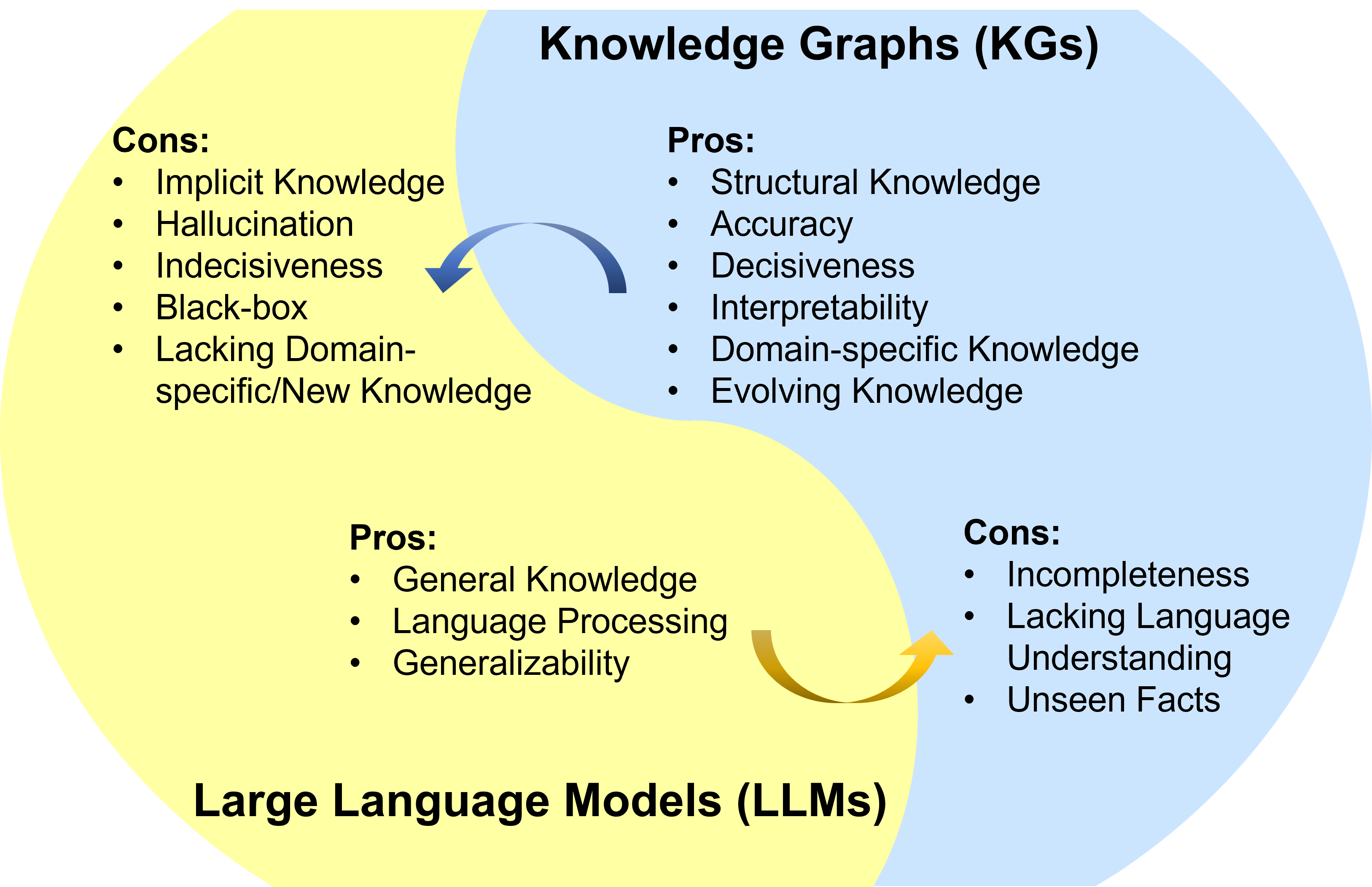
The image is a diagram comparing the pros and cons of Knowledge Graphs (KGs) and Large Language Models (LLMs). It uses a yin-yang style layout with two overlapping circles, one yellow representing LLMs and one blue representing KGs. Arrows indicate a flow or relationship between the two.
### Components/Axes
* **Title:** Knowledge Graphs (KGs)
* **Subtitle:** Large Language Models (LLMs)
* **KG Pros:**
* Structural Knowledge
* Accuracy
* Decisiveness
* Interpretability
* Domain-specific Knowledge
* Evolving Knowledge
* **KG Cons:**
* Incompleteness
* Lacking Language Understanding
* Unseen Facts
* **LLM Pros:**
* General Knowledge
* Language Processing
* Generalizability
* **LLM Cons:**
* Implicit Knowledge
* Hallucination
* Indecisiveness
* Black-box
* Lacking Domain-specific/New Knowledge
* **Arrows:** A blue arrow curves from the LLM cons section towards the KG pros section. A gold arrow curves from the KG cons section towards the LLM pros section.
### Detailed Analysis or Content Details
The diagram visually represents the strengths and weaknesses of Knowledge Graphs (KGs) and Large Language Models (LLMs). The blue circle on the top-right lists the pros and cons of KGs, while the yellow circle on the bottom-left lists the pros and cons of LLMs.
* **Knowledge Graphs (KGs):**
* **Pros:** The KG pros are listed in the top-right of the diagram. They include structural knowledge, accuracy, decisiveness, interpretability, domain-specific knowledge, and evolving knowledge.
* **Cons:** The KG cons are listed in the bottom-right of the diagram. They include incompleteness, lacking language understanding, and unseen facts.
* **Large Language Models (LLMs):**
* **Pros:** The LLM pros are listed in the bottom-left of the diagram. They include general knowledge, language processing, and generalizability.
* **Cons:** The LLM cons are listed in the top-left of the diagram. They include implicit knowledge, hallucination, indecisiveness, black-box nature, and lacking domain-specific/new knowledge.
* **Arrows:**
* The blue arrow suggests that the cons of LLMs (implicit knowledge, hallucination, etc.) can be addressed or mitigated by the pros of KGs (structural knowledge, accuracy, etc.).
* The gold arrow suggests that the cons of KGs (incompleteness, lacking language understanding, etc.) can be addressed or mitigated by the pros of LLMs (general knowledge, language processing, etc.).
### Key Observations
* The diagram highlights a complementary relationship between KGs and LLMs.
* The arrows suggest a potential for synergy between the two technologies, where the strengths of one can compensate for the weaknesses of the other.
* The diagram presents a high-level overview of the trade-offs involved in choosing between or combining KGs and LLMs.
### Interpretation
The diagram illustrates the idea that Knowledge Graphs and Large Language Models have distinct strengths and weaknesses. It suggests that these technologies can be used together to create more robust and effective knowledge systems. The arrows indicate a flow of benefits, implying that integrating KGs and LLMs can lead to a system that leverages the structured knowledge and accuracy of KGs with the general knowledge and language processing capabilities of LLMs. This integration could potentially mitigate the issues of hallucination and lack of domain-specific knowledge in LLMs, while also addressing the incompleteness and language understanding limitations of KGs. The diagram promotes the idea of a hybrid approach, combining the best aspects of both technologies.