\n
## Diagram: Knowledge Graphs vs. Large Language Models
### Overview
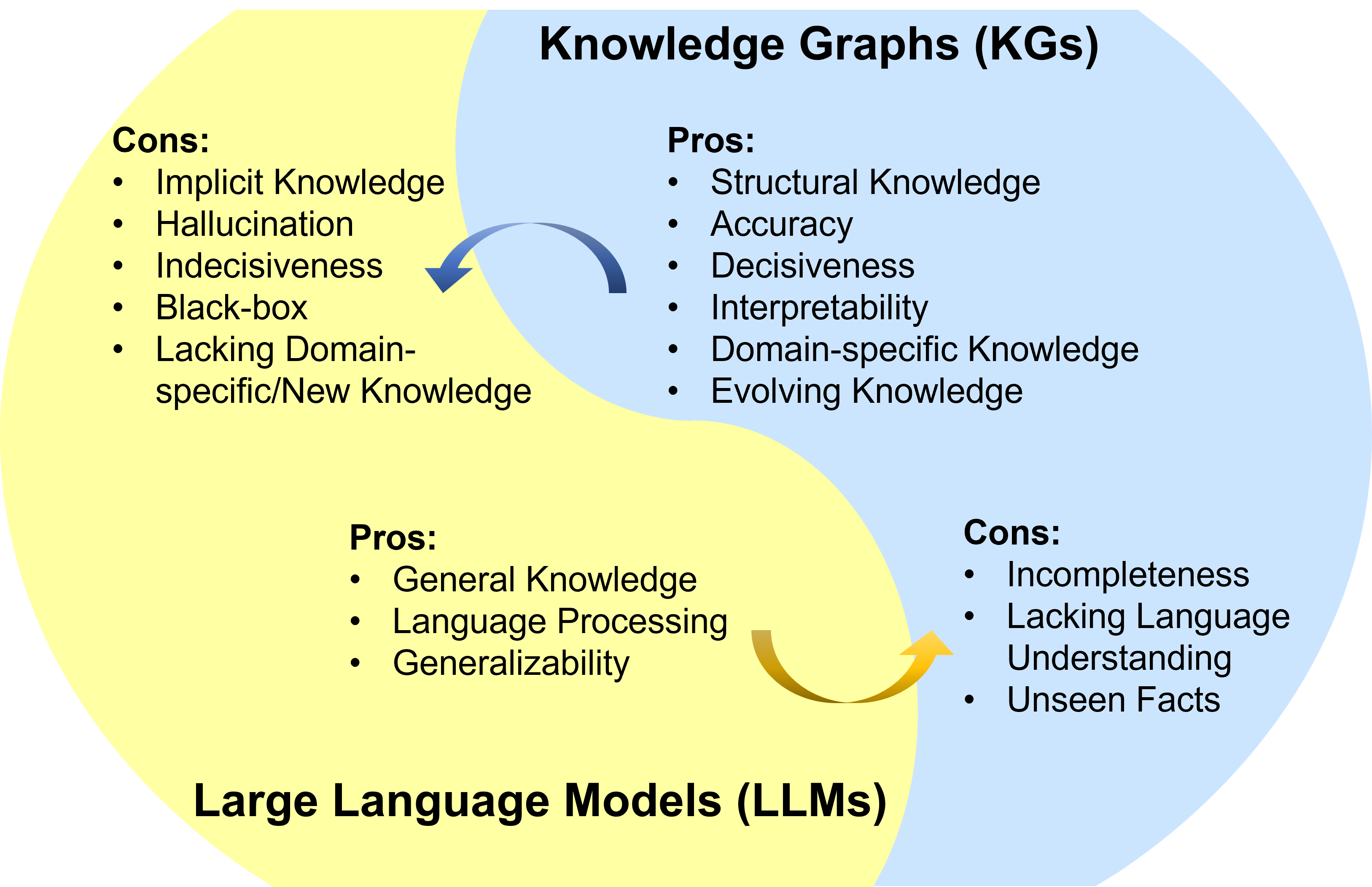
The image is a diagram illustrating the pros and cons of Knowledge Graphs (KGs) and Large Language Models (LLMs). It uses two overlapping circles, representing the two technologies, with lists of advantages and disadvantages positioned around each circle. Arrows indicate areas of overlap and potential interaction.
### Components/Axes
The diagram consists of:
* **Title:** "Knowledge Graphs (KGs)" at the top center.
* **Two Overlapping Circles:** One labeled "Knowledge Graphs (KGs)" and the other "Large Language Models (LLMs)".
* **Pros & Cons Lists:** Bulleted lists of pros and cons associated with each technology.
* **Arrows:** Blue and yellow arrows indicating areas of overlap and potential interaction.
### Detailed Analysis or Content Details
**Knowledge Graphs (KGs) - Pros (Right Side):**
* Structural Knowledge
* Accuracy
* Decisiveness
* Interpretability
* Domain-specific Knowledge
* Evolving Knowledge
**Knowledge Graphs (KGs) - Cons (Left Side):**
* Implicit Knowledge
* Hallucination
* Indecisiveness
* Black-box
* Lacking Domain-specific/New Knowledge
**Large Language Models (LLMs) - Pros (Bottom):**
* General Knowledge
* Language Processing
* Generalizability
**Large Language Models (LLMs) - Cons (Bottom-Right):**
* Incompleteness
* Lacking Language Understanding
* Unseen Facts
**Arrows:**
* A blue arrow originates from the "Cons" list of KGs and points towards the "Pros" list of LLMs.
* A yellow arrow originates from the "Pros" list of LLMs and points towards the "Cons" list of KGs.
### Key Observations
The diagram highlights the complementary strengths and weaknesses of KGs and LLMs. KGs excel in structured, accurate, and interpretable knowledge, but struggle with implicit or new information. LLMs are strong in general knowledge and language processing, but can be incomplete or lack deep understanding. The arrows suggest that LLMs can potentially address some of the shortcomings of KGs, and vice versa.
### Interpretation
This diagram presents a comparative analysis of Knowledge Graphs and Large Language Models, positioning them not as competing technologies, but as potentially synergistic ones. The pros and cons are carefully contrasted to show where each technology shines and where it falls short.
The blue arrow from KG cons to LLM pros suggests that LLMs can help mitigate the limitations of KGs, particularly in handling implicit knowledge and new information. LLMs can infer and generate knowledge that isn't explicitly stored in a KG.
Conversely, the yellow arrow from LLM pros to KG cons indicates that KGs can address the weaknesses of LLMs, such as incompleteness and lack of understanding. KGs provide a structured foundation for LLMs, grounding them in factual knowledge and improving their interpretability.
The diagram implies that a combined approach, leveraging the strengths of both KGs and LLMs, could lead to more robust and intelligent systems. This is a common theme in current AI research, with many projects exploring ways to integrate these two paradigms. The diagram doesn't provide quantitative data, but rather a qualitative assessment of the relative strengths and weaknesses of each technology.