## Question Answering Diagram: Wigan Athletic F.C. Sponsorship
### Overview
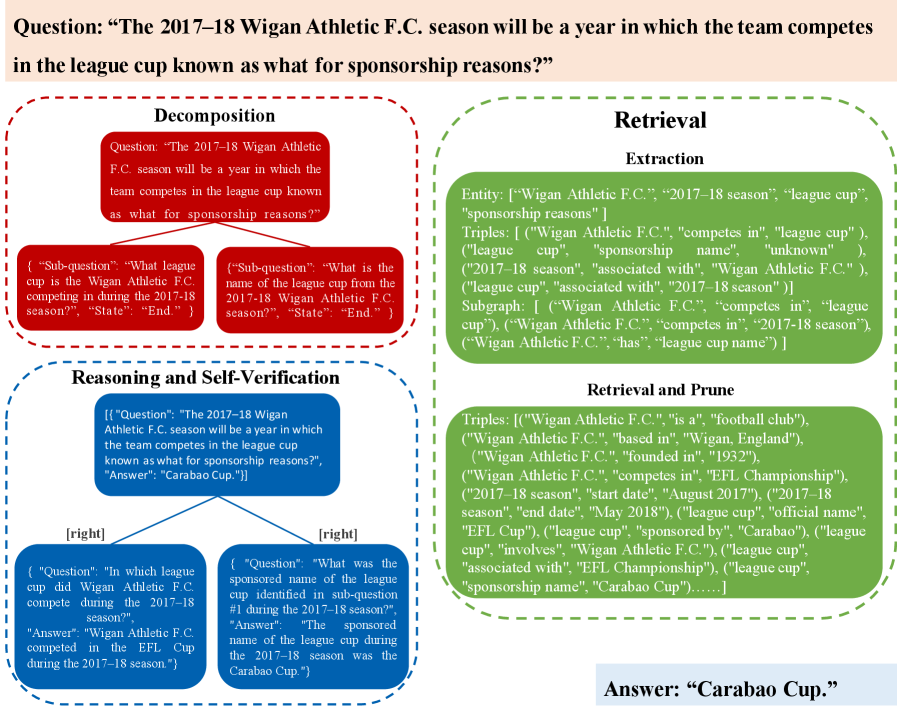
The image presents a diagram illustrating a question-answering process related to the sponsorship of the league cup in which Wigan Athletic F.C. competed during the 2017-18 season. The diagram is divided into four sections: Decomposition, Retrieval, Reasoning and Self-Verification, and Answer. Each section outlines a step in the process of answering the question: "The 2017-18 Wigan Athletic F.C. season will be a year in which the team competes in the league cup known as what for sponsorship reasons?".
### Components/Axes
* **Overall Question (Top):** "The 2017-18 Wigan Athletic F.C. season will be a year in which the team competes in the league cup known as what for sponsorship reasons?"
* **Decomposition (Top-Left, Red Border):**
* Contains the original question.
* Two sub-questions are derived from the original question:
* "What league cup is the Wigan Athletic F.C. competing in during the 2017-18 season?"
* "What is the name of the league cup from the 2017-18 Wigan Athletic F.C. season?"
* Both sub-questions have a "State": "End." attribute.
* **Retrieval (Top-Right, Green Border):**
* **Extraction:**
* Entity: \["Wigan Athletic F.C.", "2017-18 season", "league cup", "sponsorship reasons"]
* Triples: \[("Wigan Athletic F.C.", "competes in", "league cup"), ("league cup", "sponsorship name", "unknown"), ("2017-18 season", "associated with", "Wigan Athletic F.C."), ("league cup", "associated with", "2017-18 season")]
* Subgraph: \[("Wigan Athletic F.C.", "competes in", "league cup"), ("Wigan Athletic F.C.", "competes in", "2017-18 season"), ("Wigan Athletic F.C.", "has", "league cup name")]
* **Retrieval and Prune:**
* Triples: \[("Wigan Athletic F.C.", "is a", "football club"), ("Wigan Athletic F.C.", "based in", "Wigan, England"), ("Wigan Athletic F.C.", "founded in", "1932"), ("Wigan Athletic F.C.", "competes in", "EFL Championship"), ("2017-18 season", "start date", "August 2017"), ("2017-18 season", "end date", "May 2018"), ("league cup", "official name", "EFL Cup"), ("league cup", "sponsored by", "Carabao"), ("league cup", "involves", "Wigan Athletic F.C."), ("league cup", "associated with", "EFL Championship"), ("league cup", "sponsorship name", "Carabao Cup")......]
* **Reasoning and Self-Verification (Bottom-Left, Blue Border):**
* Contains the original question and the final answer: "Carabao Cup."
* Two branches representing reasoning steps:
* Left Branch:
* Question: "In which league cup did Wigan Athletic F.C. compete during the 2017-18 season?"
* Answer: "Wigan Athletic F.C. competed in the EFL Cup during the 2017-18 season."
* Right Branch:
* Question: "What was the sponsored name of the league cup identified in sub-question #1 during the 2017-18 season?"
* Answer: "The sponsored name of the league cup during the 2017-18 season was the Carabao Cup."
* **Answer (Bottom-Right):** "Carabao Cup."
### Detailed Analysis or ### Content Details
* **Decomposition:** The original question is broken down into two sub-questions to simplify the retrieval and reasoning process.
* **Retrieval:** This section extracts relevant information from a knowledge base or database. It includes entities, triples (subject-predicate-object relationships), and a subgraph representing the relationships between entities. The "Retrieval and Prune" section refines the extracted information.
* **Reasoning and Self-Verification:** This section uses the answers to the sub-questions to derive the final answer. The diagram shows a tree-like structure where the original question is at the root, and the sub-questions and their answers form the branches.
* **Answer:** The final answer to the original question is "Carabao Cup."
### Key Observations
* The diagram illustrates a structured approach to question answering, involving decomposition, information retrieval, and reasoning.
* The use of triples and subgraphs in the Retrieval section indicates a knowledge graph-based approach.
* The Reasoning and Self-Verification section demonstrates how the answers to sub-questions are combined to arrive at the final answer.
### Interpretation
The diagram demonstrates a question-answering system's process for determining the sponsorship name of a league cup. The system breaks down the complex question into smaller, more manageable sub-questions. It then retrieves relevant information from a knowledge base, prunes irrelevant data, and uses the retrieved information to answer the sub-questions. Finally, it combines the answers to the sub-questions to arrive at the final answer. This approach highlights the importance of structured knowledge representation and reasoning in question-answering systems. The system correctly identifies "Carabao Cup" as the answer, demonstrating its ability to process and understand complex queries related to sports sponsorships.