## Scatter Plot: Qwen3-4B (50x Compaction)
### Overview
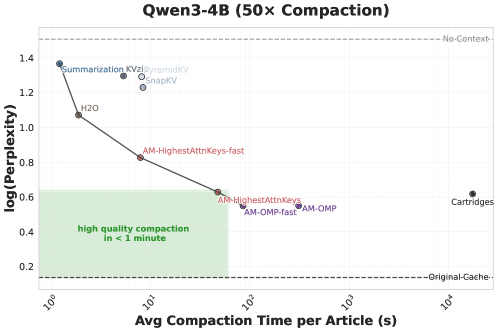
This scatter plot compares the relationship between **compaction time per article** (x-axis) and **perplexity** (y-axis) for various Qwen3-4B model compression techniques. It includes labeled data points, a shaded "high quality" region, and reference lines for context.
---
### Components/Axes
- **Title**: "Qwen3-4B (50x Compaction)"
- **X-axis**:
- Label: "Avg Compaction Time per Article (s)"
- Scale: Logarithmic (10⁰ to 10⁴)
- Tick marks: 10⁰, 10¹, 10², 10³, 10⁴
- **Y-axis**:
- Label: "log(Perplexity)"
- Scale: Linear (0.2 to 1.4)
- Tick marks: 0.2, 0.4, 0.6, 0.8, 1.0, 1.2, 1.4
- **Legend**:
- Located at the top-left of the plot.
- Colors:
- Red: "AM-HighestAttnKeys-fast"
- Purple: "AM-OMP"
- Gray: "No-Context" (dashed line)
- Black: "Original-Cache" (dashed line)
- **Shaded Region**:
- Green rectangle labeled "high quality compaction in < 1 minute"
- Bounds: X = 10⁰–10² s, Y = 0.4–0.6
---
### Detailed Analysis
1. **Data Points**:
- **H2O**: (10⁰ s, 1.1 perplexity)
- **Summarization KVzl**: (10⁰.⁵ s, 1.3 perplexity)
- **SnapKV**: (10¹ s, 1.25 perplexity)
- **AM-HighestAttnKeys**: (10¹.⁵ s, 0.65 perplexity)
- **AM-HighestAttnKeys-fast**: (10¹.⁵ s, 0.8 perplexity)
- **AM-OMP**: (10² s, 0.55 perplexity)
- **AM-OMP-fast**: (10² s, 0.6 perplexity)
- **Cartridges**: (10⁴ s, 0.6 perplexity)
2. **Trends**:
- A diagonal trendline connects H2O → Summarization KVzl → SnapKV → AM-HighestAttnKeys → AM-OMP, showing **increasing compaction time** with **decreasing perplexity**.
- AM-OMP-fast and AM-HighestAttnKeys-fast cluster in the "high quality" region (green shaded area).
- Cartridges deviates to the far right (10⁴ s) with moderate perplexity.
3. **Reference Lines**:
- "No-Context" (dashed horizontal line at Y = 1.4).
- "Original-Cache" (dashed horizontal line at Y = 0.2).
---
### Key Observations
- **Efficiency Tradeoff**: Most methods cluster in the "high quality" region, balancing speed and low perplexity.
- **Outliers**:
- **Cartridges** requires 10⁴ s (10,000x slower than H2O) but achieves the same perplexity as AM-OMP.
- **AM-HighestAttnKeys-fast** and **AM-OMP-fast** achieve near-optimal perplexity (<0.6) within the <1-minute compaction window.
- **Baselines**:
- "No-Context" represents the worst-case perplexity (1.4).
- "Original-Cache" represents the best-case perplexity (0.2).
---
### Interpretation
The plot demonstrates that **AM-OMP** and **AM-HighestAttnKeys** variants offer the best compromise between speed and quality, achieving low perplexity (<0.6) within the "high quality" region (<1 minute). **Cartridges** is an outlier, suggesting either inefficiency or specialized use cases. The diagonal trendline implies a general inverse relationship between compaction time and perplexity, though exceptions exist. The "No-Context" and "Original-Cache" lines frame the performance boundaries, highlighting that most methods outperform baseline caching strategies.
**Critical Insight**: Methods labeled with "-fast" suffixes (e.g., AM-HighestAttnKeys-fast) prioritize speed without sacrificing quality, making them ideal for real-time applications.