## Logic Puzzle Diagram: Numbered Grid with Path
### Overview
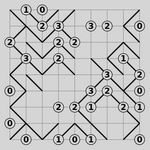
The image displays a 6x6 grid-based logic puzzle, likely a variant of "Slitherlink" or "Loop the Loop." The grid contains numbers within certain cells, and a continuous, non-intersecting black line (a loop) is drawn along the grid lines, connecting the dots at the corners of the cells. The numbers indicate how many of the four edges of that specific cell are part of the loop. The puzzle appears to be in a solved state, as the drawn loop satisfies all numerical constraints.
### Components/Axes
* **Grid Structure:** A 6x6 square grid, creating 36 individual cells. The grid lines are light gray.
* **Numerical Labels:** Numbers (0, 1, 2, 3) are placed inside specific cells. These are the puzzle's constraints.
* **Path/Loop:** A thick, black line forms a single, continuous closed loop that travels along the grid lines. It does not cross itself or branch.
* **Spatial Layout:** The grid occupies the entire image frame. There are no axis titles, legends, or external labels. The numbers are the only embedded text.
### Detailed Analysis
**Grid Content (Row by Row, from top-left):**
* **Row 1:** Cell(1,1): `1` | Cell(1,2): `0` | Cell(1,3): (empty) | Cell(1,4): `3` | Cell(1,5): `3` | Cell(1,6): `2`
* **Row 2:** Cell(2,1): `2` | Cell(2,2): `3` | Cell(2,3): `2` | Cell(2,4): `2` | Cell(2,5): (empty) | Cell(2,6): `0`
* **Row 3:** Cell(3,1): `2` | Cell(3,2): `3` | Cell(3,3): (empty) | Cell(3,4): (empty) | Cell(3,5): `3` | Cell(3,6): `2`
* **Row 4:** Cell(4,1): (empty) | Cell(4,2): `2` | Cell(4,3): `2` | Cell(4,4): `3` | Cell(4,5): `2` | Cell(4,6): `0`
* **Row 5:** Cell(5,1): `0` | Cell(5,2): (empty) | Cell(5,3): `2` | Cell(5,4): `1` | Cell(5,5): `1` | Cell(5,6): `2`
* **Row 6:** Cell(6,1): `0` | Cell(6,2): (empty) | Cell(6,3): `0` | Cell(6,4): `1` | Cell(6,5): `1` | Cell(6,6): `0`
**Path Description (Trend Verification):**
The black line forms a single, winding loop. It starts and ends at the same point, creating a closed circuit. The path's trend is meandering, with no clear directional bias (e.g., not predominantly left-to-right or top-to-bottom). It carefully navigates around the grid to satisfy the number in each cell.
**Component Isolation & Path Trace (Approximate):**
A precise trace is complex, but key segments include:
* The loop runs along the entire top edge of the grid from column 2 to column 5.
* It makes a deep incursion into the bottom-left quadrant, forming a rectangular detour around cells (5,1), (6,1), (6,2), and (5,2).
* It has a significant "finger" that extends down the right side, covering the right edges of cells (1,6) through (4,6).
* The path frequently makes 90-degree turns at grid intersections to avoid crossing itself and to meet the edge-count requirements of adjacent numbered cells.
### Key Observations
1. **Constraint Satisfaction:** Every numbered cell has a loop segment count matching its number. For example, all `0` cells (e.g., top-left of Row 1, bottom-right corner) have no black lines on any of their four edges. All `3` cells have exactly three of their four edges used by the loop.
2. **Empty Cells:** Cells without numbers have no constraint; the loop passes through them as needed to connect the path.
3. **Loop Integrity:** The path is a single, continuous, non-branching loop with no loose ends. It does not intersect itself.
4. **Spatial Distribution:** The numbers are distributed across the grid, with a slight concentration of higher numbers (`2`, `3`) in the top-left and central areas, and more `0`s and `1`s toward the bottom and right edges.
### Interpretation
This image is the solution to a deductive logic puzzle. The data (the numbers and the drawn line) demonstrates a valid state where all local constraints (the number in each cell) are satisfied by a global structure (the single loop).
* **What it demonstrates:** It shows the application of logical rules to determine the only possible path that fulfills all given conditions. The puzzle tests spatial reasoning and constraint propagation.
* **Relationship between elements:** The numbers are the rules; the black line is the solution that obeys those rules. Each number dictates the local behavior of the line around it, and the line's global continuity links all these local decisions into one coherent whole.
* **Notable patterns:** The `0` cells act as "barriers" the loop must go around. The `3` cells are "attractors" that force the loop to use three of their sides, often creating complex turns. The solved state shows no contradictions, indicating a well-formed puzzle.
* **Underlying information:** The puzzle likely has a unique solution. The image provides all necessary information to verify the solution's correctness by checking each numbered cell's edge count against the drawn loop. It is a self-contained record of a completed logic problem.