\n
## Diagram: Commutative Diagram of Stability Maps in Homotopy Theory
### Overview
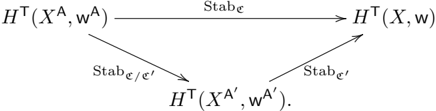
The image displays a commutative diagram from mathematical topology, specifically homotopy theory or stable homotopy theory. It illustrates relationships between four mathematical objects (likely spectra or cohomology theories) connected by three "stability" maps. The diagram is structured as a non-rectangular quadrilateral with diagonal arrows, implying a commutative relationship between different composition paths.
### Components/Axes
The diagram consists of four nodes (mathematical objects) and three directed arrows (maps) with labels.
**Nodes (Objects):**
1. **Top-Left Node:** `H^T(X^A, w^A)`
2. **Top-Right Node:** `H^T(X, w)`
3. **Bottom-Left Node:** `H^T(X^{A'}, w^{A'})`
4. **Bottom-Right Node:** `H^T(X, w)` (Identical label to the top-right node)
**Arrows (Maps):**
1. **Horizontal Arrow (Top):** Connects the Top-Left node to the Top-Right node. Label: `Stab_ε`
2. **Diagonal Arrow (Left):** Connects the Top-Left node to the Bottom-Left node. Label: `Stab_{ε/ε'}`
3. **Diagonal Arrow (Bottom):** Connects the Bottom-Left node to the Bottom-Right node. Label: `Stab_{ε'}`
**Spatial Layout:**
* The diagram is arranged in a diamond or kite-like shape.
* The two `H^T(X, w)` nodes are positioned on the right side, one above the other.
* The two distinct nodes with superscripts `A` and `A'` are on the left side, one above the other.
* The arrows create two potential paths from the top-left node to the bottom-right node:
* **Path 1:** Top-Left → Top-Right → Bottom-Right (This path is *not* explicitly drawn with an arrow).
* **Path 2:** Top-Left → Bottom-Left → Bottom-Right (This path is explicitly drawn).
### Detailed Analysis
* **Notation:** The notation `H^T` likely denotes a generalized cohomology theory or a spectrum indexed by `T`. The arguments `(X, w)` suggest a space `X` equipped with some additional structure `w` (e.g., a weight, a tangential structure, or a parameter).
* **Superscripts:** The superscripts `A` and `A'` on the left-hand nodes likely denote different indexing sets, parameters, or approximations applied to the base space `X`.
* **Map Labels:** The maps are all labeled `Stab`, indicating they are "stability" maps or "stabilization" functors. The subscripts `ε`, `ε'`, and `ε/ε'` are parameters (likely real numbers or tolerances) governing these stability constructions. The label `Stab_{ε/ε'}` suggests a map that compares or relates the two parameters `ε` and `ε'`.
* **Implied Commutativity:** Although not explicitly stated with a symbol (like `=` or `∘`), the structure of the diagram strongly implies that the composition of maps along the two different paths from `H^T(X^A, w^A)` to `H^T(X, w)` should be equivalent. That is, `Stab_ε` (top path) is expected to equal the composition `Stab_{ε'} ∘ Stab_{ε/ε'}` (bottom path). This is the core property of a commutative diagram.
### Key Observations
1. **Duplicate Node:** The object `H^T(X, w)` appears twice, serving as both the target of the top map and the target of the bottom composition. This is a common device in commutative diagrams to show that two different processes lead to the same result.
2. **Parameter Dependence:** The stability maps are explicitly parameterized (`ε`, `ε'`), indicating that the construction is sensitive to these choices. The map `Stab_{ε/ε'}` acts as a bridge between the two parameter regimes.
3. **Asymmetric Structure:** The diagram is not a simple square. The direct vertical connection on the right side is absent, emphasizing that the relationship between the two `H^T(X, w)` nodes is mediated through the left-hand objects and the stability maps.
### Interpretation
This diagram formalizes a **consistency or naturality condition** for a family of stability constructions parameterized by `ε`. It asserts that stabilizing a parameterized object `(X^A, w^A)` directly to a tolerance `ε` yields the same result as first stabilizing it to an intermediate tolerance `ε/ε'` (producing `(X^{A'}, w^{A'})`) and then further stabilizing that result to tolerance `ε'`.
In essence, it demonstrates that the stability functor `Stab` behaves predictably when its parameters are scaled or related. This is a fundamental type of diagram in areas like parametrized stable homotopy theory, the theory of parametrized spectra, or in the study of assembly maps and parametrized homology theories. It ensures that the mathematical constructions are well-defined and independent of the specific path taken through the parameter space, which is crucial for building robust theoretical frameworks. The presence of weights or additional structures (`w`) suggests this may be in the context of tangential or framed structures.