## Diagram: Medical Diagnostic Reasoning Process
### Overview
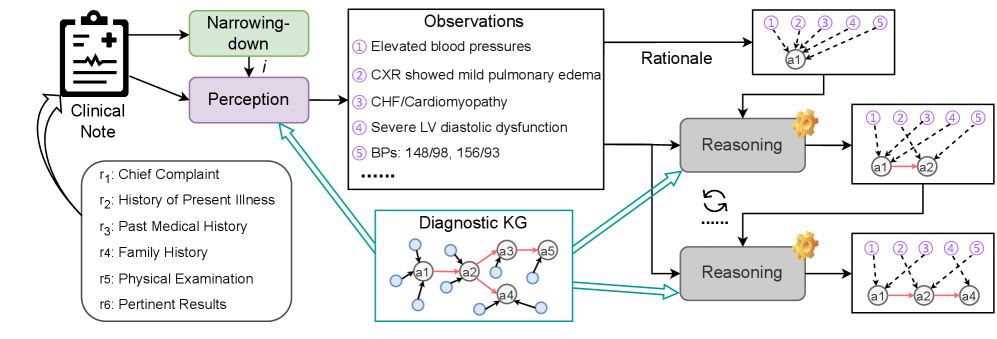
This image is a technical flowchart illustrating an AI-assisted medical diagnostic reasoning pipeline. It depicts how unstructured clinical notes are processed through perception, observation extraction, integration with a diagnostic knowledge graph (KG), and iterative reasoning to arrive at a diagnosis. The diagram emphasizes a structured, multi-step cognitive process.
### Components/Axes
The diagram is organized into several interconnected functional blocks, flowing generally from left to right with feedback loops.
**1. Input Source (Top-Left):**
* **Icon:** A clipboard with a medical cross and a waveform, labeled **"Clinical Note"**.
* **Associated List (Bottom-Left):** A rounded rectangle lists the components of the clinical note:
* `r₁: Chief Complaint`
* `r₂: History of Present Illness`
* `r₃: Past Medical History`
* `r₄: Family History`
* `r₅: Physical Examination`
* `r₆: Pertinent Results`
**2. Initial Processing (Center-Left):**
* **"Narrowing-down"** (Green box): Receives input from the Clinical Note.
* **"Perception"** (Purple box): Receives input from both the Clinical Note and the "Narrowing-down" step. An arrow labeled `i` points from "Narrowing-down" to "Perception".
**3. Observation Extraction (Center):**
* **"Observations"** (Large white box): The output of the "Perception" step. It contains a numbered list of extracted clinical findings:
1. Elevated blood pressures
2. CXR showed mild pulmonary edema
3. CHF/Cardiomyopathy
4. Severe LV diastolic dysfunction
5. BPs: 148/98, 156/93
* `......` (indicating additional observations)
**4. Knowledge Base (Bottom-Center):**
* **"Diagnostic KG"** (Cyan-bordered box): Represents a Diagnostic Knowledge Graph. It contains a network diagram with nodes labeled `a1`, `a2`, `a3`, `a4`, `a5` connected by directional arrows, illustrating relationships between medical concepts.
**5. Reasoning Engine (Right Side):**
* **"Rationale"** (Top-Right): A box showing a network diagram where numbered observations (①, ②, ③, ④, ⑤) are connected via dashed lines to a node labeled `a1`.
* **"Reasoning"** (Two grey boxes with gear icons): These represent iterative reasoning steps.
* **First Reasoning Box:** Receives input from "Observations" and "Diagnostic KG". Its internal diagram shows observations connected to nodes `a1` and `a2`, with a solid red arrow from `a1` to `a2`.
* **Second Reasoning Box:** Connected to the first via a circular feedback arrow (`↻`). Its diagram shows observations connected to nodes `a1`, `a2`, and `a4`, with a solid red arrow from `a1` to `a2` and another from `a2` to `a4`.
**6. Data Flow (Arrows):**
* Solid black arrows indicate the primary flow of information.
* Cyan arrows show bidirectional interaction between the "Diagnostic KG" and the "Reasoning" blocks.
* A circular arrow between the two "Reasoning" boxes indicates an iterative or recursive process.
### Detailed Analysis
The diagram maps a specific clinical scenario to its diagnostic reasoning pathway.
* **Input Data:** The process starts with a clinical note containing six standard sections (`r₁` to `r₆`).
* **Extracted Observations:** Five specific findings are listed from the example note. Notably, observation #5 provides concrete numerical data: two blood pressure readings (148/98 and 156/93 mmHg), which are elevated.
* **Knowledge Graph Structure:** The "Diagnostic KG" is visualized as a small graph with five key concept nodes (`a1`-`a5`). The exact medical meaning of these nodes is not labeled, but they represent entities in the diagnostic space.
* **Reasoning Progression:**
1. **Rationale Formation:** The initial step links the five observations to a single concept node (`a1`).
2. **First Reasoning Step:** Integrates the observations with the KG to connect `a1` to `a2`.
3. **Second Reasoning Step (Iterative):** Further refines the hypothesis, now connecting `a1` to `a2` and `a2` to `a4`, suggesting a chain of diagnostic reasoning (e.g., `a1` leads to `a2`, which leads to `a4`).
### Key Observations
1. **Structured Pipeline:** The process is highly structured, moving from raw data (note) to filtered perception, to explicit observations, to knowledge-grounded reasoning.
2. **Iterative Refinement:** The presence of two "Reasoning" boxes with a feedback loop indicates that diagnosis is not a single-step conclusion but a process of hypothesis generation and refinement.
3. **Integration of Symbolic and Subsymbolic Data:** The system combines symbolic data (textual observations like "CHF/Cardiomyopathy") with numerical data (BP readings) and structured knowledge (the KG).
4. **Focus on Cardiovascular Pathology:** The example observations (elevated BP, pulmonary edema, CHF, LV dysfunction) strongly point to a cardiovascular or heart failure diagnostic scenario.
### Interpretation
This diagram represents the architecture of an AI system designed to mimic or augment clinical diagnostic reasoning. It demonstrates a **Peircean abductive reasoning** process: starting with surprising facts (the clinical observations), it uses a knowledge base (the Diagnostic KG) to form a hypothesis (the chain `a1`→`a2`→`a4`) that best explains those facts.
The system's value lies in its ability to:
* **Structure Unstructured Data:** It systematically extracts and categorizes findings from free-text clinical notes.
* **Ground Reasoning in Medical Knowledge:** The Diagnostic KG ensures that reasoning steps are constrained by established medical relationships, not just statistical patterns.
* **Provide Explainability:** The intermediate steps (Observations, Rationale, reasoning chains) offer a traceable path from input data to diagnostic output, which is crucial for clinical trust and validation.
The specific numerical data (BP: 148/98, 156/93) serves as a concrete example of the type of quantitative data the system ingests alongside qualitative findings. The overall flow suggests a move from data to information (observations) to knowledge (KG-linked reasoning) to potential wisdom (diagnostic conclusion).