## Line Chart: Model Accuracy on Math Problems
### Overview
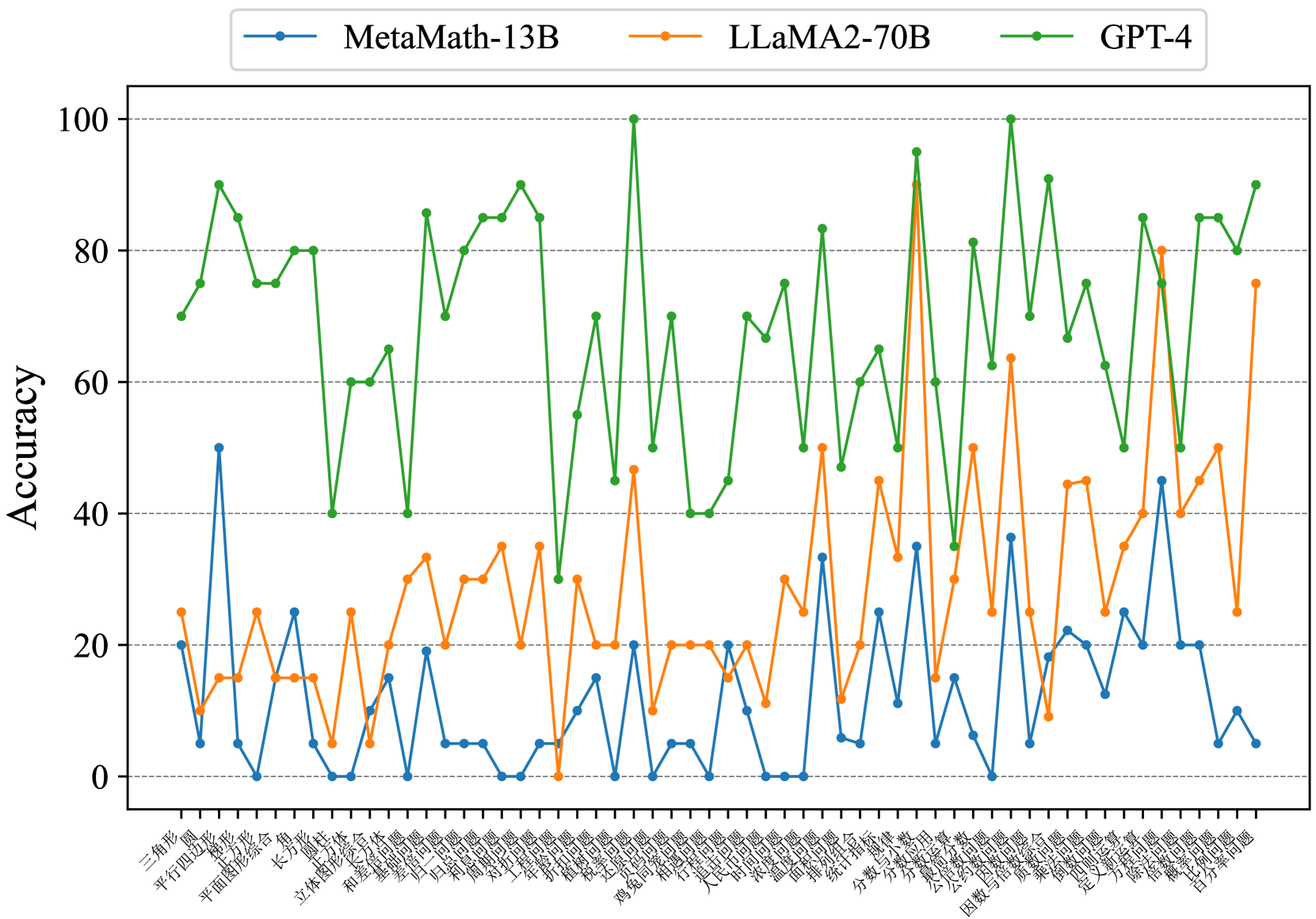
The image is a line chart comparing the accuracy of three language models (MetaMath-13B, LLaMA2-70B, and GPT-4) on a series of math problems. The x-axis represents different types of math problems, and the y-axis represents accuracy, ranging from 0 to 100.
### Components/Axes
* **Title:** (Implicit) Model Accuracy on Math Problems
* **X-axis:** Math Problem Types (in Chinese)
* **Y-axis:** Accuracy (ranging from 0 to 100, with gridlines at intervals of 20)
* **Legend:** Located at the top of the chart.
* MetaMath-13B (blue)
* LLaMA2-70B (orange)
* GPT-4 (green)
### Detailed Analysis
**X-Axis Labels (Math Problem Types - Chinese with English Translation):**
The x-axis labels are in Chinese. Here are the labels and their approximate English translations:
1. 三角形 (sān jiǎo xíng): Triangle
2. 平行四边形 (píng xíng sì biān xíng): Parallelogram
3. 平面图形综合 (píng miàn tú xíng zōng hé): Plane figure synthesis/combination
4. 梯形 (tī xíng): Trapezoid
5. 长方形 (cháng fāng xíng): Rectangle
6. 正方形 (zhèng fāng xíng): Square
7. 立体图形 (lì tǐ tú xíng): Solid figure
8. 和差倍问题 (hé chā bèi wèn tí): Sum-difference-multiple problem
9. 基础几何问题 (jī chǔ jǐ hé wèn tí): Basic geometry problem
10. 归一问题 (guī yī wèn tí): Reduction to one problem
11. 归总问题 (guī zǒng wèn tí): Summation problem
12. 周长问题 (zhōu cháng wèn tí): Perimeter problem
13. 面积问题 (miàn jī wèn tí): Area problem
14. 工程问题 (gōng chéng wèn tí): Work problem
15. 折扣问题 (zhé kòu wèn tí): Discount problem
16. 植树问题 (zhí shù wèn tí): Tree planting problem
17. 还原问题 (huán yuán wèn tí): Restoration problem
18. 盈亏问题 (yíng kuī wèn tí): Profit and loss problem
19. 鸡兔同笼 (jī tù tóng lóng): Chicken and rabbit in the same cage (a type of math problem)
20. 相遇问题 (xiāng yù wèn tí): Meeting problem
21. 行程问题 (xíng chéng wèn tí): Travel problem
22. 浓度问题 (nóng dù wèn tí): Concentration problem
23. 简单平均数 (jiǎn dān píng jūn shù): Simple average
24. 定义新运算 (dìng yì xīn yùn suàn): Define new operation
25. 整数计算 (zhěng shù jì suàn): Integer calculation
26. 除法计算 (chú fǎ jì suàn): Division calculation
27. 比例问题 (bǐ lì wèn tí): Ratio problem
28. 概率问题 (gài lǜ wèn tí): Probability problem
29. 百分数问题 (bǎi fēn shù wèn tí): Percentage problem
**Data Series Analysis:**
* **MetaMath-13B (blue):** Generally low accuracy across all problem types, mostly below 40. It has a spike at "Plane figure synthesis/combination" reaching approximately 50 accuracy. Many data points are at or near 0 accuracy.
* Triangle: ~10
* Parallelogram: ~5
* Plane figure synthesis/combination: ~50
* Trapezoid: ~25
* Rectangle: ~25
* Square: ~20
* Solid figure: ~5
* Sum-difference-multiple problem: ~0
* Basic geometry problem: ~20
* Reduction to one problem: ~5
* Summation problem: ~5
* Perimeter problem: ~5
* Area problem: ~0
* Work problem: ~0
* Discount problem: ~20
* Tree planting problem: ~20
* Restoration problem: ~20
* Profit and loss problem: ~5
* Chicken and rabbit in the same cage: ~35
* Meeting problem: ~20
* Travel problem: ~5
* Concentration problem: ~35
* Simple average: ~20
* Define new operation: ~10
* Integer calculation: ~40
* Division calculation: ~20
* Ratio problem: ~20
* Probability problem: ~20
* Percentage problem: ~10
* **LLaMA2-70B (orange):** Higher accuracy than MetaMath-13B, but still generally lower than GPT-4. Accuracy fluctuates between approximately 10 and 50.
* Triangle: ~10
* Parallelogram: ~10
* Plane figure synthesis/combination: ~15
* Trapezoid: ~25
* Rectangle: ~15
* Square: ~25
* Solid figure: ~35
* Sum-difference-multiple problem: ~30
* Basic geometry problem: ~20
* Reduction to one problem: ~35
* Summation problem: ~20
* Perimeter problem: ~20
* Area problem: ~30
* Work problem: ~30
* Discount problem: ~35
* Tree planting problem: ~20
* Restoration problem: ~20
* Profit and loss problem: ~25
* Chicken and rabbit in the same cage: ~20
* Meeting problem: ~30
* Travel problem: ~40
* Concentration problem: ~35
* Simple average: ~45
* Define new operation: ~50
* Integer calculation: ~30
* Division calculation: ~25
* Ratio problem: ~45
* Probability problem: ~50
* Percentage problem: ~30
* **GPT-4 (green):** Significantly higher accuracy than both MetaMath-13B and LLaMA2-70B. Accuracy generally ranges between 40 and 100.
* Triangle: ~70
* Parallelogram: ~90
* Plane figure synthesis/combination: ~80
* Trapezoid: ~80
* Rectangle: ~60
* Square: ~65
* Solid figure: ~80
* Sum-difference-multiple problem: ~90
* Basic geometry problem: ~90
* Reduction to one problem: ~50
* Summation problem: ~40
* Perimeter problem: ~75
* Area problem: ~50
* Work problem: ~60
* Discount problem: ~85
* Tree planting problem: ~70
* Restoration problem: ~40
* Profit and loss problem: ~65
* Chicken and rabbit in the same cage: ~85
* Meeting problem: ~100
* Travel problem: ~70
* Concentration problem: ~90
* Simple average: ~70
* Define new operation: ~95
* Integer calculation: ~70
* Division calculation: ~50
* Ratio problem: ~80
* Probability problem: ~85
* Percentage problem: ~90
### Key Observations
* GPT-4 consistently outperforms MetaMath-13B and LLaMA2-70B across all math problem types.
* MetaMath-13B has very low accuracy, often near zero, for many problem types.
* LLaMA2-70B shows moderate accuracy, but is still significantly lower than GPT-4.
* There is significant variance in accuracy across different problem types for all models.
### Interpretation
The data suggests that GPT-4 is significantly better at solving these types of math problems compared to MetaMath-13B and LLaMA2-70B. The varying accuracy across different problem types indicates that the models have different strengths and weaknesses. MetaMath-13B appears to struggle significantly with these math problems. The chart highlights the performance gap between different language models on mathematical reasoning tasks.