## Line Chart: (c) Training Batch Accuracy (%)
### Overview
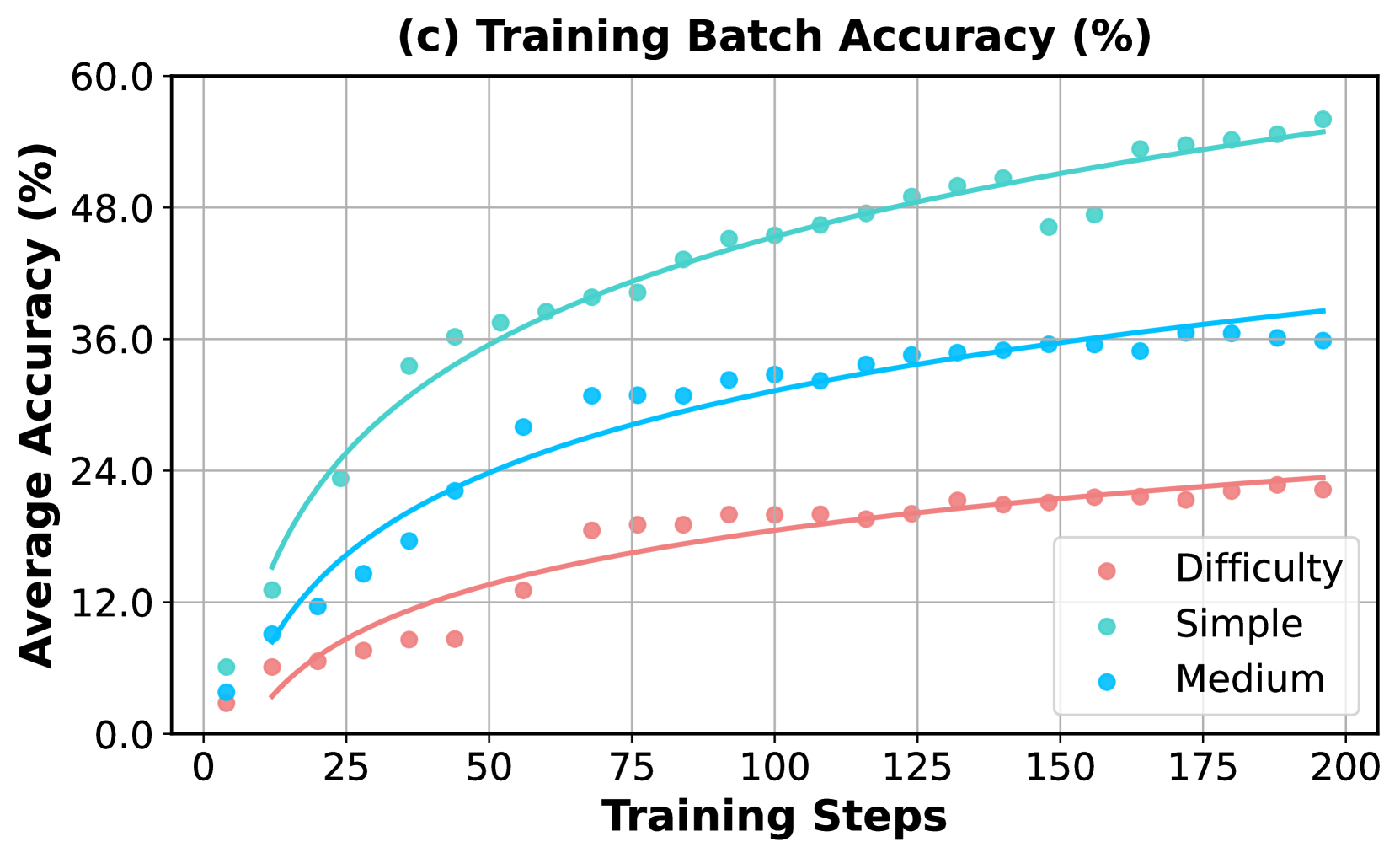
This image displays a line chart showing the average accuracy (%) on the y-axis against training steps on the x-axis. Three distinct data series, representing different difficulty levels (Difficulty, Simple, and Medium), are plotted with corresponding trend lines. The chart illustrates how the average accuracy evolves over training steps for each difficulty category.
### Components/Axes
* **Title:** "(c) Training Batch Accuracy (%)"
* **Y-axis Label:** "Average Accuracy (%)"
* **Scale:** Linear, ranging from 0.0 to 60.0, with major ticks at 0.0, 12.0, 24.0, 36.0, 48.0, and 60.0. Minor grid lines are present at intervals of approximately 4.0.
* **X-axis Label:** "Training Steps"
* **Scale:** Linear, ranging from 0 to 200, with major ticks at 0, 25, 50, 75, 100, 125, 150, 175, and 200. Minor grid lines are present at intervals of approximately 5.0.
* **Legend:** Located in the bottom-right quadrant of the chart.
* **Difficulty:** Represented by pink dots and a pink trend line.
* **Simple:** Represented by teal/cyan dots and a teal/cyan trend line.
* **Medium:** Represented by blue dots and a blue trend line.
### Detailed Analysis or Content Details
**Data Series: Difficulty (Pink)**
* **Trend:** The pink data series shows an upward trend, indicating that the average accuracy for the "Difficulty" category increases with training steps. The rate of increase appears to slow down as training progresses, suggesting a saturation point.
* **Data Points (approximate values):**
* Training Step 0: ~2.0%
* Training Step 10: ~5.0%
* Training Step 25: ~9.0%
* Training Step 35: ~11.0%
* Training Step 50: ~13.0%
* Training Step 65: ~14.5%
* Training Step 75: ~15.5%
* Training Step 90: ~16.5%
* Training Step 100: ~17.0%
* Training Step 115: ~17.5%
* Training Step 125: ~18.0%
* Training Step 140: ~18.5%
* Training Step 150: ~19.0%
* Training Step 165: ~19.5%
* Training Step 175: ~20.0%
* Training Step 190: ~20.5%
* Training Step 200: ~20.8%
**Data Series: Simple (Teal/Cyan)**
* **Trend:** The teal/cyan data series exhibits a strong upward trend, showing the highest average accuracy among the three categories. The accuracy increases rapidly in the initial training steps and then continues to rise, albeit at a slower pace, throughout the observed training period.
* **Data Points (approximate values):**
* Training Step 0: ~4.0%
* Training Step 10: ~14.0%
* Training Step 20: ~23.0%
* Training Step 25: ~27.0%
* Training Step 35: ~32.0%
* Training Step 50: ~36.0%
* Training Step 65: ~39.0%
* Training Step 75: ~41.0%
* Training Step 90: ~43.0%
* Training Step 100: ~44.0%
* Training Step 115: ~45.5%
* Training Step 125: ~46.5%
* Training Step 140: ~47.5%
* Training Step 150: ~48.5%
* Training Step 165: ~49.5%
* Training Step 175: ~50.5%
* Training Step 190: ~51.5%
* Training Step 200: ~52.0%
**Data Series: Medium (Blue)**
* **Trend:** The blue data series also shows a clear upward trend, with accuracy increasing with training steps. This category achieves higher accuracy than "Difficulty" but lower than "Simple." The initial learning rate appears to be substantial, followed by a more gradual increase.
* **Data Points (approximate values):**
* Training Step 0: ~3.0%
* Training Step 10: ~9.0%
* Training Step 20: ~14.0%
* Training Step 25: ~17.0%
* Training Step 35: ~21.0%
* Training Step 50: ~24.0%
* Training Step 65: ~26.5%
* Training Step 75: ~28.0%
* Training Step 90: ~29.5%
* Training Step 100: ~30.5%
* Training Step 115: ~31.5%
* Training Step 125: ~32.5%
* Training Step 140: ~33.0%
* Training Step 150: ~33.5%
* Training Step 165: ~34.0%
* Training Step 175: ~34.5%
* Training Step 190: ~35.0%
* Training Step 200: ~35.5%
### Key Observations
* **Hierarchy of Accuracy:** Across all training steps, the "Simple" category consistently achieves the highest average accuracy, followed by "Medium," and then "Difficulty."
* **Learning Rate:** All three categories show a significant initial increase in accuracy within the first 25-50 training steps. The "Simple" category demonstrates the steepest initial learning curve.
* **Saturation:** While all series are trending upwards, the rate of increase appears to be diminishing for all categories, especially for "Difficulty" and "Medium," suggesting they might be approaching their respective performance ceilings within the observed training range. The "Simple" category shows a more sustained, though still decelerating, improvement.
* **Consistency:** The trend lines closely follow the plotted data points for each category, indicating a good fit and consistent performance within each batch difficulty.
### Interpretation
This chart demonstrates the impact of batch difficulty on the learning process and final accuracy of a model. The data suggests that:
1. **Model Performance is Difficulty-Dependent:** The model is inherently more capable of achieving higher accuracy when presented with simpler data batches. This is a common observation in machine learning, where easier examples allow the model to learn fundamental patterns more effectively.
2. **Training Strategy:** The observed trends imply that a training strategy might involve starting with simpler batches to build a strong foundation and then gradually introducing more complex ones. The "Simple" category's high accuracy suggests it might represent an ideal scenario or a well-learned task.
3. **Learning Dynamics:** The diminishing returns in accuracy as training progresses indicate that the model is converging. The fact that "Difficulty" has the lowest accuracy and a slower learning rate suggests that these batches might contain more noise, ambiguity, or complex features that the model struggles to learn or generalize from.
4. **Peircean Investigative Reading:** From a semiotic perspective, the three lines can be seen as representing different "signs" or "indices" of the model's learning capability under varying conditions. The "Simple" line acts as a "firstness" of potential, showing what the model *can* achieve under ideal circumstances. The "Medium" line represents a "secondness," a more realistic outcome of learning with moderate challenges. The "Difficulty" line, a "thirdness," signifies the struggle and limitations of the model when faced with complex or problematic data. The overall trend across all lines shows the "evolution" of the model's understanding, moving from initial uncertainty (low accuracy at step 0) towards a more stable, albeit varying, state of knowledge. The chart, therefore, is not just a plot of accuracy but a narrative of the model's learning journey and its inherent biases or capabilities related to data complexity.
5. **Reading Between the Lines:** The gap between the "Simple" and "Medium" accuracy, and further between "Medium" and "Difficulty," highlights the significant challenge posed by increased complexity. It suggests that the model's architecture or training objective might be more sensitive to certain types of data variations than others. If the goal is high overall accuracy, a significant portion of the training data might need to be "simple" or the model might require architectural changes to better handle "difficult" batches. The plateauing of accuracy for "Difficulty" might indicate that the model has reached its capacity to learn from these specific challenging examples within the current training paradigm.