## Diagram: Token Grounding Process
### Overview
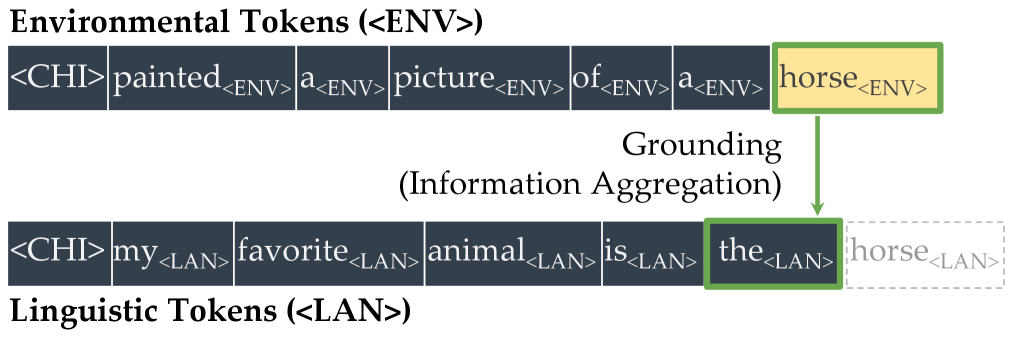
The image is a conceptual diagram illustrating a "Grounding" or "Information Aggregation" process between two parallel sequences of tokens. It demonstrates how a specific token from an "Environmental" sequence is used to inform or replace a token in a corresponding "Linguistic" sequence.
### Components/Axes
The diagram is composed of two horizontal rows of token blocks, a connecting arrow, and descriptive labels.
1. **Top Row: Environmental Tokens (<ENV>)**
* **Label:** "Environmental Tokens (<ENV>)" is written in bold, black text above the row.
* **Token Sequence:** A series of adjacent dark gray rectangular blocks, each containing a token. The sequence is:
`<CHI>`, `painted<ENV>`, `a<ENV>`, `picture<ENV>`, `of<ENV>`, `a<ENV>`, `horse<ENV>`
* **Highlight:** The final token, `horse<ENV>`, is highlighted with a yellow background and a green border.
2. **Bottom Row: Linguistic Tokens (<LAN>)**
* **Label:** "Linguistic Tokens (<LAN>)" is written in bold, black text below the row.
* **Token Sequence:** A similar series of dark gray blocks. The sequence is:
`<CHI>`, `my<LAN>`, `favorite<LAN>`, `animal<LAN>`, `is<LAN>`, `the<LAN>`, `horse<LAN>`
* **Highlight & Modification:** The token `the<LAN>` is outlined with a green border. The final token, `horse<LAN>`, is rendered in a faded, light gray color with a dashed border, indicating it is the target of the grounding process.
3. **Grounding Process**
* **Label:** The text "Grounding (Information Aggregation)" is centered between the two rows.
* **Visual Flow:** A solid green arrow originates from the bottom of the highlighted `horse<ENV>` token in the top row and points directly down to the outlined `the<LAN>` token in the bottom row. This visually represents the flow of information.
### Detailed Analysis
* **Token Structure:** Each token appears to be a word or symbol followed by a subscript tag (`<ENV>` or `<LAN>`), indicating its source or type. The `<CHI>` token at the start of both sequences lacks a subscript, possibly serving as a common initiator or speaker tag.
* **Spatial Grounding:** The legend (the labels "Environmental Tokens" and "Linguistic Tokens") is placed directly above and below their respective data series. The key action—the grounding arrow—is centrally positioned, connecting the specific source (`horse<ENV>`) to the specific target (`the<LAN>`).
* **Process Logic:** The diagram shows a one-to-one mapping. The environmental concept "horse" is being used to ground or specify the linguistic token "the" in the sentence "my favorite animal is the...". The faded `horse<LAN>` suggests that the generic linguistic token "horse" is being superseded or informed by the specific environmental instance.
### Key Observations
1. **Asymmetric Highlighting:** The source token (`horse<ENV>`) is highlighted in yellow, while the target token (`the<LAN>`) is only outlined in green. This may distinguish the *source of information* from the *point of application*.
2. **Token Fading:** The `horse<LAN>` token is visually de-emphasized (faded, dashed border), strongly implying that the grounding process provides a more specific or correct referent than the standalone linguistic token.
3. **Parallel Structure:** The two sequences are structurally parallel (both start with `<CHI>` and contain similar grammatical structures), emphasizing that the grounding is a cross-modal alignment between two different representations of related information.
### Interpretation
This diagram illustrates a core mechanism in multimodal AI or cognitive modeling, where abstract linguistic representations are connected to concrete environmental or sensory data.
* **What it demonstrates:** The process shows how a system might resolve or specify a vague linguistic reference ("the") by grounding it in a concrete entity ("horse") perceived in the environment. The sentence "my favorite animal is the..." is incomplete until the environmental token provides the specific object.
* **Relationship between elements:** The `<ENV>` sequence represents a direct observation or context ("painted a picture of a horse"). The `<LAN>` sequence represents an internal linguistic model or statement. The "Grounding" arrow is the critical link that allows the internal model to be informed by external reality, enabling accurate reference.
* **Underlying concept:** This is a visual metaphor for **symbol grounding**—the problem of how words (symbols) get their meaning. Here, the meaning of "the" in the linguistic chain is grounded in the specific environmental instance of "horse." The faded `horse<LAN>` suggests that without grounding, the linguistic symbol is hollow or ambiguous; grounding fills it with concrete meaning. This is fundamental for tasks like visual question answering, image captioning, or any AI that must connect language to the physical world.