## Diagram: Token Grounding and Information Aggregation
### Overview
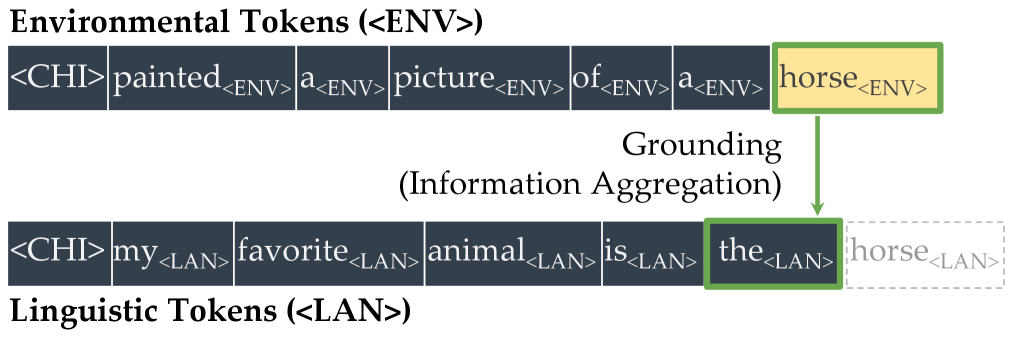
The image illustrates a two-tiered token grounding process, mapping environmental tokens (<ENV>) to linguistic tokens (<LAN>). It emphasizes the relationship between concrete environmental concepts (e.g., "horse") and their linguistic representations, with explicit grounding via a highlighted connection.
### Components/Axes
1. **Sections**:
- **Environmental Tokens (<ENV>)**: Top row, labeled with `<ENV>` tags.
- **Linguistic Tokens (<LAN>)**: Bottom row, labeled with `<LAN>` tags.
2. **Highlighted Tokens**:
- `horse_<ENV>` (yellow background, green border).
- `the_<LAN>` (green border, connected via arrow).
3. **Arrow**:
- Green arrow labeled "Grounding (Information Aggregation)" links `horse_<ENV>` to `the_<LAN>`.
### Detailed Analysis
#### Environmental Tokens (<ENV>)
- Sequence: `<CHI> painted_<ENV> a_<ENV> picture_<ENV> of_<ENV> a_<ENV> horse_<ENV>`.
- Structure:
- `<CHI>`: Likely a context or scene identifier.
- Tokens describe a painted picture of a horse, with `<ENV>` tags indicating environmental grounding.
- `horse_<ENV>` is emphasized via color (yellow) and the grounding arrow.
#### Linguistic Tokens (<LAN>)
- Sequence: `<CHI> my_<LAN> favorite_<LAN> animal_<LAN> is_<LAN> the_<LAN> horse_<LAN>`.
- Structure:
- `<CHI>`: Matches the environmental section, suggesting shared context.
- Tokens form a sentence fragment: "my favorite animal is the horse."
- `the_<LAN>` is highlighted, mirroring the environmental `horse_<ENV>` via the arrow.
#### Grounding Mechanism
- The arrow explicitly connects `horse_<ENV>` (environmental) to `the_<LAN>` (linguistic), indicating a semantic mapping.
- Both highlighted tokens share a green border, reinforcing their linkage.
### Key Observations
1. **Repetition of `<CHI>`**: Appears in both sections, possibly denoting a shared context or identifier.
2. **Token Alignment**:
- Environmental tokens describe a scene (`painted picture of a horse`).
- Linguistic tokens form a sentence fragment referencing the same scene.
3. **Highlighting**:
- `horse_<ENV>` and `the_<LAN>` are visually linked, suggesting they represent the same entity across modalities.
4. **Tagging**:
- `<ENV>` and `<LAN>` tags differentiate token types, critical for grounding tasks.
### Interpretation
This diagram demonstrates **cross-modal grounding**, where environmental data (e.g., visual or sensory tokens) is mapped to linguistic representations. The highlighted connection between `horse_<ENV>` and `the_<LAN>` implies that the system aggregates information to associate concrete entities (e.g., a horse in a scene) with their linguistic counterparts (e.g., the word "the horse").
The repetition of `<CHI>` suggests a shared context or identifier, possibly denoting a specific instance or scenario. The grounding arrow acts as a bridge between modalities, emphasizing the importance of aligning environmental and linguistic data for tasks like natural language understanding or multimodal AI systems.
Notably, the absence of `<LAN>` tags on `horse_<LAN>` (it is grayed out) may indicate it is inferred or derived from the grounding process rather than explicitly labeled. This aligns with how grounding often involves implicit mappings rather than explicit annotations.