## Cognitive Process Diagram: Percentage Calculation
### Overview
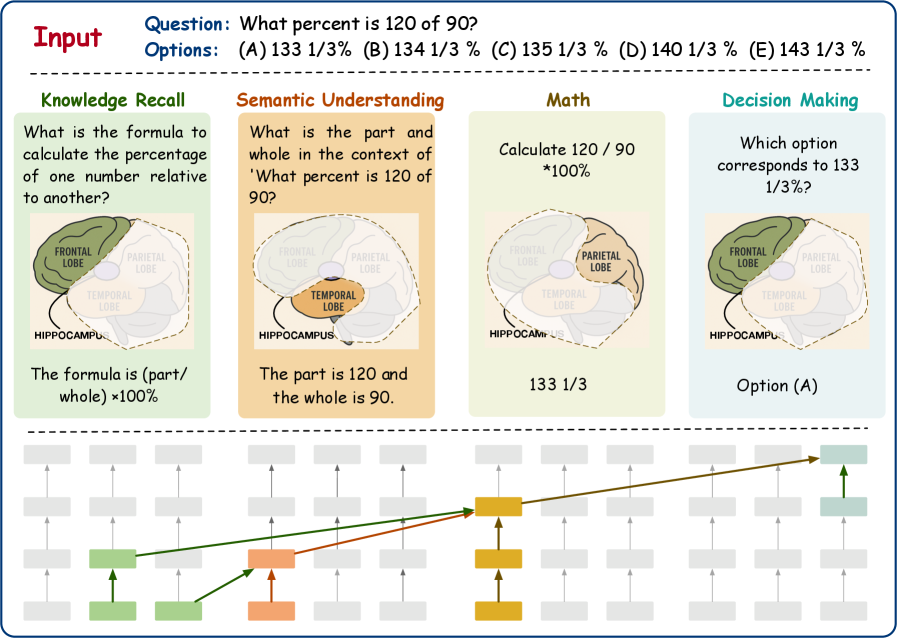
The image illustrates the cognitive processes involved in solving a percentage problem. It breaks down the problem-solving process into four stages: Knowledge Recall, Semantic Understanding, Math, and Decision Making. Each stage is represented with a brain diagram highlighting the relevant brain region and a textual description of the cognitive task. The diagram also includes a neural network representation showing the flow of information between these stages.
### Components/Axes
* **Header:**
* "Input" label in red.
* Question: "What percent is 120 of 90?"
* Options: (A) 133 1/3% (B) 134 1/3% (C) 135 1/3% (D) 140 1/3% (E) 143 1/3%
* **Main Sections (Left to Right):**
* **Knowledge Recall:**
* Title: "Knowledge Recall"
* Text: "What is the formula to calculate the percentage of one number relative to another?"
* Brain Diagram: Frontal lobe highlighted in green. Parietal and Temporal lobes are also labeled. Hippocampus is labeled.
* Text: "The formula is (part/whole) x100%"
* **Semantic Understanding:**
* Title: "Semantic Understanding"
* Text: "What is the part and whole in the context of 'What percent is 120 of 90?'"
* Brain Diagram: Temporal lobe highlighted in orange. Frontal and Parietal lobes are also labeled. Hippocampus is labeled.
* Text: "The part is 120 and the whole is 90."
* **Math:**
* Title: "Math"
* Text: "Calculate 120/90 *100%"
* Brain Diagram: Parietal lobe highlighted in tan. Frontal and Temporal lobes are also labeled. Hippocampus is labeled.
* Text: "133 1/3"
* **Decision Making:**
* Title: "Decision Making"
* Text: "Which option corresponds to 133 1/3%?"
* Brain Diagram: Frontal lobe highlighted in green. Parietal and Temporal lobes are also labeled. Hippocampus is labeled.
* Text: "Option (A)"
* **Neural Network Representation (Bottom):**
* A series of interconnected nodes representing a neural network.
* Nodes are colored grey, green, orange, and yellow, corresponding to the stages above.
* Arrows indicate the flow of information between nodes.
### Detailed Analysis
* **Knowledge Recall:** The frontal lobe is highlighted, suggesting its role in retrieving relevant formulas. The text states the formula for calculating percentage.
* **Semantic Understanding:** The temporal lobe is highlighted, indicating its involvement in understanding the context of the problem. The text identifies the part and the whole from the given question.
* **Math:** The parietal lobe is highlighted, suggesting its role in mathematical calculations. The text shows the calculation and the result.
* **Decision Making:** The frontal lobe is highlighted again, indicating its role in selecting the correct answer based on the calculated result. The text identifies the correct option.
* **Neural Network:**
* The network consists of multiple layers of nodes.
* The initial nodes are green, corresponding to Knowledge Recall.
* These connect to orange nodes, corresponding to Semantic Understanding.
* The orange nodes connect to yellow nodes, corresponding to Math.
* Finally, the yellow nodes connect to green nodes, corresponding to Decision Making.
* The arrows indicate the flow of information from one stage to the next.
### Key Observations
* The diagram clearly illustrates the different cognitive stages involved in solving a percentage problem.
* Each stage is associated with a specific brain region and a corresponding cognitive task.
* The neural network representation shows the flow of information between these stages.
* The diagram highlights the importance of both knowledge recall and semantic understanding in solving mathematical problems.
### Interpretation
The diagram demonstrates a simplified model of how the brain processes a mathematical problem. It suggests that solving such problems involves a sequence of cognitive stages, each relying on different brain regions and cognitive functions. The flow of information between these stages is crucial for arriving at the correct solution. The diagram also emphasizes the interconnectedness of different cognitive processes, highlighting the importance of both knowledge and understanding in problem-solving. The neural network representation, although simplified, provides a visual analogy for how information might be processed and transmitted within the brain during this process.