\n
## Diagram: Clinical Reasoning for Stroke Diagnosis
### Overview
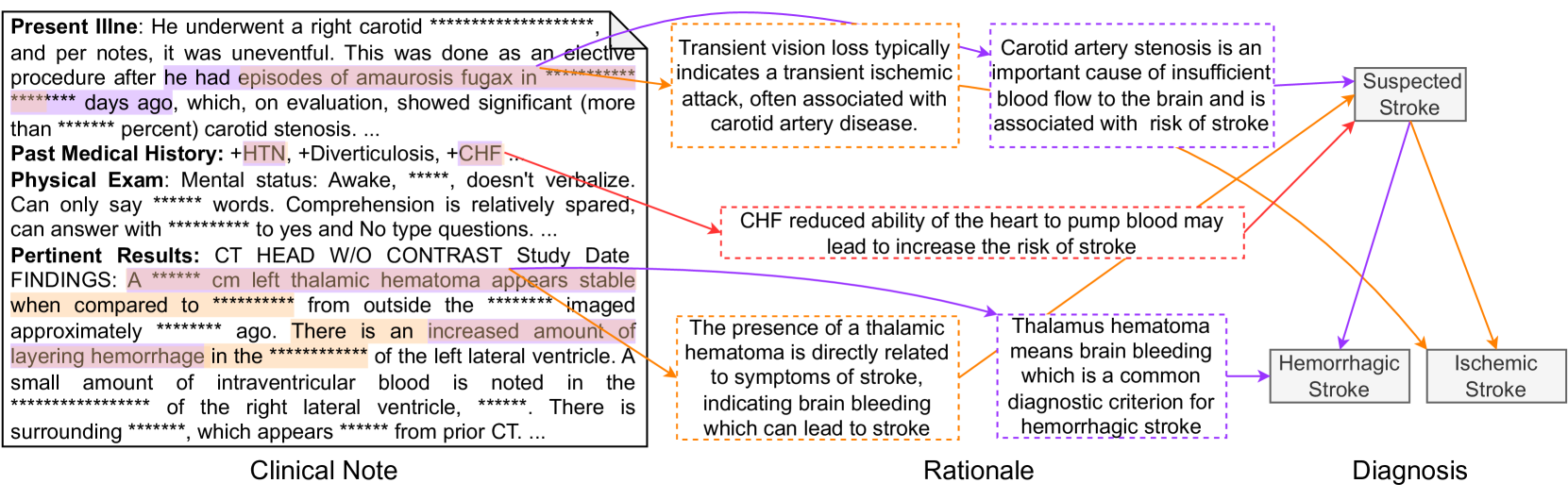
This diagram illustrates the clinical reasoning process for diagnosing stroke, linking clinical notes, rationale, and potential diagnoses (suspected stroke, hemorrhagic stroke, ischemic stroke). It presents a flow of information from patient presentation (Clinical Note) through the underlying medical reasoning (Rationale) to the final diagnostic possibilities (Diagnosis). The diagram uses colored arrows to indicate the relationships between these elements.
### Components/Axes
The diagram is divided into three main sections, positioned horizontally:
* **Clinical Note** (Left): Contains patient medical information.
* **Rationale** (Center): Explains the medical reasoning connecting the clinical note to the diagnosis.
* **Diagnosis** (Right): Lists potential diagnoses.
The diagram uses arrows to show the flow of information. Red arrows indicate a connection to "Suspected Stroke" and "Hemorrhagic Stroke", while purple arrows indicate a connection to "Ischemic Stroke".
### Detailed Analysis or Content Details
**Clinical Note:**
The clinical note contains the following information, with some values obscured by asterisks:
* **Present Illness:** Patient underwent a right carotid procedure, was uneventful. Episodes of amaurosis fugax for approximately `******` days, which showed significant (more than `******` percent) carotid stenosis.
* **Past Medical History:** +HTN, +Diverticulosis, +CHF.
* **Physical Exam:** Mental status: Awake, `******`, doesn't verbalize. Can only say `******` words. Comprehension is relatively spared, can answer with `******` to yes and no type questions.
* **Pertinent Results: CT HEAD W/O CONTRAST Study Date FINDINGS:** A `******` cm left thalamic hematoma appears stable when compared to `******` from outside the `******` imaged approximately `******` ago. There is an increased amount of layering hemorrhage in the `******` of the left lateral ventricle. A small amount of intraventricular blood is noted in the `******` of the right lateral ventricle, `******`. There is surrounding `******`, which appears from prior CT.
**Rationale:**
* Transient vision loss typically indicates a transient ischemic attack, often associated with carotid artery disease.
* Carotid artery stenosis is an important cause of insufficient blood flow to the brain and is associated with risk of stroke.
* CHF reduced ability of the heart to pump blood may lead to increase the risk of stroke.
* The presence of a thalamic hematoma is directly related to symptoms of stroke, indicating brain bleeding which can lead to stroke.
* Thalamus hematoma means brain bleeding which is a common diagnostic criterion for hemorrhagic stroke.
**Diagnosis:**
* Suspected Stroke
* Hemorrhagic Stroke
* Ischemic Stroke
**Arrow Connections:**
* The Clinical Note connects to "Suspected Stroke" via a red arrow.
* The Clinical Note connects to "Hemorrhagic Stroke" via a red arrow.
* The Rationale section connects to "Hemorrhagic Stroke" via a red arrow.
* The Rationale section connects to "Ischemic Stroke" via a purple arrow.
### Key Observations
The diagram highlights the connection between carotid stenosis, CHF, and thalamic hematoma to the potential diagnoses of stroke. The presence of a thalamic hematoma strongly suggests hemorrhagic stroke. The diagram emphasizes the importance of considering both ischemic and hemorrhagic stroke in the differential diagnosis.
### Interpretation
This diagram represents a simplified model of clinical reasoning in stroke diagnosis. It demonstrates how a physician integrates patient history, physical exam findings, and imaging results to arrive at a diagnosis. The diagram emphasizes the importance of considering multiple potential diagnoses and the need to weigh the evidence carefully. The obscured values (`******`) indicate that this is likely a template or example, and specific patient data would fill in those gaps. The use of color-coded arrows helps to visually represent the strength of the association between different elements. The diagram suggests that the patient's presentation (Clinical Note) points towards both ischemic and hemorrhagic stroke possibilities, requiring further investigation to differentiate between the two. The rationale section provides the medical basis for these diagnostic considerations. The diagram is a useful tool for illustrating the diagnostic process and for educating healthcare professionals.