## Violin Plot: Comparison of Mean Capacity Factors Across Energy Models
### Overview
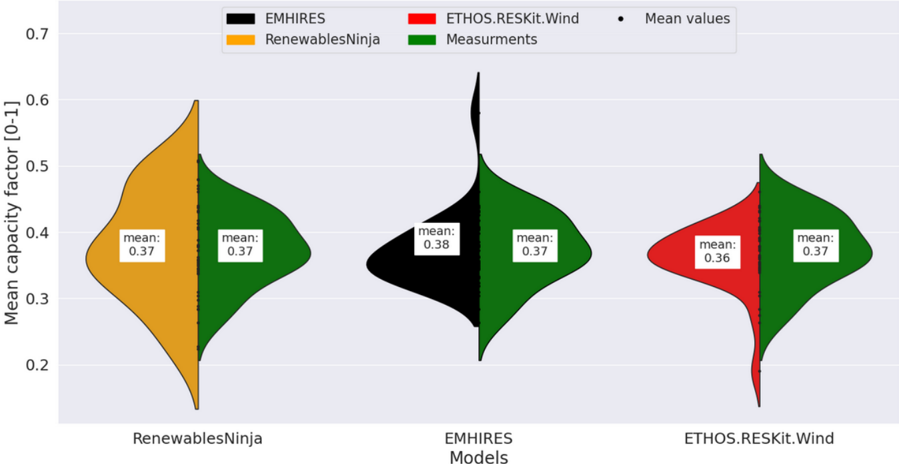
The image presents a comparative analysis of mean capacity factors for three energy models (RenewablesNinja, EMHIRES, ETHOS.RESKIt.Wind) against empirical measurements. Each model is represented by a violin plot split into two sections: one for the model's predictions (colored) and one for empirical measurements (green). Mean values are annotated on each plot, with a legend clarifying color associations.
### Components/Axes
- **X-axis**: Labeled "Models" with categories:
- RenewablesNinja (yellow)
- EMHIRES (black)
- ETHOS.RESKIt.Wind (red)
- **Y-axis**: Labeled "Mean capacity factor [0-1]" with a scale from 0.2 to 0.7.
- **Legend**: Located at the top-right corner, mapping colors to categories:
- Black: EMHIRES
- Red: ETHOS.RESKIt.Wind
- Yellow: RenewablesNinja
- Green: Measurements
- **Mean markers**: Black dots indicating mean values for each model.
### Detailed Analysis
1. **RenewablesNinja (Yellow)**:
- Mean capacity factor: **0.37** (annotated on the yellow section).
- Distribution: Symmetrical with a slight skew toward higher values.
- Overlap with green (measurements): The green section (measurements) has a mean of **0.37**, matching the model's prediction.
2. **EMHIRES (Black)**:
- Mean capacity factor: **0.38** (annotated on the black section).
- Distribution: Narrower spread compared to other models, indicating lower variability.
- Overlap with green (measurements): The green section has a mean of **0.37**, slightly lower than the model's prediction.
3. **ETHOS.RESKIt.Wind (Red)**:
- Mean capacity factor: **0.36** (annotated on the red section).
- Distribution: Broader spread with a slight skew toward lower values.
- Overlap with green (measurements): The green section has a mean of **0.37**, slightly higher than the model's prediction.
### Key Observations
- All models show mean capacity factors close to the empirical measurements (green), with EMHIRES (0.38) being the highest and ETHOS.RESKIt.Wind (0.36) the lowest.
- The green "Measurements" sections for each model have nearly identical means (~0.37), suggesting consistent empirical data across scenarios.
- EMHIRES exhibits the smallest variability (narrowest violin), while ETHOS.RESKIt.Wind shows the largest spread.
- The mean markers (black dots) align closely with the annotated values, confirming accuracy.
### Interpretation
The data suggests that:
1. **Model Calibration**: All models are reasonably calibrated to empirical measurements, with mean capacity factors within ±0.01 of the green "Measurements" section.
2. **Performance Variance**: EMHIRES outperforms the others slightly (0.38 vs. 0.37 for RenewablesNinja and 0.36 for ETHOS.RESKIt.Wind), though differences are marginal.
3. **Predictive Uncertainty**: The broader distributions for ETHOS.RESKIt.Wind and RenewablesNinja imply higher uncertainty in their predictions compared to EMHIRES.
4. **Measurement Consistency**: The near-identical means of the green sections (0.37) across models indicate that empirical data is stable, serving as a reliable benchmark.
This analysis highlights the trade-offs between model accuracy, variability, and calibration to real-world measurements, with EMHIRES emerging as the most consistent performer.