TECHNICAL ASSET FINGERPRINT
9e1214f03789b060fa9e4e61
Click to view fullscreen
Press ESC or click to close
FOUND IN PAPERS
EXPERT: healer-alpha-free VERSION 1
RUNTIME: free/openrouter/healer-alpha
INTEL_VERIFIED
## Cognitive Architecture Diagram: Memory System Interactions
### Overview
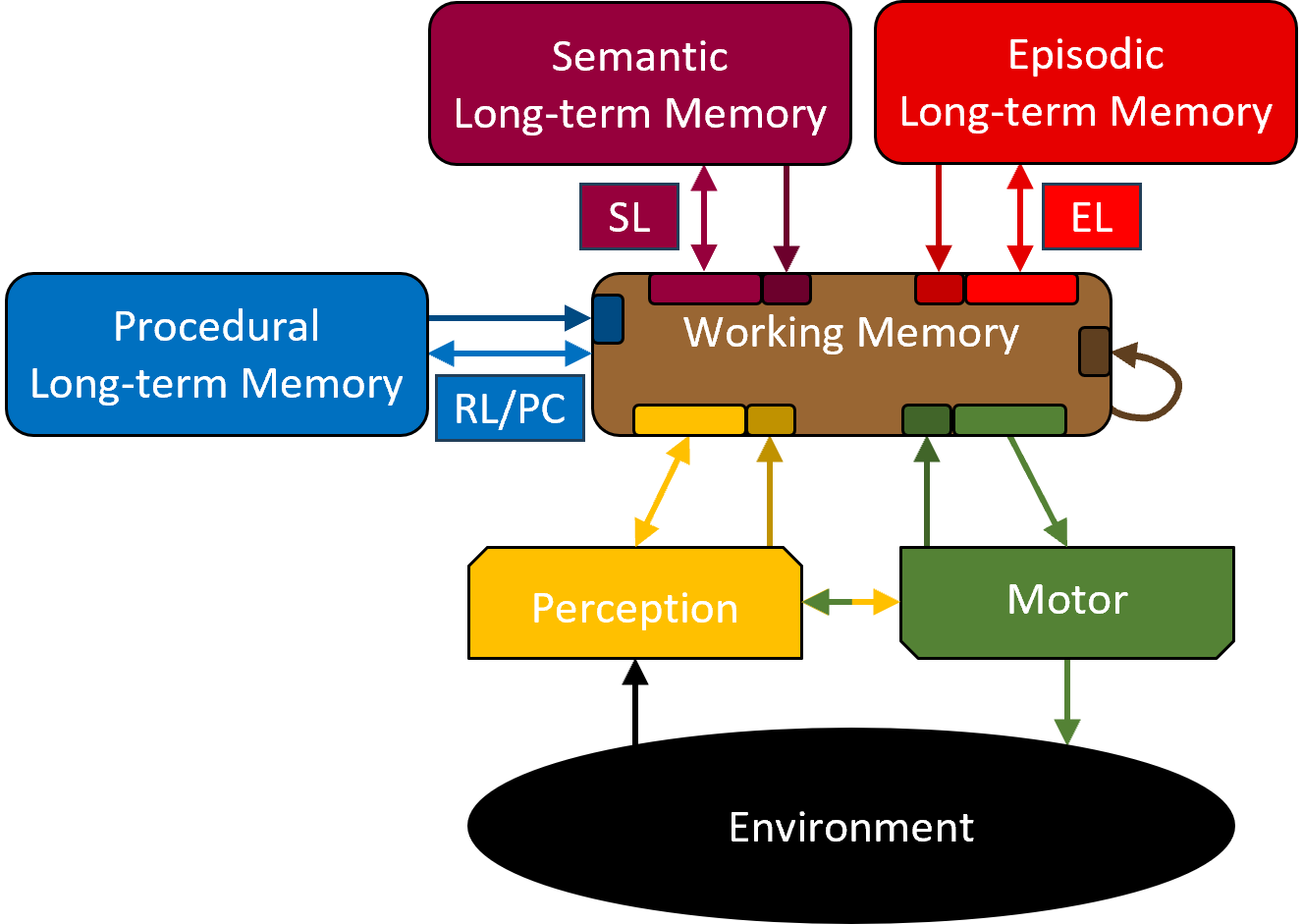
The image is a technical block diagram illustrating a cognitive architecture model. It depicts the structural components of a memory system and their functional interconnections, showing how information flows between different types of memory, perceptual and motor systems, and the external environment. The diagram uses color-coded blocks and directional arrows to represent components and data pathways.
### Components/Axes
The diagram consists of seven primary components, each represented by a colored block with a text label. Their spatial arrangement and connections are as follows:
1. **Semantic Long-term Memory** (Maroon block, top-left)
* Contains the text: "Semantic Long-term Memory"
* Has a smaller attached maroon block labeled "SL".
* **Connections**: Bidirectional arrows (one up, one down) connect it to the central "Working Memory" block.
2. **Episodic Long-term Memory** (Red block, top-right)
* Contains the text: "Episodic Long-term Memory"
* Has a smaller attached red block labeled "EL".
* **Connections**: Bidirectional arrows (one up, one down) connect it to the central "Working Memory" block.
3. **Procedural Long-term Memory** (Blue block, middle-left)
* Contains the text: "Procedural Long-term Memory"
* Has a smaller attached blue block labeled "RL/PC".
* **Connections**: Bidirectional arrows (one right, one left) connect it to the central "Working Memory" block.
4. **Working Memory** (Brown block, center)
* Contains the text: "Working Memory".
* This is the central hub of the diagram. It has colored tabs on its top and bottom edges that correspond to the colors of the connected modules (maroon, red, yellow, green), visually indicating integration points.
* **Connections**: It has a self-referential loop arrow on its right side. It receives inputs from and sends outputs to all other major components except the Environment.
5. **Perception** (Yellow block, bottom-left)
* Contains the text: "Perception".
* **Connections**: A bidirectional arrow connects it to the "Motor" block. Two arrows (one yellow, one brown) connect it to "Working Memory" (one up, one down). A black arrow points upward from the "Environment" to this block.
6. **Motor** (Green block, bottom-right)
* Contains the text: "Motor".
* **Connections**: A bidirectional arrow connects it to the "Perception" block. Two arrows (one green, one brown) connect it to "Working Memory" (one up, one down). A green arrow points downward from this block to the "Environment".
7. **Environment** (Black oval, bottom-center)
* Contains the text: "Environment".
* **Connections**: It is the source of input (black arrow to "Perception") and the target of output (green arrow from "Motor").
### Detailed Analysis
**Information Flow and Relationships:**
* **Central Integration**: "Working Memory" is the central processing unit. It has direct, bidirectional communication channels with all three long-term memory stores (Semantic, Episodic, Procedural) and the Perception/Motor systems.
* **Long-Term Memory Specialization**: The three long-term memory types are distinct but interconnected via Working Memory.
* **Semantic** (facts/knowledge) and **Episodic** (events/experiences) memories are positioned symmetrically at the top, suggesting they are higher-level, declarative memory systems.
* **Procedural** (skills/how-to) memory is positioned to the side, connected via a pathway labeled "RL/PC" (likely Reinforcement Learning / Procedural Conditioning).
* **Sensorimotor Loop**: A clear loop exists between the external "Environment" and the internal cognitive system:
1. Information flows from the **Environment** to **Perception** (black arrow).
2. **Perception** processes this input and communicates with **Working Memory**.
3. **Working Memory** integrates this with information from long-term memories and sends commands to the **Motor** system.
4. The **Motor** system executes actions, affecting the **Environment** (green arrow).
5. There is also direct cross-talk between **Perception** and **Motor** systems (bidirectional arrow).
* **Internal Processing**: The self-loop on "Working Memory" indicates internal rehearsal, maintenance, or manipulation of information independent of external input or long-term memory retrieval.
### Key Observations
* **Color-Coding Consistency**: The diagram uses color consistently to link components and their connection points. For example, the maroon tab on Working Memory aligns with the Semantic Memory block and its connecting arrows.
* **Asymmetry in Connections**: While Semantic and Episodic memories have identical connection patterns, Procedural memory's connection is labeled with "RL/PC," hinting at a different underlying mechanism (learning-based vs. storage/retrieval).
* **Bidirectional Dominance**: Almost all connections are bidirectional, emphasizing interactive, two-way communication rather than a simple linear pipeline. The primary exceptions are the unidirectional flows from the Environment to Perception and from Motor to the Environment, defining the system's input and output boundaries.
### Interpretation
This diagram presents a functional model of an intelligent agent's cognitive architecture. It suggests that:
1. **Working Memory is the Nexus**: All conscious processing, integration of new sensory data with past knowledge (from long-term memory), and planning of actions occur within Working Memory. Its central position and numerous connections highlight its critical role as a bottleneck and integrator.
2. **Memory is Modular but Integrated**: Different types of knowledge (what, when, how) are stored in specialized long-term memory systems but are dynamically accessed and combined in Working Memory to guide behavior.
3. **Cognition is Embodied and Situated**: The system is not closed; it is fundamentally coupled with an external Environment through Perception and Action (Motor). This reflects an embodied cognition perspective, where thinking is inseparable from interacting with the world.
4. **The Model Implies Learning**: The "RL/PC" label on the Procedural memory pathway and the closed-loop interaction with the environment suggest the system can learn from experience, updating its procedural skills based on outcomes.
The architecture balances specialized processing (different memory types) with a centralized integrator (Working Memory), all grounded in environmental interaction. It provides a blueprint for understanding or building a system that perceives, remembers, thinks, and acts.
DECODING INTELLIGENCE...