## Line Chart: Accuracy vs. Attack Ratio for Different Federated Learning Algorithms
### Overview
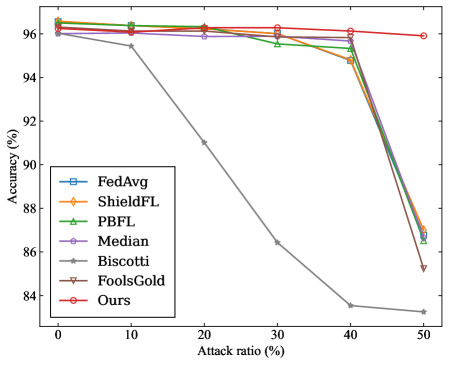
The image is a line chart comparing the accuracy of different federated learning algorithms as the attack ratio increases. The x-axis represents the attack ratio (percentage), and the y-axis represents the accuracy (percentage). Several algorithms are compared, including FedAvg, ShieldFL, PBFL, Median, Biscotti, FoolsGold, and "Ours".
### Components/Axes
* **X-axis:** Attack ratio (%), with markers at 0, 10, 20, 30, 40, and 50.
* **Y-axis:** Accuracy (%), with markers at 84, 86, 88, 90, 92, 94, and 96.
* **Legend:** Located on the left side of the chart, listing the algorithms and their corresponding line colors and markers:
* FedAvg (blue, square marker)
* ShieldFL (orange, diamond marker)
* PBFL (green, triangle marker)
* Median (purple, circle marker)
* Biscotti (gray, star marker)
* FoolsGold (brown, inverted triangle marker)
* Ours (red, circle marker)
### Detailed Analysis
* **FedAvg (blue, square marker):** Starts at approximately 96.2% accuracy at 0% attack ratio. It remains relatively stable until an attack ratio of 40%, where it begins to drop sharply, reaching approximately 87% at 50% attack ratio.
* (0, 96.2)
* (10, 96.2)
* (20, 96.2)
* (30, 95.8)
* (40, 95.2)
* (50, 87)
* **ShieldFL (orange, diamond marker):** Starts at approximately 96.3% accuracy at 0% attack ratio. It remains relatively stable until an attack ratio of 40%, where it begins to drop sharply, reaching approximately 87% at 50% attack ratio.
* (0, 96.3)
* (10, 96.2)
* (20, 96.2)
* (30, 96.1)
* (40, 95.1)
* (50, 87)
* **PBFL (green, triangle marker):** Starts at approximately 96.4% accuracy at 0% attack ratio. It remains relatively stable until an attack ratio of 40%, where it begins to drop sharply, reaching approximately 87% at 50% attack ratio.
* (0, 96.4)
* (10, 96.3)
* (20, 96.2)
* (30, 95.7)
* (40, 95.3)
* (50, 87.2)
* **Median (purple, circle marker):** Starts at approximately 96.1% accuracy at 0% attack ratio. It remains relatively stable until an attack ratio of 40%, where it begins to drop sharply, reaching approximately 87% at 50% attack ratio.
* (0, 96.1)
* (10, 96.1)
* (20, 96.1)
* (30, 96)
* (40, 95.9)
* (50, 87.3)
* **Biscotti (gray, star marker):** Starts at approximately 96.1% accuracy at 0% attack ratio. It decreases linearly as the attack ratio increases, reaching approximately 83% at 50% attack ratio.
* (0, 96.1)
* (10, 95.5)
* (20, 91)
* (30, 87.5)
* (40, 83.5)
* (50, 83)
* **FoolsGold (brown, inverted triangle marker):** Starts at approximately 96.3% accuracy at 0% attack ratio. It remains relatively stable until an attack ratio of 40%, where it begins to drop sharply, reaching approximately 85.5% at 50% attack ratio.
* (0, 96.3)
* (10, 96.2)
* (20, 96.1)
* (30, 95.9)
* (40, 94.8)
* (50, 85.5)
* **Ours (red, circle marker):** Starts at approximately 96.5% accuracy at 0% attack ratio. It remains relatively stable until an attack ratio of 40%, where it begins to drop sharply, reaching approximately 87.5% at 50% attack ratio.
* (0, 96.5)
* (10, 96.4)
* (20, 96.3)
* (30, 96.2)
* (40, 96)
* (50, 87.5)
### Key Observations
* The Biscotti algorithm (gray line) is the most sensitive to increasing attack ratios, showing a steady decline in accuracy.
* The other algorithms (FedAvg, ShieldFL, PBFL, Median, FoolsGold, and "Ours") maintain relatively high accuracy until the attack ratio reaches 40%, after which their accuracy drops sharply.
* The "Ours" algorithm (red line) appears to have the highest accuracy at 0% attack ratio and maintains a slightly higher accuracy than the other algorithms until the 40% attack ratio mark.
* At 50% attack ratio, the algorithms FedAvg, ShieldFL, PBFL, Median, and "Ours" converge to a similar accuracy level.
### Interpretation
The chart demonstrates the impact of increasing attack ratios on the accuracy of different federated learning algorithms. The Biscotti algorithm is significantly more vulnerable to attacks compared to the other algorithms tested. The algorithms FedAvg, ShieldFL, PBFL, Median, FoolsGold, and "Ours" exhibit similar resilience to attacks up to a certain threshold (40% attack ratio), beyond which their performance degrades rapidly. The "Ours" algorithm shows a slight advantage in maintaining higher accuracy at lower attack ratios. The data suggests that the choice of federated learning algorithm is crucial in environments where adversarial attacks are a concern, and that some algorithms are better equipped to handle such attacks than others.