\n
## Diagram: NEON-RVV Intrinsics Migration
### Overview
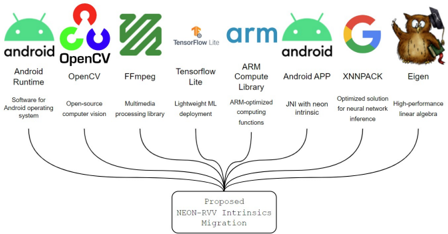
The image is a diagram illustrating the components feeding into a "Proposed NEON-RVV Intrinsics Migration". It depicts eight different software/library components arranged horizontally above converging arrows that point to the migration proposal. Each component is labeled with its name and a brief description.
### Components/Axes
The diagram consists of the following components, arranged horizontally from left to right:
1. **Android Runtime:** "Software for Android operating system"
2. **OpenCV:** "Open-source computer vision"
3. **FFmpeg:** "Multimedia processing library"
4. **Tensorflow Lite:** "Lightweight ML deployment"
5. **ARM Compute Library:** "ARM-optimized computing functions"
6. **Android APP:** "JNI with neon intrinsic"
7. **XNNPACK:** "Optimized solution for neural network inference"
8. **Eigen:** "High-performance linear algebra"
Below these components is a rectangular box labeled:
**Proposed NEON-RVV Intrinsics Migration**
Arrows converge from each component towards this box.
### Detailed Analysis or Content Details
The diagram does not contain numerical data or axes. It is a visual representation of dependencies or inputs to a proposed migration. The components are positioned in a single row, with the migration proposal positioned centrally below them. The arrows indicate a flow of information or dependency towards the migration.
### Key Observations
The diagram highlights the diverse range of software components involved in the proposed NEON-RVV Intrinsics Migration. These components span operating system runtime, computer vision, multimedia processing, machine learning, and numerical computation. The inclusion of "JNI with neon intrinsic" suggests a focus on leveraging existing Neon intrinsics during the migration process.
### Interpretation
The diagram suggests that the "Proposed NEON-RVV Intrinsics Migration" aims to integrate or optimize these eight components with a new architecture (RVV). The convergence of arrows indicates that the migration will likely involve modifications or adaptations to each of these components. The diversity of the components suggests a broad scope for the migration, potentially impacting various aspects of Android software development and performance. The diagram doesn't provide details on *how* the migration will be achieved, only *what* components are involved. The emphasis on Neon intrinsics suggests a phased approach, potentially leveraging existing optimizations before fully transitioning to RVV. The diagram is a high-level overview and doesn't delve into the technical specifics of the migration process.