\n
## Diagram: LLMs Meet KGs - A Taxonomy of Approaches
### Overview
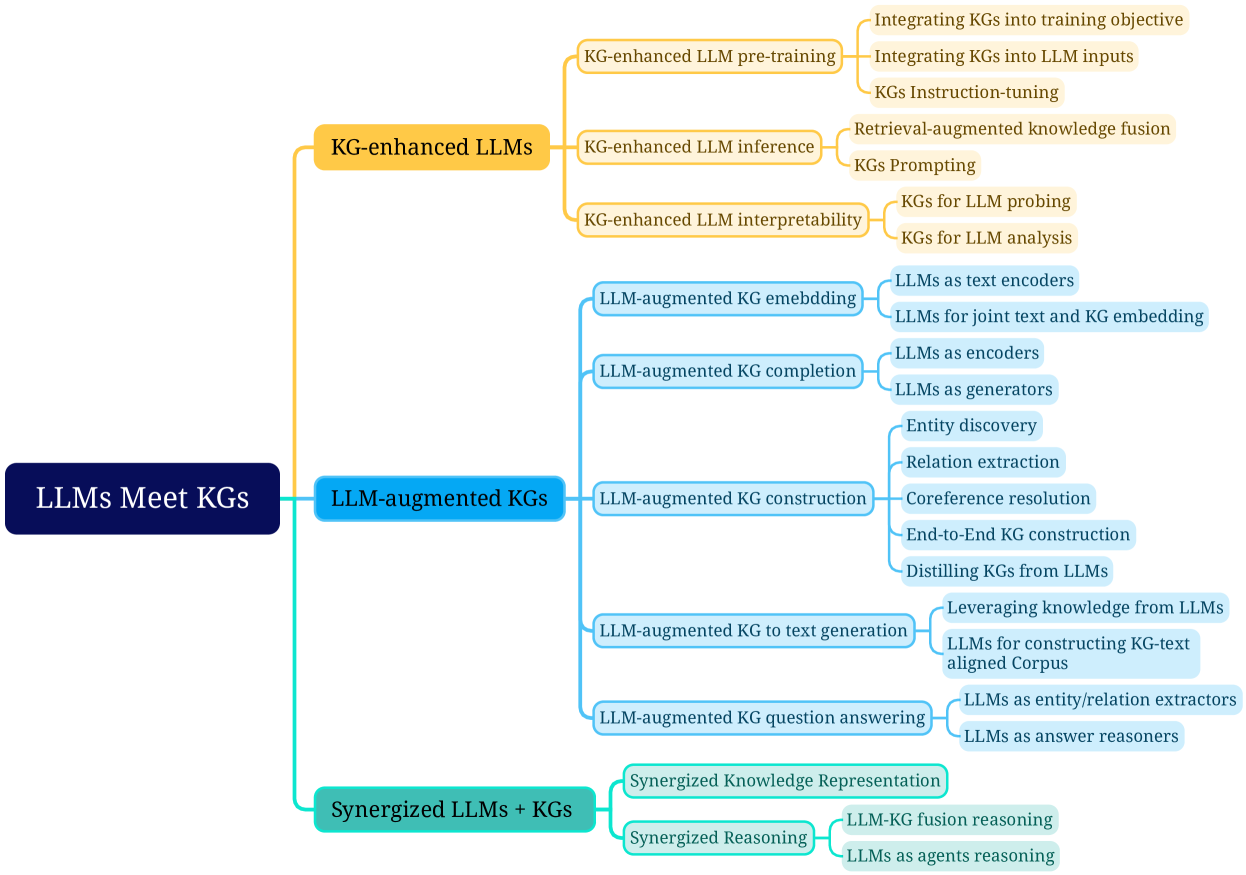
The image is a diagram illustrating a taxonomy of approaches at the intersection of Large Language Models (LLMs) and Knowledge Graphs (KGs). It categorizes these approaches into four main areas: KG-enhanced LLMs, LLM-augmented KGs, LLMs Meet KGs (a central connector), and Synergized LLMs + KGs. Each area branches out into more specific techniques, represented as rectangular nodes connected by arrows. The diagram visually represents a hierarchical relationship between these techniques.
### Components/Axes
The diagram is structured around four primary categories, positioned vertically and horizontally. The categories are:
* **KG-enhanced LLMs** (Leftmost column, yellow boxes)
* **LLMs Meet KGs** (Central connector, green boxes)
* **LLM-augmented KGs** (Rightmost column, cyan boxes)
* **Synergized LLMs + KGs** (Bottom, teal boxes)
Each category has sub-categories, indicated by the rectangular nodes. Arrows connect these nodes, suggesting a flow or relationship between them. There are no explicit axes or scales in the traditional chart sense.
### Detailed Analysis or Content Details
**1. KG-enhanced LLMs (Yellow)**
* **KG-enhanced LLM pre-training:**
* Integrating KGs into training objective
* Integrating KGs into LLM inputs
* KGs Instruction-tuning
* Retrieval-augmented knowledge fusion
* **KG-enhanced LLM inference:**
* KGs Prompting
* **KG-enhanced LLM interpretability:**
* KGs for LLM probing
* KGs for LLM analysis
**2. LLMs Meet KGs (Green)**
* **LLM-augmented KG embedding:**
* LLMs as text encoders
* LLMs for joint text and KG embedding
* **LLM-augmented KG completion:**
* LLMs as encoders
* LLMs as generators
* **LLM-augmented KG construction:**
* Entity discovery
* Relation extraction
* Coreference resolution
* End-to-End KG construction
* Distilling KGs from LLMs
* **LLM-augmented KG to text generation:**
* Leveraging knowledge from LLMs
* LLMs for constructing KG-text aligned Corpus
* **LLM-augmented KG question answering:**
* LLMs as entity/relation extractors
* LLMs as answer reasoners
**3. LLM-augmented KGs (Cyan)**
* No specific sub-categories are listed.
**4. Synergized LLMs + KGs (Teal)**
* **Synergized Knowledge Representation:**
* LLM-KG fusion reasoning
* **Synergized Reasoning:**
* LLMs as agents reasoning
The diagram uses arrows to indicate relationships between the categories and sub-categories. The positioning of the categories suggests a progression or interplay between them.
### Key Observations
The diagram highlights the diverse ways LLMs and KGs can be integrated. The "LLMs Meet KGs" category appears to be a central hub, connecting the KG-enhanced LLMs and LLM-augmented KGs. The "Synergized LLMs + KGs" category represents a more advanced stage of integration, focusing on reasoning and knowledge representation. The diagram is not quantitative; it's a qualitative representation of different approaches.
### Interpretation
This diagram illustrates the evolving landscape of research combining LLMs and KGs. It suggests a shift from simply enhancing LLMs with KGs (KG-enhanced LLMs) or augmenting KGs with LLMs (LLM-augmented KGs) towards a more synergistic approach where both technologies work together to achieve more complex tasks (Synergized LLMs + KGs). The "LLMs Meet KGs" category acts as a bridge, showcasing various intermediate techniques like KG embedding, completion, construction, and question answering.
The diagram implies that the field is moving beyond simply using one technology to improve the other and is now exploring how to create truly integrated systems that leverage the strengths of both LLMs (reasoning, language understanding) and KGs (structured knowledge, explainability). The lack of specific data points suggests this is a conceptual overview rather than a quantitative analysis of performance. The diagram serves as a useful taxonomy for researchers and practitioners in this rapidly developing field. It provides a framework for understanding the different approaches and identifying potential areas for future research.