## Diagram: Network Flow with Central Node
### Overview
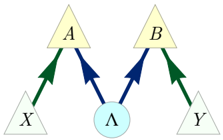
The image displays a directed graph or network diagram consisting of five nodes connected by four directional arrows. The diagram is symmetric along a vertical axis, with a central node influencing two upper nodes, which in turn are influenced by two lower peripheral nodes. The visual style uses simple geometric shapes with color-coded arrows to indicate different types of relationships or flows.
### Components/Axes
**Nodes (Shapes & Labels):**
1. **Top-Left Node:** A light yellow triangle labeled with the capital letter **"A"**.
2. **Top-Right Node:** A light yellow triangle labeled with the capital letter **"B"**.
3. **Bottom-Left Node:** A white triangle with a black outline, labeled with the capital letter **"X"**.
4. **Bottom-Right Node:** A white triangle with a black outline, labeled with the capital letter **"Y"**.
5. **Central Node:** A light blue circle labeled with the Greek capital letter **"Λ"** (Lambda).
**Connections (Arrows):**
* **Arrow 1 (Green):** Originates from the top of node **X** and points to the bottom-left side of node **A**.
* **Arrow 2 (Blue):** Originates from the top-left of node **Λ** and points to the bottom-right side of node **A**.
* **Arrow 3 (Blue):** Originates from the top-right of node **Λ** and points to the bottom-left side of node **B**.
* **Arrow 4 (Green):** Originates from the top of node **Y** and points to the bottom-right side of node **B**.
**Spatial Layout:**
* Nodes **A** and **B** are positioned at the top, horizontally aligned.
* Nodes **X** and **Y** are positioned at the bottom, horizontally aligned and directly below **A** and **B** respectively.
* Node **Λ** is positioned in the bottom-center, horizontally between **X** and **Y**, and vertically below the midpoint between **A** and **B**.
### Detailed Analysis
The diagram defines a clear relational structure:
* **Node A** receives two inputs: a green arrow from **X** and a blue arrow from **Λ**.
* **Node B** receives two inputs: a blue arrow from **Λ** and a green arrow from **Y**.
* **Node Λ** is a central source, sending blue arrows to both **A** and **B**.
* **Nodes X and Y** are peripheral sources, each sending a single green arrow to their corresponding upper node (**X→A**, **Y→B**).
The color coding is consistent: all arrows originating from the peripheral nodes (**X**, **Y**) are **green**, while all arrows originating from the central node (**Λ**) are **blue**.
### Key Observations
1. **Symmetry:** The diagram exhibits near-perfect bilateral symmetry. The left side (X, A, and their connection) mirrors the right side (Y, B, and their connection) in structure and color.
2. **Central Influence:** Node **Λ** has a dual influence, affecting both primary upper nodes (**A** and **B**), making it a pivotal component in the network.
3. **Dual Input Structure:** Both **A** and **B** are composite nodes, each integrating signals from two distinct sources (one peripheral, one central).
4. **Visual Hierarchy:** The use of color (yellow for top nodes, blue for center, white for bottom) and shape (triangles vs. circle) creates a clear visual hierarchy, distinguishing the roles of the nodes.
### Interpretation
This diagram models a system where two primary entities (**A** and **B**) are formed or influenced by the combination of a dedicated, specific input (**X** for **A**, **Y** for **B**) and a common, central input (**Λ**).
* **Possible Meanings:** It could represent:
* A **decision-making model** where **A** and **B** are conclusions based on specific evidence (**X**, **Y**) and a shared underlying principle or bias (**Λ**).
* A **biological or chemical pathway** where **A** and **B** are compounds synthesized from specific precursors (**X**, **Y**) and a common catalyst or enzyme (**Λ**).
* An **information processing system** where **A** and **B** are processed outputs combining dedicated data streams (**X**, **Y**) with a global context or filter (**Λ**).
* **The Role of Λ (Lambda):** As the central, uniquely shaped node, **Λ** represents a unifying or modulating factor. Its influence is not direct on the final outputs but is mediated through the intermediate nodes **A** and **B**. The Greek letter Lambda often signifies a parameter, a function, or a wavelength in technical contexts, suggesting **Λ** is a variable or controlling function in this system.
* **System Behavior:** The structure suggests that **A** and **B** are not independent; they are correlated because they share a common input (**Λ**). However, their individuality is maintained by their unique inputs (**X** and **Y**). The system's output would be the state or values of **A** and **B**, which are co-determined by both specific and general factors.