## Geometry Problem: Circle Tangent and Angle Calculation
### Overview
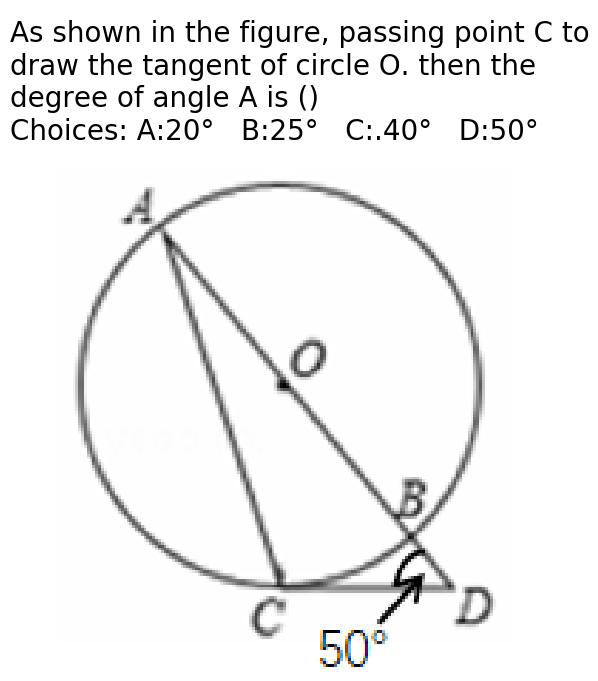
This image presents a geometry problem involving a circle with center O, a tangent line, and an inscribed angle. The problem asks to find the measure of angle A given that line CD is tangent to circle O at point C, and angle D is 50°.
### Components/Axes
**Text Content (English):**
> "As shown in the figure, passing point C to draw the tangent of circle O. then the degree of angle A is ()"
>
> **Choices:** A:20° B:25° C:40° D:50°
**Diagram Elements:**
| Element | Description | Position |
|---------|-------------|----------|
| Circle O | Main circle with center marked as point O | Center of diagram |
| Point A | On circle circumference | Upper-left region |
| Point B | On circle circumference | Lower-right region |
| Point C | On circle circumference | Bottom region |
| Point D | Outside circle | Bottom-right, external to circle |
| Line segment AB | Chord passing through/near center O | Diagonal from upper-left to lower-right |
| Line segment AC | Chord connecting A to C | Left side of circle |
| Line segment CD | Tangent line at point C | Horizontal line at bottom |
| Line segment BD | Extension of line AB to external point D | Bottom-right extension |
| Angle marker | Arc with arrow indicating 50° | At vertex D (angle ADC) |
**Geometric Configuration:**
- **Tangent:** Line CD touches circle O at exactly point C
- **Secant:** Line ABD passes through points A and B on the circle, extending to external point D
- **Given angle:** ∠ADC = 50° (angle between tangent CD and secant AD at external point D)
### Detailed Analysis
**Geometric Relationships Identified:**
1. **Tangent-Chord Theorem:** The angle between tangent CD and chord BC (angle BCD) equals the inscribed angle subtended by chord BC in the alternate segment (angle BAC = angle A).
2. **Tangent-Secant Angle Theorem:** For an external point D with tangent DC and secant DAB:
$$\angle ADC = \frac{1}{2}(\text{arc } AC - \text{arc } BC)$$
3. **Visual Observation:** Line AB appears to pass through or very near center O, suggesting AB may be a diameter.
**Step-by-Step Solution:**
Assuming AB is a diameter (supported by visual evidence):
- Arc AB = 180°
- From tangent-secant theorem: 50° = ½(arc AC - arc BC)
- Therefore: arc AC - arc BC = 100°
- Since arc AB + arc BC + arc CA = 360°:
- 180° + arc BC + arc CA = 360°
- arc BC + arc CA = 180°
- Solving simultaneously:
- arc CA = arc BC + 100°
- arc BC + (arc BC + 100°) = 180°
- 2·arc BC = 80°
- **arc BC = 40°**
- **arc AC = 140°**
**Angle A Calculation:**
$$\angle A = \frac{1}{2}(\text{arc } BC) = \frac{1}{2}(40°) = 20°$$
### Key Observations
1. **Answer Choice Match:** The calculated value of 20° corresponds to **Choice A**
2. **Verification via Triangle BCD:**
- ∠BCD (tangent-chord angle) = ∠A = 20°
- ∠BDC = 50° (given)
- ∠CBD = 180° - 20° - 50° = 110°
- ∠ABC (supplementary to ∠CBD) = 70°
- Check: ∠ABC = ½(arc AC) = ½(140°) = 70° ✓
3. **Visual Consistency:** The diagram proportions align with the calculated values—angle A appears acute and smaller than angle D.
### Interpretation
This problem tests understanding of **circle theorems**, specifically:
- The relationship between tangent lines and inscribed angles
- The tangent-secant angle theorem for external points
- Inscribed angle properties (angle = half the intercepted arc)
The key insight is recognizing that AB functions as a diameter, which constrains the arc relationships and allows for a unique solution. Without this assumption, the problem would be underdetermined.
**Final Answer: ∠A = 20° (Choice A)**